

When I first looked at VanarChain, I wasn’t thinking about AI or automation. I was thinking about state. Not price charts. Not token supply. Just the quiet question underneath every blockchain system: what exactly gets remembered, and what actually gets executed?
Most chains treat state like a ledger snapshot. A wallet balance updates. A contract variable flips from false to true. The network agrees, locks it in, and moves on. It’s clean. Deterministic. Limited. That design made sense in 2017 when blockchains were mostly about transferring value. But the moment AI agents enter the picture, that thin layer of memory starts to feel incomplete.
VanarChain seems to be leaning into that tension.
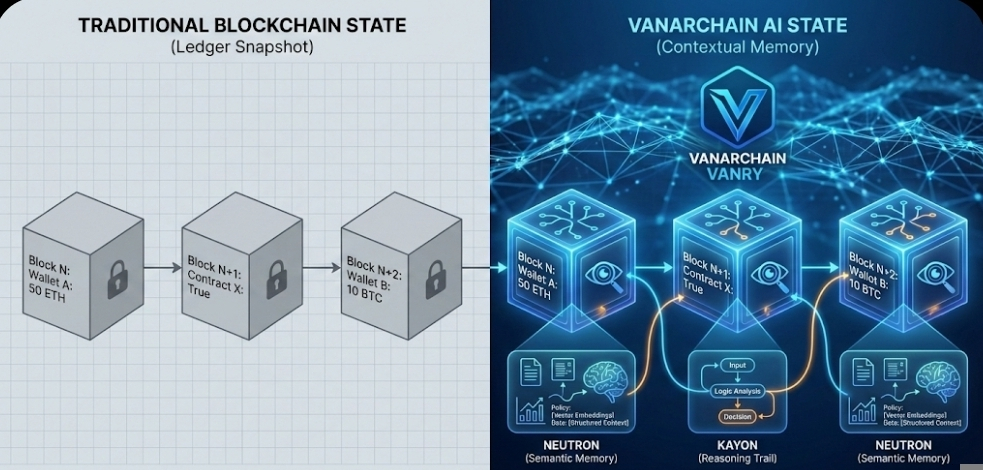
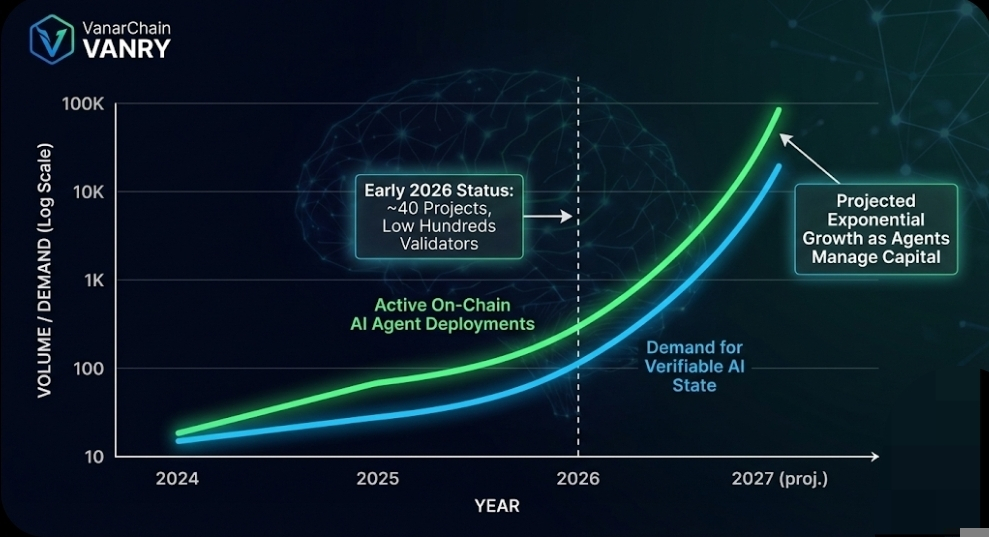
As of early 2026, the network reports validator participation in the low hundreds. That matters because it suggests a distributed but still maturing foundation. Meanwhile, ecosystem deployments have crossed 40 active projects, which is not massive, but it’s enough to show real experimentation. The interesting part is not transaction throughput. It’s that the technical updates increasingly reference AI workflows and persistent context instead of just TPS.
On the surface, this looks like marketing language. Underneath, it’s about redefining what state means.
In a traditional smart contract system, state is transactional. You call a function. It executes. It updates storage. End of story. There is no memory beyond the variables you explicitly encode. If you want something to “remember,” you write it into storage manually, pay gas, and hope your logic is airtight.
VanarChain’s approach introduces something different through components like Kayon and semantic memory layers. The surface explanation is simple: AI agents interacting with the chain can retain context and reasoning trails. Underneath that, it’s more subtle. Instead of treating AI outputs as off-chain guesses that get settled on-chain, the reasoning process itself can be anchored and verifiable.
That changes execution.
Imagine an AI agent that manages treasury rebalancing for a DAO. On most chains, it would run off-chain, analyze data, and then push a transaction. The chain sees only the final instruction. With Vanar’s model, early signs suggest the agent’s memory and logic path can be recorded in structured form. Not just the action, but the reasoning context. That adds texture to state.
Understanding that helps explain why they keep talking about explainability.
Explainability is not just a philosophical layer. It affects trust. If an AI-controlled wallet executes a $2 million reallocation, stakeholders will ask why. If the logic trail is cryptographically anchored, it creates a different foundation for governance. Not perfect trust, but earned transparency.
As of February 2026, market conditions are unstable. Bitcoin volatility has tightened compared to 2024 levels, but liquidity is thinner across alt ecosystems. That environment pressures infrastructure projects to justify their existence beyond speed. Vanar’s focus on AI state feels aligned with that reality. If blockchains are going to host autonomous agents, they cannot remain memory-thin.
That momentum creates another effect. Execution stops being a one-off event and starts becoming part of a longer narrative thread. When memory persists, actions compound.
There are risks here. More layers mean more complexity. Every additional abstraction increases potential attack surfaces. If AI memory structures are poorly designed, they could expose sensitive data or create manipulation vectors. A malicious agent could theoretically poison contextual memory to bias future decisions. The more intelligent the system appears, the more dangerous subtle flaws become.
That’s not theoretical. We’ve already seen how prompt injection affects AI models. Translating that into blockchain context introduces new categories of risk.
Still, the alternative is equally uncomfortable. If chains remain purely transactional, AI agents will live off-chain and treat the blockchain as a settlement rail. That preserves simplicity but limits coordination. It keeps intelligence outside the ledger instead of embedding it into the system’s memory layer.
What struck me is that Vanar is not trying to replace cloud AI infrastructure. It’s building a bridge layer. The blockchain becomes a verifiable memory substrate. The AI still reasons in complex models, but its outputs and contextual anchors sit on-chain.
Surface layer, a transaction executes. Underneath, a structured reasoning snapshot is stored. That enables downstream automation. It also creates auditability. It’s quiet work, but foundational.
Validator counts in the low hundreds suggest decentralization is still developing. That means governance over these memory structures is concentrated compared to Ethereum’s thousands of validators. If this holds, scaling validator diversity will matter. Otherwise, the integrity of AI-anchored state could depend on too few actors.
Meanwhile, cross-chain integration efforts signal another layer. By expanding availability beyond a single ecosystem, Vanar positions its AI memory model as portable infrastructure. That matters because AI agents won’t care about chain loyalty. They’ll care about reliability and context persistence.
Execution without memory is mechanical. Memory without execution is inert. Combining the two changes how systems coordinate.
There’s also an economic angle. Persistent AI state implies more data storage, more structured interactions, potentially higher demand for network resources. If 40 active deployments grow to 200, the pressure on storage economics will surface quickly. Fees must balance usability with sustainability. Otherwise, developers revert to off-chain storage and the thesis weakens.
Early signs suggest developers are experimenting rather than committing fully. That’s healthy. It means the idea is being tested in small pockets before becoming dominant design.
What this reveals about the broader pattern is simple. We are moving from chains that record what happened to chains that remember why it happened. That difference seems small until autonomous agents control capital flows, governance proposals, and cross-chain liquidity routing.
If blockchains are going to host machine-native economies, state cannot remain shallow. It needs depth. Not noise. Depth.
VanarChain is not alone in exploring AI alignment, but its emphasis on memory structures feels deliberate rather than reactive. Whether it scales remains uncertain. Validator expansion, security audits, and real-world agent adoption will determine durability. If the ecosystem stalls below a few dozen meaningful deployments, the concept may stay niche.
But if autonomous systems continue expanding in 2026 as current funding trends suggest, the demand for verifiable AI state will grow quietly underneath the market’s attention.
Blockchains started as systems of record. The next phase may belong to systems of reasoning.
And the chains that understand that memory is not just storage but context may end up holding more than balances. They may hold intent.