
There is a moment in crypto that feels like a small heartbreak. You press confirm and your eyes stay locked on the screen. Time stretches. The price moves without you. Your chest tightens because you do not know if you should wait or try again. When that happens people do not just lose a trade. They lose trust in the whole idea. Fogo starts from that human pain. Fogo is a high performance Layer 1 that uses the Solana Virtual Machine. It is built for on chain finance where timing is not a luxury but the product itself. I’m writing this in a grounded way because the most important part is not the headline speed. The most important part is how it feels when the network is busy and your decision still needs to land.
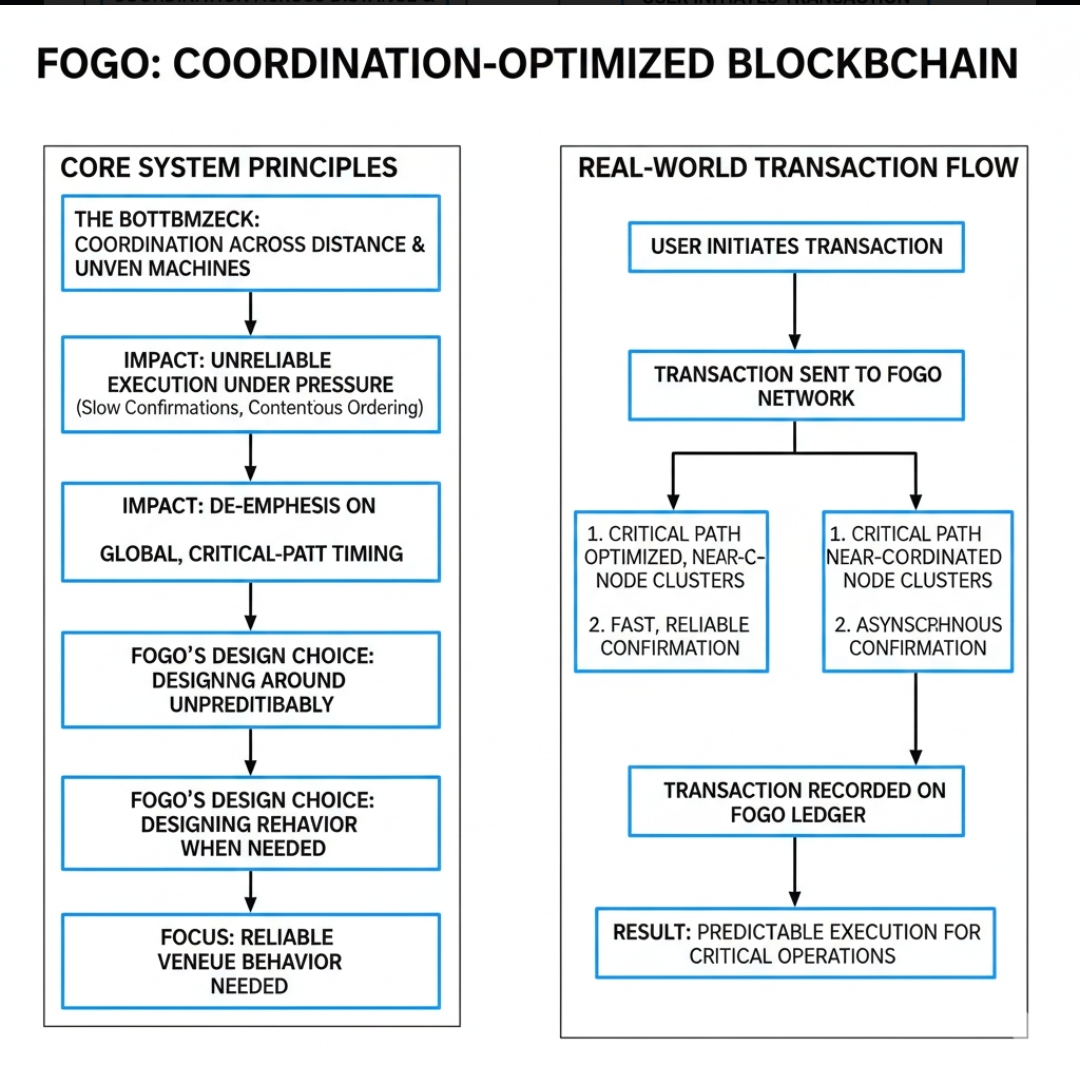
The idea stage is where everything becomes real or becomes noise. A team can chase throughput numbers and still build a chain that leaves users anxious. Fogo begins with a different question. How do we make speed feel consistent so the user experience stops swinging between smooth and scary. We’re seeing across the industry that average performance can look fine while tail latency quietly breaks people. Tail latency is the slow end of the experience where a small percentage of transactions take much longer than the rest. Those slow moments are the ones that make a trader hesitate and a builder lose users and a community lose faith. Fogo treats that slow tail as the enemy and it designs around it from the beginning.
That design starts with a practical promise to builders. Fogo chooses the Solana Virtual Machine because it is already built for parallel execution and modern hardware. In simple words many transactions can run at the same time when they do not touch the same accounts. That makes the system naturally suited for high throughput work without forcing every action into a single line. It also means existing Solana style programs and developer workflows can carry over with far less friction. They’re not being asked to forget their tools and start again. That matters emotionally because builders are people who invest years not weeks. If It becomes easy to migrate then more teams will try it and more experiments will happen and the ecosystem grows faster without breaking what already works.
Now we move from the idea to the system. A transaction is not magic. It is a journey through a pipeline that must behave well at every step. First the user signs and submits. The network must receive it quickly. A current leader must decide to include it in a block. That block must propagate through the network fast enough that validators stay in sync. Validators must verify the block and execute the transactions correctly. Then validators must vote so the chain converges on a shared outcome and applications can treat the result as settled. Every step can create anxiety if it becomes slow or inconsistent. When users say a chain is slow they usually mean one of these steps stopped feeling dependable.
Fogo keeps the recognizable Solana style structure for execution and then focuses its energy on the parts that create inconsistent timing in real life. Real life includes geography. It includes data center routes. It includes jitter. It includes operators with different skill levels and different hardware budgets. It includes the uncomfortable truth that a network can be constrained by its weakest participants and by its longest communication paths. Fogo does not try to argue with that truth. It tries to shape the protocol around it.
This is where the zone idea enters the story. Fogo introduces a zone based architecture where validators are grouped by physical proximity. The reason is simple. When machines are closer the latency between them approaches the limits of hardware and local networking. That makes tight consensus loops faster and more predictable. Instead of forcing every block to be a global coordination problem all the time the system can keep the most time sensitive voting path physically tighter for an epoch and then rotate responsibility over time. The emotional goal is not to exclude the world. The emotional goal is to stop making every confirmation feel like it is traveling through the slowest possible route.
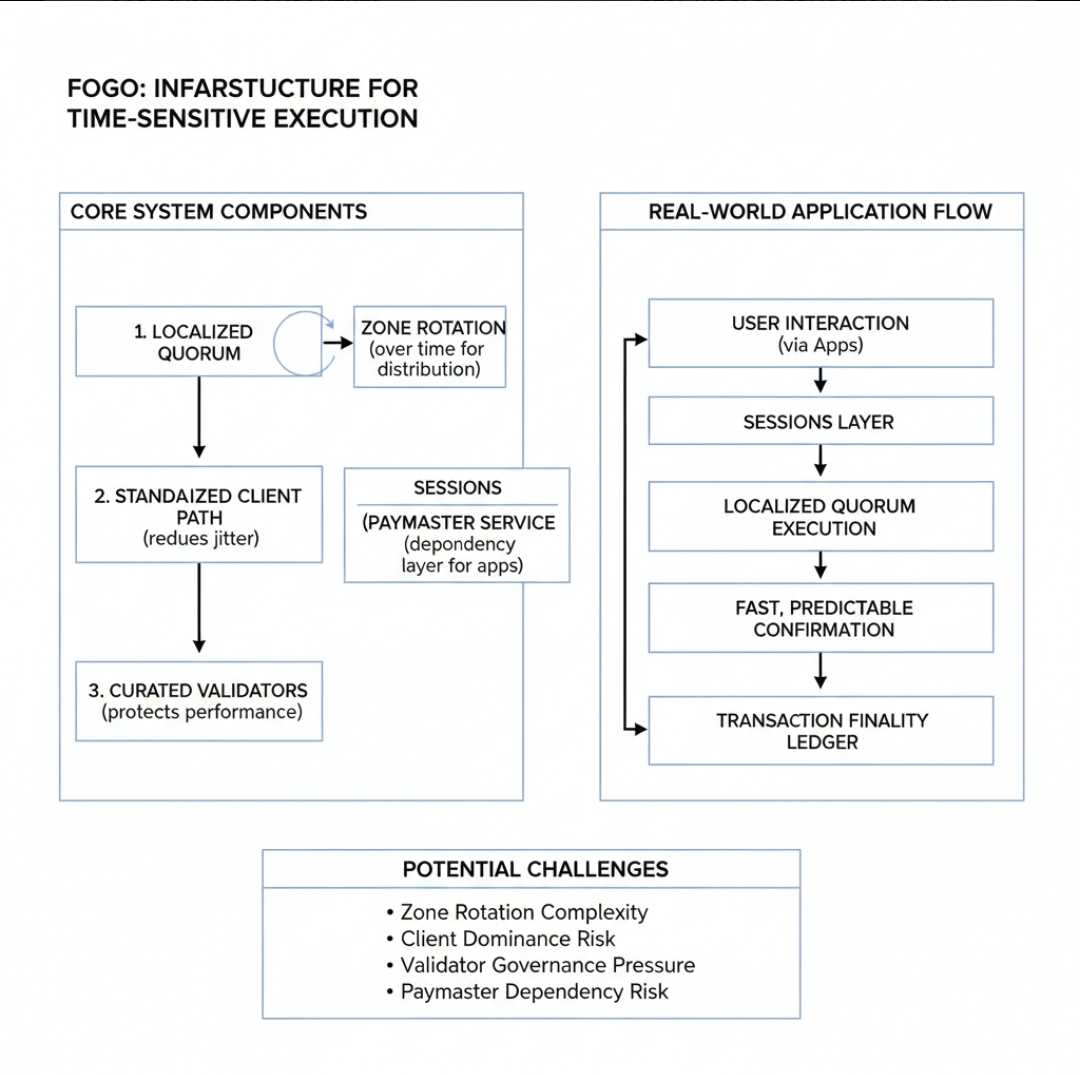
A system like this needs rules that keep it honest. Zone selection is not just a performance choice. It becomes a security choice. Fogo uses stake and voting to coordinate which zone is active and it sets expectations so an underpowered region cannot quietly take over the most critical role. This is also why fallback behavior matters. If the active zone cannot reach quorum in time or if an active zone fails then the network needs a safe way to continue in a more conservative mode. Without that safety valve a performance design can turn into downtime and downtime turns into fear. I’m pointing this out because resilience is an emotional feature. It is the difference between a scary incident and a manageable one.
Another pillar of the design is reducing validator performance variance. In many networks the slowest implementation can set the pace when stress arrives. That is why Fogo leans toward a standardized high performance validator client direction that is based on Firedancer. Firedancer is a validator client built from scratch with a focus on speed and security and client independence. The deeper reason behind this choice is not just raw throughput. The deeper reason is consistency. If validators run wildly different stacks then timing becomes unpredictable and unpredictability is what users feel as anxiety. Fogo aims to make the network behave more like one coherent machine and less like a collection of mismatched machines that only sometimes align.
This brings us to a design decision that is easy to misunderstand. Performance standardization can look like it is only about control. But it can also be about fairness. If under provisioned validators can participate without meeting minimal expectations then everyone pays the cost. Blocks propagate slower. Votes converge slower. Confirmation becomes uneven. Builders get blamed. Users get hurt. Fogo is trying to avoid that pattern by making performance an explicit responsibility. The tradeoff is real. Too much curation can push the network toward centralization pressures. Too little curation can push the network toward inconsistency. The long term challenge is to widen participation while keeping performance predictable and that means the rules must be transparent and the pathway to participation must be real not symbolic.
Fogo also treats user friction as part of performance. Many people think performance is only block time. Users feel performance as interruptions. Every extra wallet prompt breaks the flow. Every repeated signature turns a simple action into a stressful ritual. Fogo Sessions is designed to reduce that friction by allowing session keys that can act within defined boundaries. In plain English it is a way to grant limited permissions for a period so an app can feel smooth while still respecting safety constraints. This matters because a fast chain that still feels exhausting will not keep users. If It becomes normal that people can use apps without constant signing then the chain starts to feel like a real product instead of a constant test.
There are also deliberate boundaries that reflect security thinking. Fogo Sessions focuses on SPL tokens and not on direct interaction with native FOGO in the session flow. The intention is that user activity lives in SPL token space while native FOGO supports low level primitives such as fee sponsorship mechanisms. That separation can reduce the blast radius of mistakes and keep user behavior consistent. It also helps developers design experiences that are safer by default. They’re small decisions but small decisions are what make a system feel stable.
Now we talk about tracking progress because speed without measurement is just storytelling. Fogo can track block time targets and throughput but those are not enough to protect users from disappointment. The most honest metrics are the ones that reflect what people feel. Confirmation time end to end. Tail latency not only the average. Slot miss rate and leader performance consistency. Fork rate and vote convergence behavior. Transaction inclusion reliability during congestion. Fee behavior under load and whether prioritization mechanisms behave fairly. RPC reliability because users judge the chain through the access layer they touch every day. Validator variance because rising variance is often the first sign that the network will start feeling uneven.
Progress should also be measured in operational maturity. How quickly incidents are detected. How quickly the team can identify root causes. How safely upgrades are rolled out. How clear the communication is when something goes wrong. These are not soft metrics. They are trust metrics. We’re seeing that communities forgive mistakes when they feel respected and informed. They do not forgive silence.
Every design comes with risks and this is where being honest matters most. Zoned consensus introduces complexity in configuration and governance. If zones are defined poorly or rotation is handled carelessly the system can become fragile. Performance expectations can introduce centralization pressure if only a narrow set of operators can meet them. Ultra low latency goals can shrink safety margins if testing and monitoring are not relentless. And there is a human risk that sits above the technical ones. The risk of breaking trust in moments of stress. The chain that feels amazing on a quiet day must still behave on the day everyone shows up at once.
So what comes next in the roadmap is not just more speed. The near future is about proving the design in public conditions. Hardening mainnet operations and RPC reliability. Validating that zone activation and rotation can happen without drama. Expanding participation carefully so the validator set can grow without exploding variance. Continuing to mature the Firedancer based client path so performance is not just theoretical. Improving developer experience so moving from Solana style tooling to Fogo feels natural. Strengthening Sessions tooling and patterns so user flows stay smooth without sacrificing safety.
The longer term vision is bigger than a single feature. It is a chain that can support real time on chain finance without forcing users to gamble on timing. A chain that makes high frequency use cases possible without turning the network into a fragile race car. A chain where builders can build without constantly explaining away slow confirmations. A chain where the default feeling is calm. If It becomes that then people will not remember Fogo only for speed. They will remember it for relief.
I’m going to end with the human truth that sits under all of this. People do not adopt infrastructure because it is clever. They adopt it because it holds them when things get intense. They’re looking for a place where the rules are clear and the experience is steady and the system does not change its personality under pressure. We’re seeing that the future belongs to networks that treat reliability as a promise not a statistic. If Fogo stays faithful to its own thesis then it can become the kind of chain that lets users exhale. And sometimes that single exhale is what turns a curious visitor into a lifelong builder.