
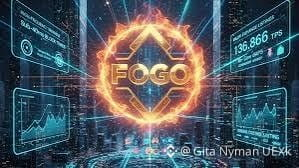
Most performance discussions in crypto revolve around averages, as if networks operate in perfectly controlled environments. Real markets don’t behave that way. Activity comes in bursts, delays have consequences, and the slowest part of the system is often what users feel most. $FOGO starts from this reality. Instead of optimizing for average speed, it focuses on tail latency—the rare but damaging slow confirmations that cause liquidations to slip, auctions to drift, and trading systems to lose precision.
A useful way to understand Fogo is by separating execution from settlement. Execution is the layer developers interact with: programs, accounts, transaction formats, and tooling. Settlement is what traders ultimately care about: how quickly the network agrees on outcomes and how consistently that process holds under stress. Fogo keeps the Solana Virtual Machine for execution because it is already optimized for parallel processing and has a mature developer ecosystem. Compatibility means existing tools and programs don’t need to be rebuilt from scratch. The real innovation is not in the runtime, but in how the network reaches agreement—faster, more predictably, and with less sensitivity to geographic distance.
This is where Fogo’s zone concept comes into play. Instead of relying on a globally scattered validator set to coordinate in real time, the network groups validators into zones and activates one zone for consensus during a given epoch. The idea is straightforward: if the validators responsible for finality are physically closer together, the messages that confirm blocks don’t have to travel across continents. That reduces the latency cost introduced by the slowest network links. Fogo treats locality as a design tool rather than a limitation, using it to keep settlement times tight and predictable.
However, physical proximity alone does not guarantee performance. Even within a single region, slow or poorly configured validators can reduce predictability. In quorum-based systems, the weakest participants often dictate the pace. Fogo addresses this by emphasizing standardization and performance enforcement. The network’s thesis depends on reducing variance across validators, not just increasing raw speed. This is where technologies like Firedancer become important. Beyond higher throughput, the deeper goal is to reduce jitter by using a highly optimized pipeline that stays stable under heavy load. Work is split into specialized components, data moves efficiently through the system, and internal bottlenecks are minimized. Consistent confirmation times require both a short network path and a stable validator architecture.
Once zones and performance enforcement become core design principles, governance becomes central to the system’s credibility. Decisions must be made about which zone is active, how rotations occur, and how validators are admitted. Fogo aims to place these controls into transparent on-chain mechanisms rather than informal coordination. That improves visibility, but it also raises the stakes. If zone selection or validator admission becomes dominated by a small group, the network risks drifting from performance discipline into gatekeeping. Long-term trust depends on processes that remain transparent, contestable, and resistant to capture.
Fogo also addresses a less glamorous but critical issue: the user interaction loop. High-frequency applications break down when every small action requires a new wallet signature. Session-based interactions allow users to grant scoped, time-limited permissions, enabling a session key to act within defined limits. This reduces constant manual approvals and makes fast chains practical for real trading workflows. The goal is not to create flashy features, but to make high-speed infrastructure usable in day-to-day operations.
Underneath the technical architecture sits the token model. Validators expected to run high-performance infrastructure and adapt to zone rotations face higher operational costs than casual nodes. Early in a network’s life, emissions and treasury policies often help maintain participation while fee revenue is still developing. Fogo’s token structure reflects this bootstrapping phase, with allocations, locks, and ecosystem funds designed to support incentives and grants. The long-term question is whether real usage can sustain validator costs without turning the network into a permanent subsidy system.

The ecosystem strategy follows a similarly practical approach. Instead of claiming to support every possible application, Fogo emphasizes core infrastructure first: oracles, bridges, indexing services, explorers, multisigs, and operational tools. This signals an intent to attract serious workloads where timing matters and the base layer must behave like dependable infrastructure.
Compared with other high-performance networks, Fogo’s differentiation is not a single metric. Some chains already target low latency, but global participation still introduces unpredictable delays. Others maintain runtime compatibility while changing settlement assumptions in ways that trade speed for simplicity. Fogo’s approach is more focused: use locality and standardization to reduce real-time consensus distances, rotate zones over time, and run a validator stack designed to minimize jitter. The goal is not just faster blocks, but fewer unpleasant surprises when market conditions become intense.
The risks are part of the design itself. Zone rotation could become fragile if concentrated in a few regions. Governance could turn into a closed circle. Validator enforcement might become opaque if rules are unclear. Session-based interactions could introduce security risks if poorly implemented. Token sustainability remains tied to real adoption and fee generation.
The clearest way to evaluate Fogo is to look beyond headline speed claims and track deeper signals. Does the network maintain tight confirmation times during periods of stress? Does zone governance remain transparent? Can the validator set expand without sacrificing predictability? Do real applications choose it because they can rely on its settlement behavior?
If those indicators hold, Fogo may stand out not just as another SVM-based chain, but as a network that treats latency as a design contract rather than a hopeful assumption.
