


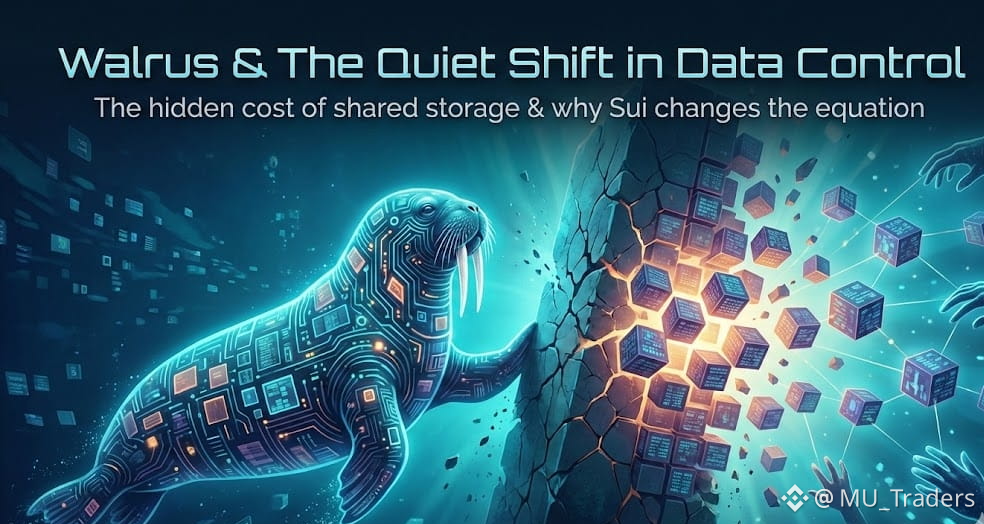
you might be overlooking how much power you’ve already handed away in crypto, and it’s not to exchanges or protocols, but to the way data itself is stored, accessed, and assumed to be neutral. Walrus feels important not because it shouts innovation, but because it questions something most of us stopped questioning a long time ago.
The hidden cost of shared storage
Most decentralized apps rely on storage layers that look neutral on the surface. In reality, data availability, ordering, and persistence shape who can participate and who quietly gets excluded. When storage is slow, opaque, or economically skewed, only large actors can reliably interact. Smaller users adapt by trusting intermediaries again, which defeats the point.
Walrus challenges this by treating data as a first-class asset, not a background utility. Ownership is not symbolic. It’s enforced through how data is encoded, validated, and retrieved.
Why Sui changes the equation
What makes Walrus different is not just design choices, but where it lives. Sui’s object-centric model allows data to be treated as mutable, owned entities rather than blobs tied to accounts. That matters because ownership becomes explicit and composable by default.
Instead of abstracting storage away, Walrus leans into this model. Data can evolve, be shared selectively, or remain private without rebuilding trust assumptions at every step. This is hard to do on account-based chains where state is global and contention is constant.
Privacy without isolation
Privacy-first storage often comes with a trade-off. Either data becomes so locked down it’s unusable, or it leaks through metadata and access patterns. Walrus sits in an interesting middle ground. It allows data to remain private while still being verifiable and useful inside applications.
That opens doors beyond typical DeFi. Think collaborative systems, regulated workflows, or user-owned identity primitives that don’t require a central coordinator. This is where crypto stops being just financial infrastructure and starts behaving like a real coordination layer.
Implications people aren’t pricing in
When users truly control their data lifecycle, incentives shift. Applications compete on experience instead of lock-in. Developers design systems that assume user sovereignty, not passive consent. Over time, this changes what gets built at all.
Walrus doesn’t promise a revolution. It quietly enables one by making data ownership practical rather than ideological. In a space crowded with noise, that kind of change is easy to miss, but hard to undo once it takes hold.