
Blockchain faces a genuine constraint. Everyone sees it during periods of congestion. Networks slow. Costs rise. This is the bottleneck. It restricts not just transactions but imagination. What can you build if every action is expensive and slow. Many approaches aim to solve this. Some enhance the base layer. Others build beside it. @Plasma from my observation chose the latter path. It is a specific architectural idea. Its approach to scalability is worth a detailed look.
The problem is fundamentally about data. A traditional blockchain requires every node to process and store every transaction. This is the source of security and decentralization. It is also the source of the bottleneck. Increasing throughput directly on this layer often means compromising on those other ideals. The trilemma persists. Plasma proposed a shift in perspective. It asked if we could create a secondary execution environment. A place where transactions could process freely. Their final state could then be anchored to the main chain. The main chain becomes a supreme court. It does not hear every case. It provides ultimate judgment and security when needed.
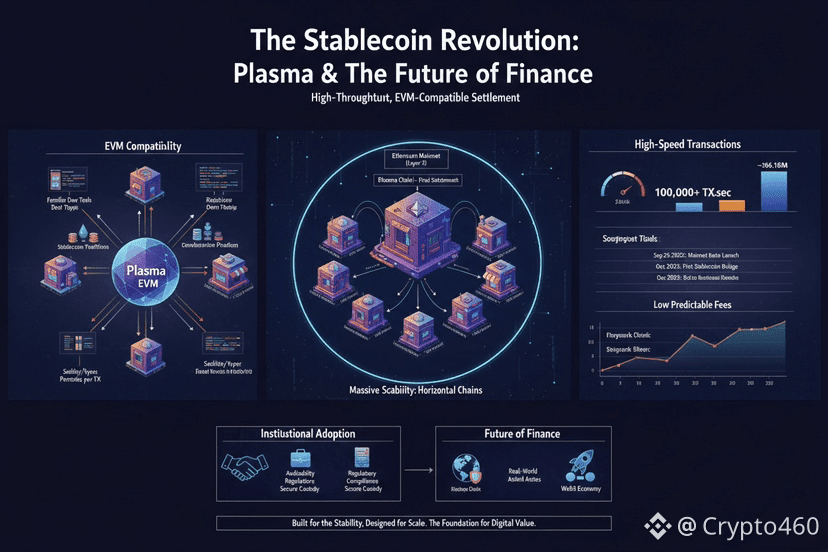
This is done through a mechanism often called a child chain. This chain operates with its own rules and validators. It can process transactions rapidly and at very low cost. Periodically it commits a cryptographic snapshot of its state back to the main Ethereum blockchain. This snapshot is a single piece of data. It represents perhaps thousands of individual interactions. The main chain does not know the details. It simply holds the proof that the child chain state is valid. This is the core of the plasma model. It moves the burden of computation and storage off the main chain. It retains the main chain as a bedrock of trust for asset custody.
From a user standpoint the experience changes. On the plasma chain itself interactions are immediate and cost pennies. You could engage with a complex application feeling no latency. You would not perceive the underlying architecture. The complexity emerges during entry and exit. To move assets onto the plasma chain you lock them in a smart contract on the main chain. The child chain then credits you. To exit you initiate a withdrawal process on the child chain. This begins a challenge period. Your funds are released on the main chain after this window passes. This process ensures security. It allows anyone to challenge a fraudulent exit by providing a fraud proof.
This security model is distinctive. It does not assume the child chain is always honest. It assumes that at least one participant is watching and will defend the truth. The system's safety relies on this economic watchfulness. It is a trade-off. It grants massive scalability by moving the active security efforts to the edges. The final fallback always remains the immutable main chain. Your assets are never truly only on the child chain. They are always anchored and ultimately recoverable from the base layer.
The practical implications for scalability are significant. A single plasma chain can achieve high throughput. More importantly the framework allows for many such chains to exist simultaneously. Each can be optimized for a specific use case. One for a particular game world. Another for a decentralized social media platform. Another for a marketplace. They become specialized districts in a broader ecosystem. All connected by the common ground of the main chain. This is horizontal scaling. It multiplies capacity by adding new spaces not by forcing one space to expand beyond its design.
For developers this model offers a familiar toolkit. They can build with Ethereum's standards and languages. They deploy to an environment that feels like Ethereum but performs far better for their users. They have a clear bridge to ultimate settlement and composability with other plasma chains through the root chain. This reduces the risk of building in an isolated silo. Their application is part of a larger interconnected network.
The evolution of this approach hinges on refinement. Early iterations faced challenges with user experience during exits and with data availability. The need for users to monitor and submit fraud proofs was a burden. Subsequent research and designs like Minimum Viable Plasma and More Viable Plasma sought to simplify these demands. The trajectory is toward abstraction. The goal is to hide the mechanism completely. A user should simply experience fast finality and low cost. They should not need to understand the security assumptions. That is the marker of mature infrastructure.
Observing Plasma provides a clear lesson in blockchain design philosophy. It demonstrates that scaling solutions are not just about more transactions per second. They are about designing appropriate security and economic models for different layers of interaction. Plasma’s approach acknowledges a hierarchy of trust and finality. It creates a space for efficient experimentation and daily use. It reserves the base layer for ultimate asset security and settlement of disputes. This is a pragmatic and elegant response to the bottleneck. It builds scale through structure and choice not through force on the core protocol. The future of such frameworks rests on their ability to become invisible. To provide a seamless environment where the bottleneck is a memory not a daily reality. For Plasma that path continues through quiet building and steady refinement.

