San Francisco – April 2025
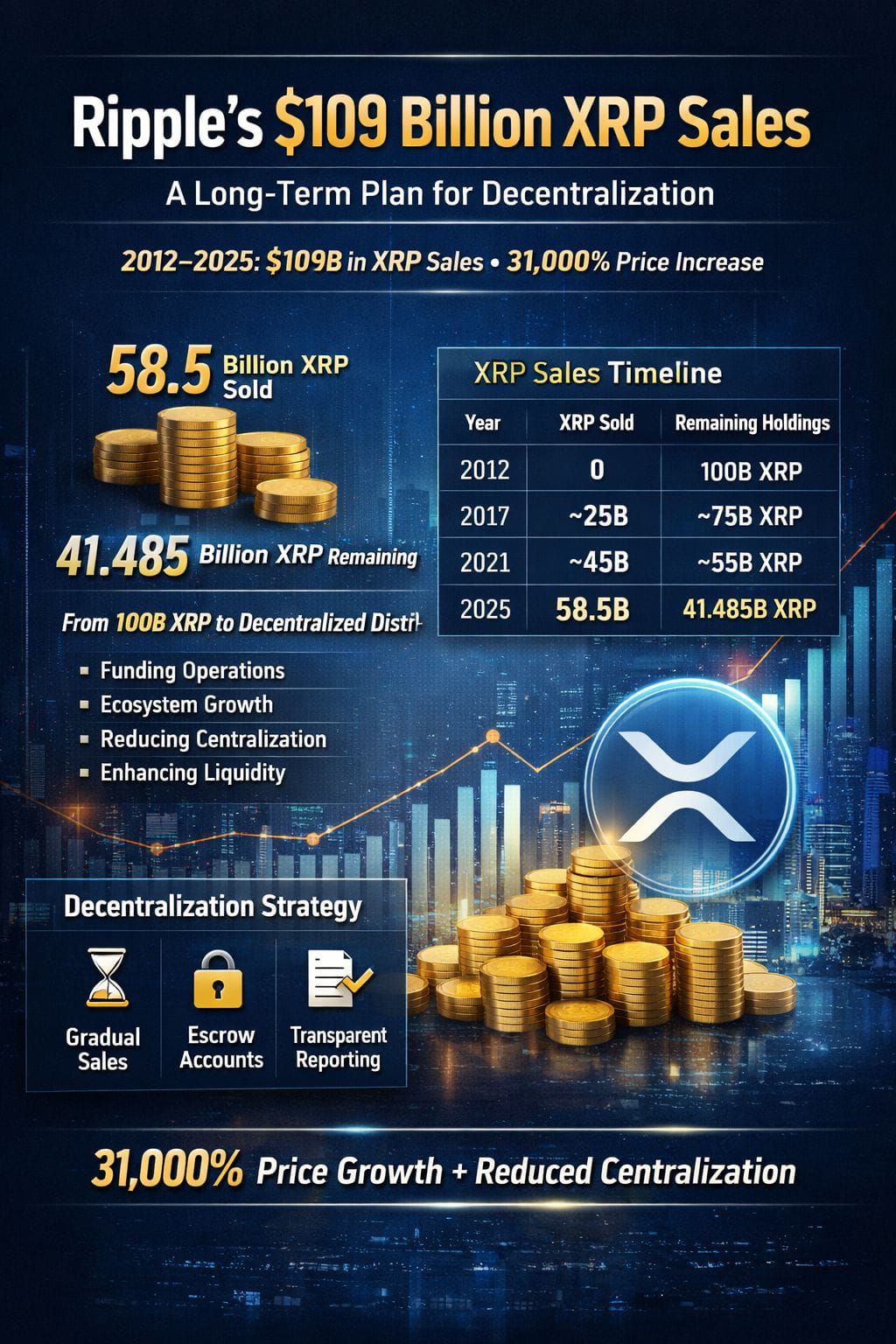
Since 2012, Ripple and its leadership have quietly executed one of the largest and most strategic token distribution plans in crypto history. Over the last 13 years, the company has sold XRP worth nearly $109 billion, gradually transforming XRP from a heavily centralized asset into a more widely distributed digital currency.
According to data compiled by CryptoBasic, Ripple and its executives have sold around 58.5 billion XRP tokens since launch. What makes this remarkable is that XRP’s price increased by nearly 31,000% during the same period—proving that large-scale token sales do not automatically damage long-term value when managed responsibly.
How Ripple’s XRP Sales Strategy Works
At launch, Ripple was allocated 100 billion XRP to support network development, partnerships, and long-term growth. Instead of dumping tokens into the market, the company adopted a slow and controlled selling strategy.
As of 2025, Ripple and its leadership now hold approximately 41.485 billion XRP, showing a major reduction in centralized ownership.
Ripple explains that XRP sales are used for:
Funding company operations
Supporting ecosystem development
Improving market liquidity
Reducing centralization concerns
Enabling fair price discovery
This approach has helped avoid sudden supply shocks while maintaining investor confidence.
XRP Distribution Timeline Overview
Estimated XRP Sold
Remaining Holdings
Year
Market Phase
2012
0
100B XRP
Network foundation
2017
~25B
~75B XRP
Bull market expansion
2021
~45B
~55B XRP
Regulatory clarity phase
2025
58.5B
41.485B XRP
Mature distribution
Ripple also introduced escrow accounts and regular public disclosures to ensure transparency—something many crypto projects still lack today.
Decentralization Progress and Market Effects
One of the biggest criticisms of XRP has always been centralization. Ripple’s long-term selling strategy directly addresses this issue.
Key features of Ripple’s decentralization model include:
Gradual token release to avoid market flooding
Public reporting of XRP sales and holdings
Escrow mechanisms to control supply impact
Regulatory-friendly structure
Ecosystem-focused funding model
Over time, XRP liquidity has improved, and volatility has reduced compared to its early years. Importantly, price growth continued alongside