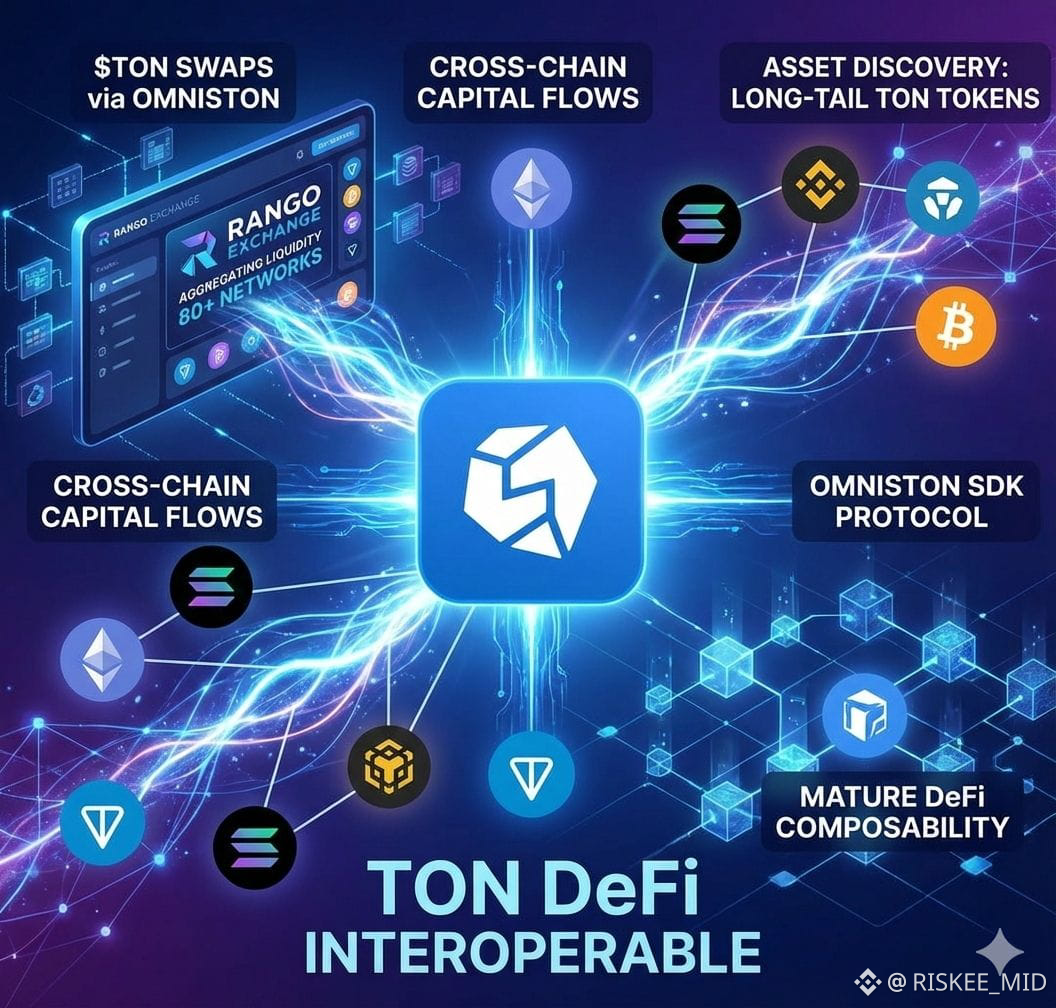
Omniston × Rango: TON’s Execution Layer Goes Multi-Chain
Executive summary
Omniston’s integration with Rango Exchange marks a practical shift for TON from a stand-alone ecosystem to an interoperable participant in the broader multi-chain economy. By surfacing TON swaps inside Rango — a liquidity aggregator that spans more than 80 networks — Omniston becomes the invisible execution layer that lets users access TON markets without learning chain-specific tooling. That change improves user experience, increases exposure for long-tail TON assets, and validates Omniston’s positioning as composable infrastructure rather than a closed product.
From isolated chains to invisible infrastructure
Blockchain ecosystems scale when their infrastructure is useful outside their native boundaries. Integrations that let users interact with a chain through familiar, chain-agnostic interfaces reduce friction at every step: wallet setup, network switching, and token routing. Rango’s aggregation of cross-chain liquidity creates precisely that familiar entry point. With Omniston handling TON swaps inside Rango, the TON network is no longer something users must explicitly join — its markets become available wherever multi-chain users already operate.
What the integration does (in plain terms)
Execution layer role: Omniston provides the routing and execution logic for TON swaps while Rango provides the cross-chain routing surface and user interface. For end users the experience is a single, seamless swap flow; behind the scenes Omniston executes TON-side actions.
No TON-specific tooling required: Users who are already comfortable using multi-chain aggregators can access TON liquidity without switching wallets, changing networks, or learning TON-centric tools.
SDK-led composability: By exposing routing logic through an SDK rather than only via a proprietary UI, Omniston becomes a reusable building block other applications can embed. This is a signal that the project is designed as infrastructure for third-party developers.
Why this matters for asset discovery and liquidity
Long-tail tokens often struggle with visibility and organic liquidity. When liquidity and order flow are siloed inside a single ecosystem, tokens depend heavily on internal marketing and on-chain native activity. Connecting TON markets to cross-chain capital flows changes that dynamic:
Broader exposure: Tokens listed or tradable on TON become discoverable by traders who operate primarily on other chains or who use cross-chain aggregators.
Organic liquidity growth: With buyer and seller demand coming from a wider addressable market, token markets can attract sustained liquidity independent of internal ecosystem incentives.
Lower onboarding friction: Reduced technical barriers means more potential users will try trading TON assets, which improves market depth and price discovery.
Validation of design and composability
The fact that Omniston exposes its routing via an SDK — and that Rango chose to route TON swaps through it — underscores a meaningful distinction: Omniston is being used as infrastructure. Composability is a hallmark of mature DeFi ecosystems; it enables new products to be built on existing primitives, reduces duplication, and concentrates engineering effort on secure, well-audited components rather than on recreating routing stacks in every app.
Broader implications for TON DeFi
Viewed positively, the partnership between Omniston and Rango is less about a specific exchange win and more about integration into the crypto economy at large:
Interoperability, not just activity: TON is moving toward being a first-class participant in cross-chain liquidity flows rather than an isolated playground.
Ecosystem growth via external demand: Growth driven by outside interest tends to be more sustainable than growth driven purely by internal incentives.
Developer and product opportunities: Third-party apps can now embed TON execution flows without building chain-specific routing, lowering the cost to experiment with TON-based products.
Considerations and next steps
No integration is risk-free. Practical considerations for the TON and Omniston communities include:
Security and audits: As TON liquidity becomes accessible through external rails, auditing execution paths and SDK security remains essential to protect funds.
Liquidity fragmentation vs. concentration: Cross-chain routing can both route volume into TON and spread volumes thin across many bridges and pools. Monitoring liquidity depth and slippage across venues will be important.
User education and support: Even with reduced friction, UX edge cases still arise (failed cross-chain transfers, bridge delays). Clear support flows and on-ramp guidance will reduce churn.
Conclusion
The Omniston–Rango integration is a practical milestone for TON: it embeds TON markets into a broader, multi-chain trading ecosystem and reframes Omniston as composable execution infrastructure. For token projects, developers, and users, that means easier access, wider discovery, and a clearer path for TON to participate in cross-chain capital flows. In short, TON’s DeFi stack is becoming interoperable — a key step toward maturity and real-world utility.
Try TON swaps at Rango: https://app.rango.exchange/