

For years blockchains have competed on speed, fees, and throughput. Those metrics made sense when the only expected users were humans clicking through wallets and dashboards. But that model quietly breaks when AI systems become participants instead of tools.
AI does not log in. It does not refresh sessions. It does not tolerate lost context. When memory disappears, the system does not retry politely. It degrades. That single difference forces a rethinking of what blockchain infrastructure actually needs to provide.
Vanar is built around that rethinking.
Instead of treating AI as an application layer feature, Vanar assumes intelligent systems will operate continuously at the infrastructure level. That changes priorities. Persistence becomes more important than peak TPS. Structured execution matters more than flashy UI integrations.
This is where Vanar’s architecture stands apart.
Memory at the base layer
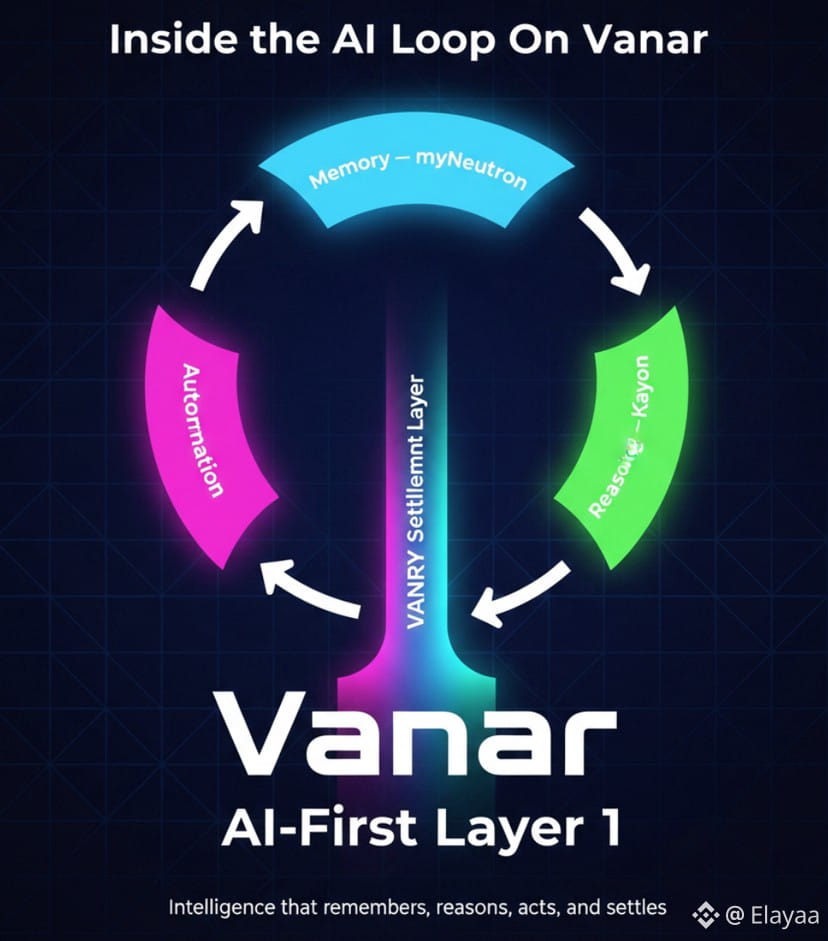
AI systems rely on context built over time. Traditional chains push that responsibility to apps or off-chain databases. Vanar moves semantic memory closer to infrastructure through myNeutron. Context can persist at the network level, allowing agents to build state across interactions rather than starting from zero each cycle. Over time, this turns behavior from reactive to accumulative.
Reasoning that can be inspected
Black box AI does not survive in environments where decisions carry economic or operational consequences. Kayon introduces on-chain reasoning and explainability, making logic traceable instead of hidden behind interfaces. This is not about transparency as a slogan. It is about making autonomous decisions auditable when outcomes matter.
Automation with boundaries
Turning intelligence into action is where many systems fail. Automation without structure becomes risk. Flows provides controlled automated execution where actions follow predefined logic, remain traceable, and can be constrained. Intelligence moves forward, but within guardrails.
These three layers — memory, reasoning, and automation — form an internal loop. Memory informs reasoning. Reasoning shapes action. Action triggers settlement. Instead of intelligence living off-chain and only touching blockchain at the payment step, Vanar keeps more of that loop inside the system.
That loop is difficult to retrofit.
Many chains now adding AI support end up stitching together external services with on-chain settlement. It works in demos. It becomes fragile under continuous autonomous operation. Vanar’s advantage is not that it talks about AI. It is that the base layer was built assuming AI would eventually be native.
Why settlement completes the loop
AI agents that cannot move value are observers, not participants. Payments are not an extra feature in AI-first systems. They are part of the feedback cycle. Decision leads to action. Action leads to settlement. Settlement influences the next decision.
$VANRY underpins this economic layer. It enables intelligent activity to carry real consequences rather than stopping at simulation. This is where infrastructure becomes economy.
Cross-chain reach matters
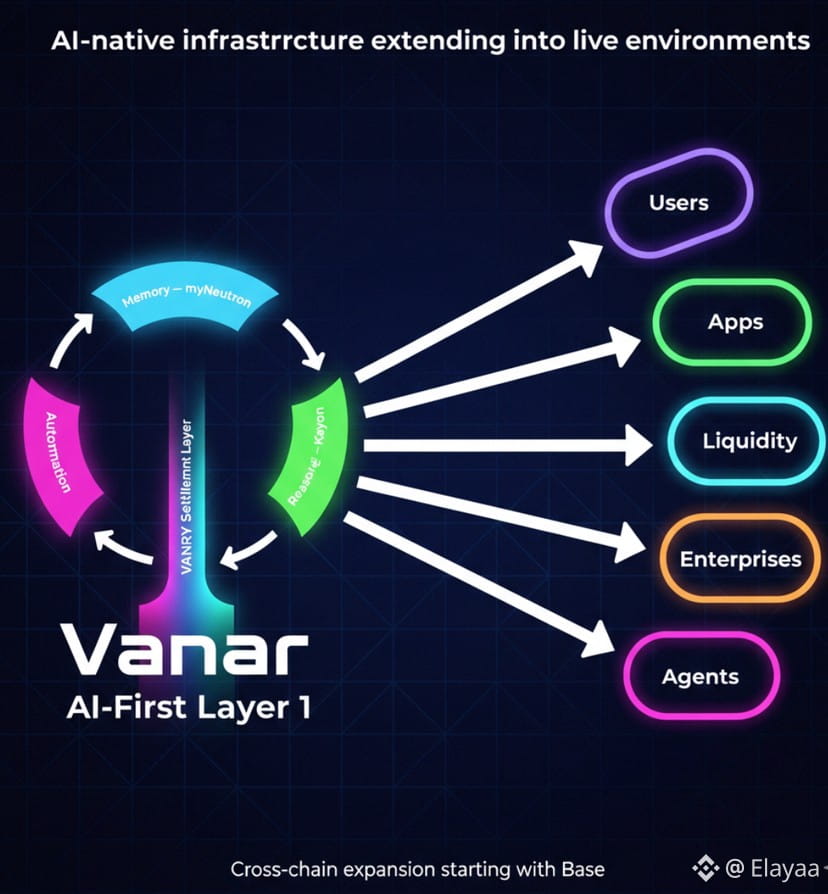
AI systems do not care which chain they are on. They care where users, liquidity, and activity already exist. Vanar extending its technology cross-chain starting with Base increases the probability that intelligent systems operate in live environments rather than isolated ones. Infrastructure gains relevance when it connects to existing ecosystems.
The bigger picture
Web3 does not lack blockchains. It lacks infrastructure designed for non-human participants. Many new networks will launch claiming AI alignment. Few will embed memory, reasoning, automation, and settlement at the base layer from the start.
Vanar’s approach is quieter and more structural. It does not revolve around short cycles of attention. It is designed for systems that run continuously, make decisions, act within boundaries, and settle value without waiting for a human to approve every step.
That is what AI-ready infrastructure actually looks like.