

When I spend time thinking about Walrus, I don’t approach it the way I approach most blockchain projects. I don’t ask what story it tells or how loudly it announces itself. I ask a simpler question: does this feel like something built for people who just want their data to exist reliably, without having to care about the machinery underneath? That framing has guided how I interpret nearly every design choice in the protocol, and it’s why I keep coming back to it as infrastructure rather than as an abstract technical exercise.
Most people who store data are not thinking about decentralization, privacy models, or cryptographic guarantees. They’re thinking about whether a file will still be there when they need it, whether access will be predictable, and whether costs will remain understandable over time. Walrus appears to start from that reality instead of trying to educate users out of it. The use of erasure coding and blob storage tells me the system expects scale, failure, and uneven conditions as normal, not exceptional. Data is split, distributed, and recoverable because real systems are messy. Networks degrade. Nodes disappear. Usage spikes unexpectedly. Designing around those facts feels less idealistic and more honest.
What I find especially telling is that Walrus does not treat storage as a secondary concern attached to applications, but as a primary constraint that shapes how applications are built in the first place. When storage is expensive, fragile, or unpredictable, developers push complexity onto users, often without realizing it. When storage becomes stable and cost-efficient, behavior changes. Applications can assume persistence. Users don’t need to micromanage what stays and what goes. That shift sounds subtle, but in practice it’s the difference between tools that feel provisional and tools that feel dependable.
There’s also an implicit understanding here of how privacy is actually used. Most users don’t want secrecy as a statement. They want discretion as a default. Walrus supports privacy-preserving storage and transactions not as an ideological stance, but as a way to reduce exposure and risk in everyday interactions. Data that isn’t constantly surfaced is easier to manage and harder to misuse. That kind of privacy is quiet, and it aligns with how people already expect digital systems to behave when they’re working well.
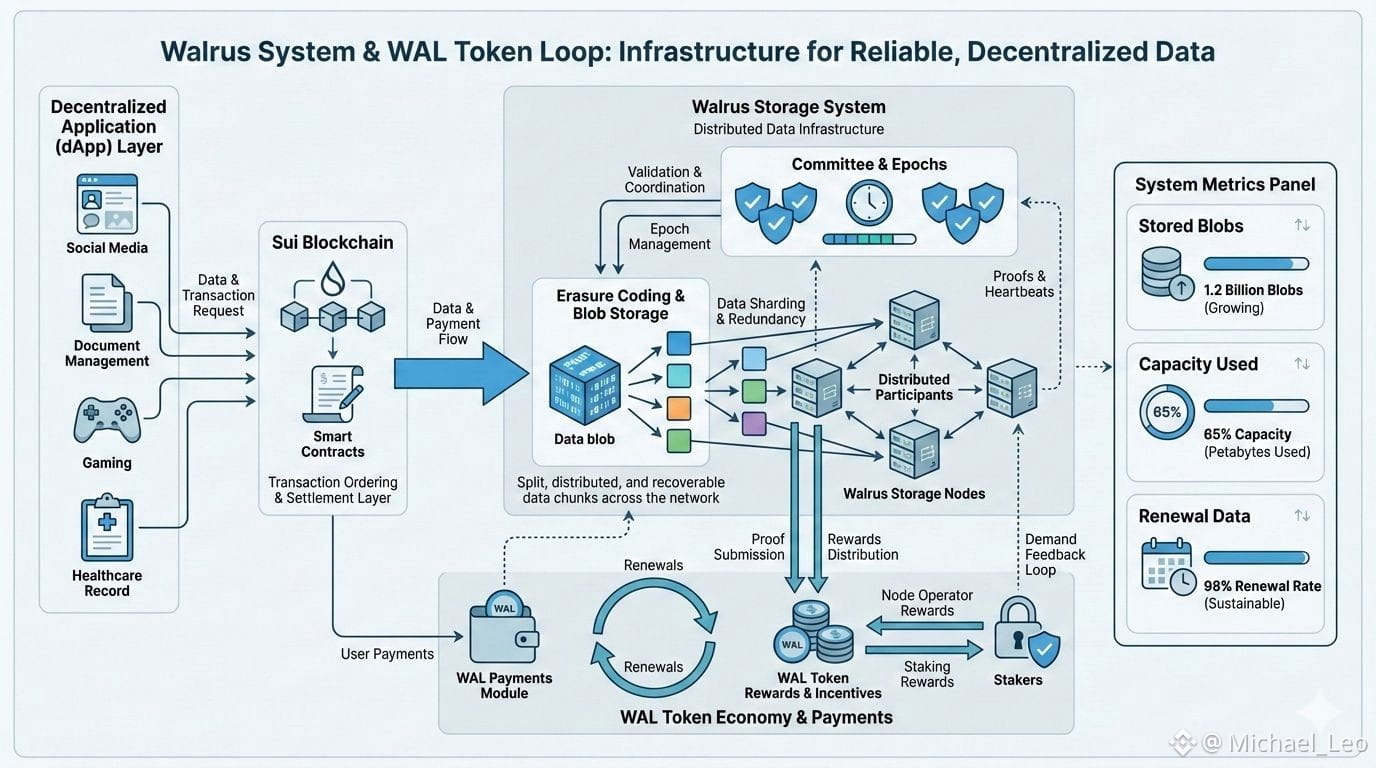 I pay close attention to how systems handle complexity, because complexity is unavoidable at scale. The question is where it lives. Walrus doesn’t try to turn its internal mechanics into something users are supposed to admire. The fragmentation, encoding, and reconstruction of data happen because they must, not because they make a good demo. From the outside, the system aims to feel boring in the best sense of the word. You put data in. You get data out. The protocol absorbs the uncertainty so the user doesn’t have to.
Operating on Sui supports this orientation toward performance and predictability, but again, not as a selling point. Throughput and efficiency matter here because they reduce waiting, reduce friction, and reduce the cognitive load on anyone building or using applications on top. When infrastructure performs consistently, people stop thinking about it. That’s usually the highest compliment you can give a system designed for real use.
I’m cautious but genuinely curious about what happens when Walrus is stressed by long-term, unglamorous workloads. Things like application backends, document archives, and persistent records are not exciting, but they are unforgiving. They expose weaknesses slowly and relentlessly. If Walrus holds up under that kind of pressure, it won’t be because of a single clever feature, but because the underlying assumptions were realistic from the start.
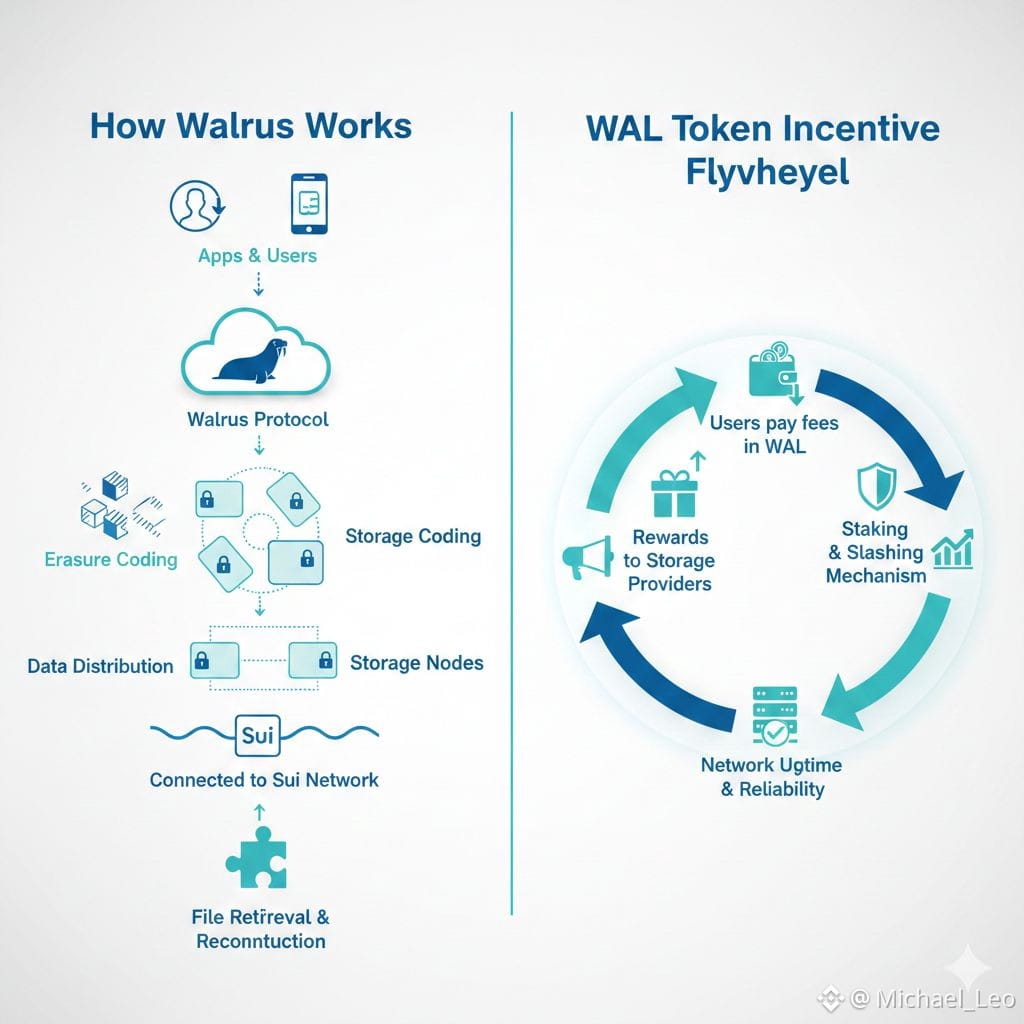 The WAL token only makes sense to me when viewed through this lens. It exists to coordinate usage, participation, and incentives within the storage network. It’s part of how the system accounts for resources and aligns behavior, not something users should need to constantly think about. When a token fades into the background of normal operation, that’s usually a sign the infrastructure is functioning as intended. The moment it demands attention, something has gone wrong.
Stepping back, Walrus feels like an argument for a quieter direction in blockchain infrastructure. One where success is measured by durability, predictability, and low friction rather than visibility. Everyday users don’t want to learn new mental models just to store data or move information. They want systems that respect their time and their habits. Walrus appears to be built with that respect in mind.
If more projects treated infrastructure this way, blockchain would feel less like a destination and more like a layer people pass through without noticing. That’s not a loss of ambition. It’s a sign of maturity. Systems that work don’t need to impress. They just need to be there, consistently, when someone reaches for them.

