


In payments, speed is usually treated as an unquestioned good. Faster confirmation, faster settlement, and faster finality create the assumption that every layer of the system benefits equally. But once settlement becomes deterministic and nearly instant on Plasma, a different dynamic appears. The chain accelerates. Organizations don’t.
That gap is where modern financial infrastructure tension lives.
On probabilistic systems, time quietly absorbs uncertainty. A transaction appears, sits in a pending state, gathers confirmations, and only gradually becomes something the business treats as real. During that window, internal systems align themselves in parallel. Risk checks run. Fraud rules evaluate. Accounting systems prepare to post. Humans, processes, and policies synchronize behind the scenes.
The delay is not just technical. It acts as coordination space.
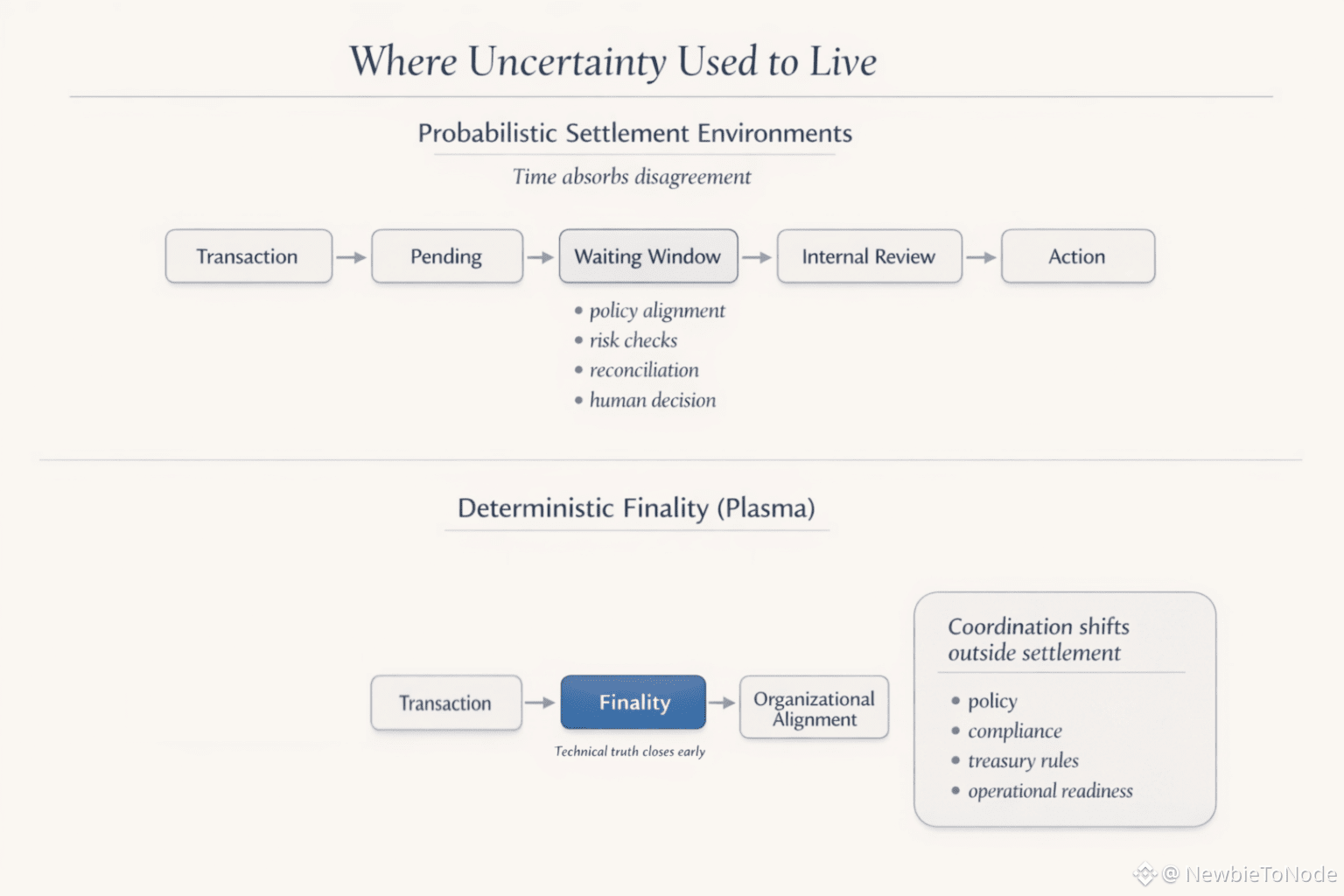
When settlement becomes deterministic through PlasmaBFT finality, that coordination space collapses. The ledger closes decisively and early. From the chain’s perspective, the transaction is finished. There is no soft zone left where systems can pretend uncertainty still exists. The state is final whether the organization is ready or not.
That shifts pressure upward.
Instead of waiting for the network to provide gradual certainty, businesses must define in advance what actionable means. Inventory release rules, treasury booking policies, compliance checks, and automation triggers can no longer lean on elapsed time as a proxy for safety. They must become explicit decisions. Approval thresholds, limits, and readiness conditions move from background assumptions into front line design.
Faster settlement does not remove complexity. It relocates it.
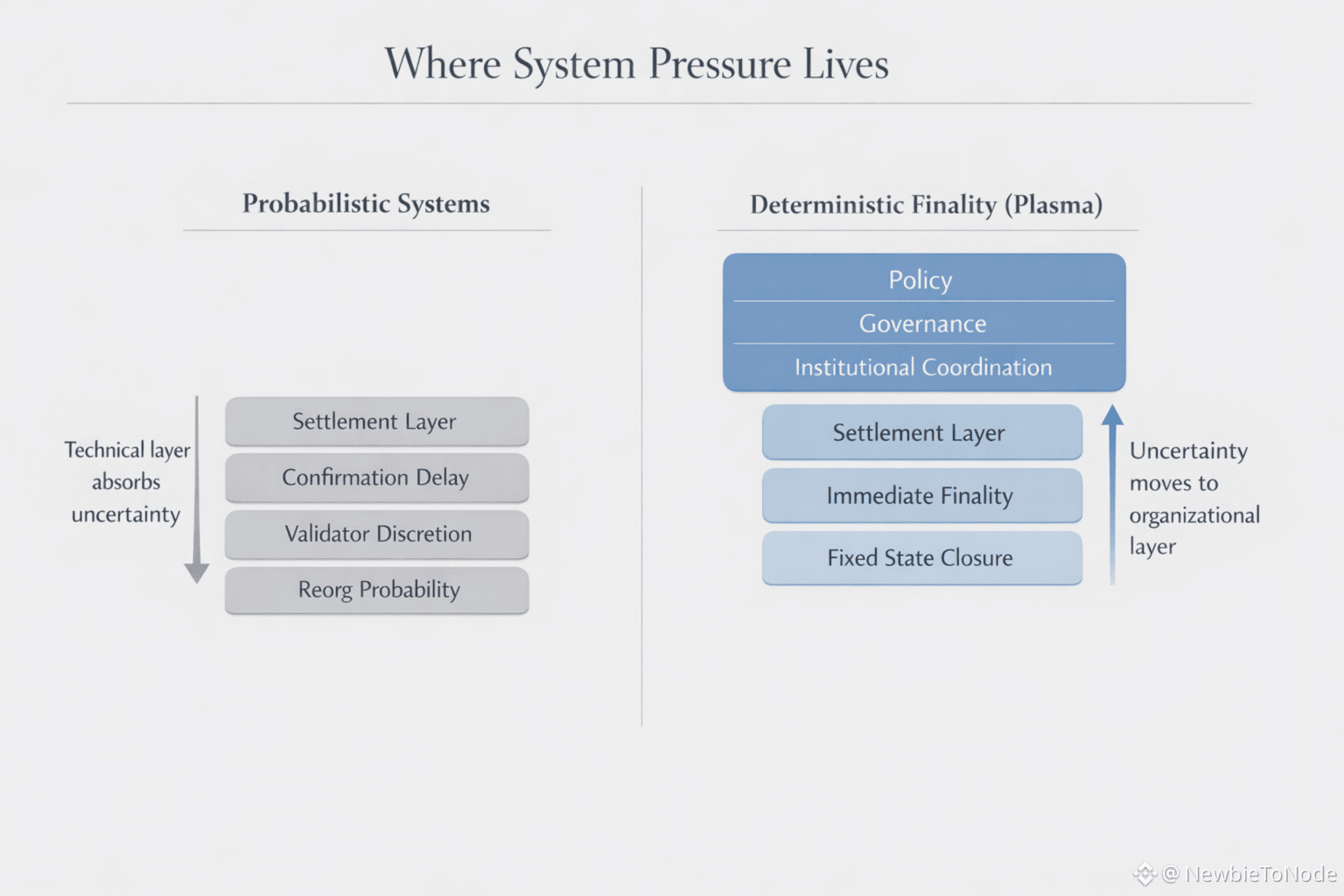
On slower or probabilistic rails, coordination hides inside delay. Teams rarely describe it that way, but it happens constantly. A few extra confirmations serve as psychological and operational buffer. A reversible window gives room for second looks. A soft pending state allows different departments to converge before action becomes irreversible.
Deterministic finality removes that cushion. The chain stops negotiating. Once state is closed, it stays closed.
This does not create instability. It creates visibility.
Organizations suddenly see how many of their workflows were implicitly tied to time rather than policy. What used to be “we will wait a bit longer” becomes “under what conditions do we act?” The difference sounds subtle, but operationally it is enormous. One is passive. The other requires governance.
That is why coordination pressure rises as settlement speed increases on Plasma. Technical uncertainty drops, but organizational decision load increases. Teams must agree earlier. Policies must be clearer. Systems must be prepared to treat finalized state as authoritative even if internal processes are still catching up.
This is not a flaw in deterministic networks. It is a maturation step.
Real financial systems do not run on ambiguous truth. They run on defined responsibility. Settlement establishes factual state. Organizations decide how to act on that state. When the boundary between those two layers becomes sharp, accountability becomes clearer.
Plasma’s model highlights this separation. Finality handles truth. Institutions handle permission. The chain does not arbitrate business intent. It simply closes the record with certainty, forcing downstream systems to be deliberate instead of reactive.
Over time, this produces healthier infrastructure. Automation becomes easier because rules are explicit. Reporting becomes more consistent because booking criteria are defined. Exceptions decrease because fewer decisions rely on implicit timing buffers.
What feels like pressure at first becomes structure.
The industry often frames faster settlement as a race toward zero latency. But the deeper shift is architectural. As consensus accelerates on Plasma, coordination must professionalize. The question stops being “has it settled yet?” and becomes “are we ready to act?”
That distinction marks the transition from speculative networks to financial infrastructure.
Deterministic finality does not eliminate work. It demands that work move to the right place, into policy, governance, and system design rather than into waiting.
And that is where scalable trust is built.