
Executive Summary


Labs represents a fundamental bet on the commoditization of zero-knowledge proof generation through decentralized market coordination. The protocol operates a verifiable application (vApp) that connects proof requesters (applications needing ZK proofs) with proof suppliers (hardware operators) via an auction-based marketplace. With SP1 Hypercube achieving real-time Ethereum proving (93% of blocks under 12 seconds) and securing $2B+ TVL across major rollups, Succinct has transitioned from research to production-grade infrastructure. However, the proof market design introduces non-trivial centralization risks through capital-intensive all-pay auctions that may favor specialized hardware operators. Succinct
Investment Thesis: Succinct solves the structural problem of ZK infrastructure fragmentation by creating a unified proving layer. If Ethereum's scaling roadmap continues toward zk-based validation (10,000 TPS target), Succinct's architecture positions it as critical infrastructure. However, realization depends on overcoming auction-based centralization risks and achieving broader adoption beyond current rollup partnerships.
1. Project Overview & Strategic Positioning
Succinct Labs operates in the zero-knowledge infrastructure sector, specifically focused on decentralized proof coordination. The protocol's core vision is "programmable truth" - enabling any software to be cryptographically verified without trust assumptions. Whitepaper
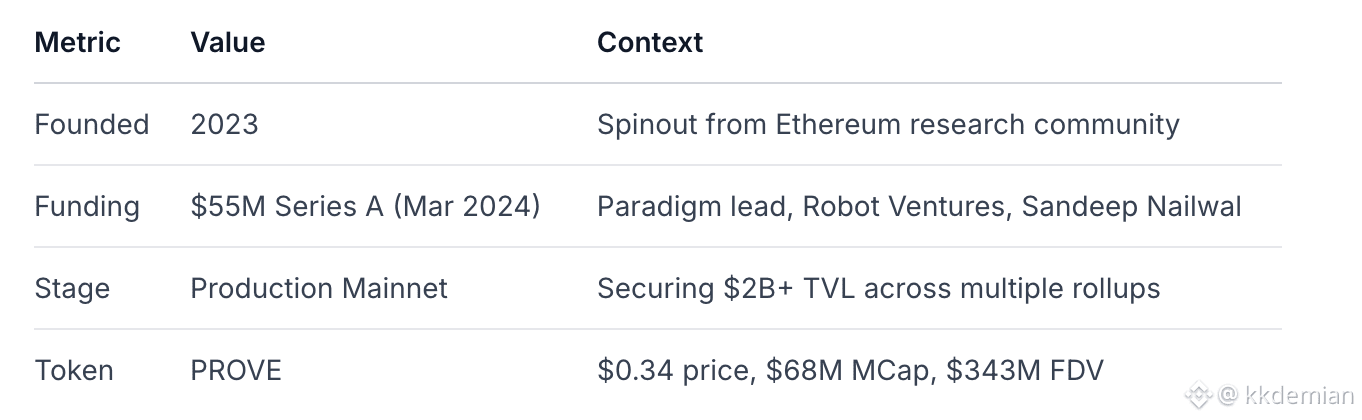
Team Background: The team combines deep cryptographic expertise with practical systems engineering. CEO Uma Roy brings machine learning and algorithmic background (ex-Citadel Datathon winner), while CTO John Guibas has published at NeurIPS on efficient architectures. Head of Cryptography Tamir Hemo leads the SP1 Hypercube development with formal verification experience. Team
Strategic Positioning: Succinct operates as a horizontal infrastructure layer rather than vertical integration. This contrasts with rollup-native proving (Polygon zkEVM) or application-specific circuits, instead providing a general-purpose proving layer that can serve multiple applications simultaneously.
2. System Architecture: vApp Design
Succinct's architecture employs a novel verifiable application (vApp) pattern that separates execution from settlement, similar to L2 sequencer designs but optimized for proof generation. Architecture
Core Components:
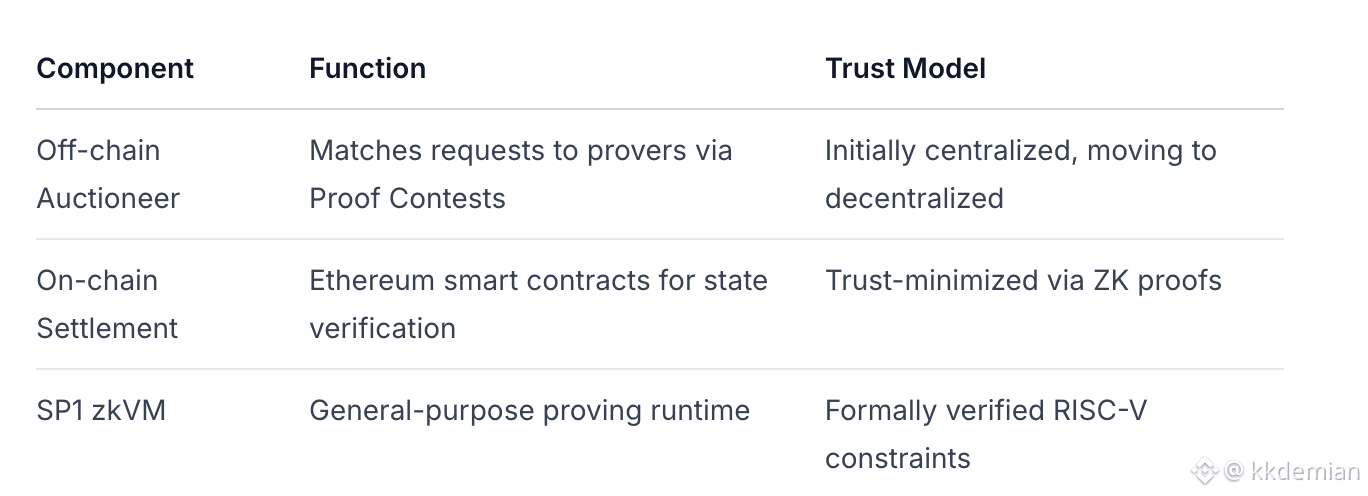
The architecture provides real-time user experience (RPC-based requests) with cryptographic settlement guarantees (on-chain verification). This hybrid approach avoids blockchain throughput limitations while maintaining verifiability.
Key Innovation: The vApp design allows Succinct to process proof requests without blockchain latency while still enabling users to independently verify network state and withdraw funds directly from Ethereum if the auctioneer fails.
3. SP1 zkVM: Technical Differentiation
SP1 (Succinct Prover 1) is a RISC-V based zkVM that uses a precompile-centric architecture to achieve performance advantages over general-purpose zkVMs. SP1 Docs
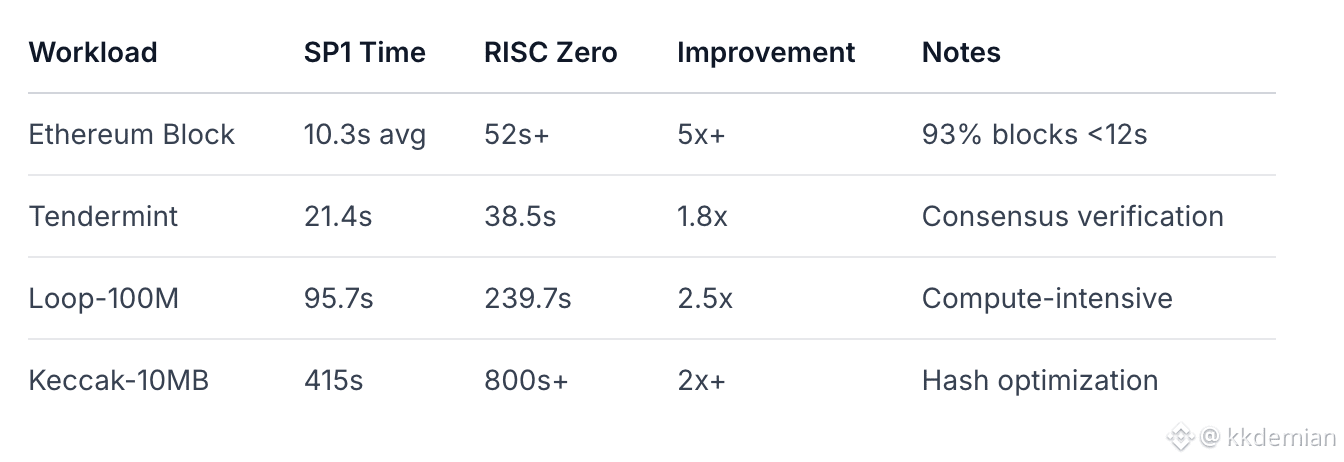
Performance Benchmarks
SP1 demonstrates significant performance advantages through specialized optimization:
SP1 Hypercube Advancements (2026 Roadmap):
Multilinear polynomial system replacing univariate STARKs
Jagged PCS commitment scheme for "pay what you use"
Formal verification of all RISC-V constraints (with Nethermind)
Elimination of proximity gap conjectures - critical security advancement
Precompile Model: SP1's key differentiation is its flexible precompile system that accelerates specific operations (secp256k1, ed25519, sha256, keccak256) through hand-optimized circuits. This provides application-specific performance while maintaining general-purpose programmability.
Competitive Landscape
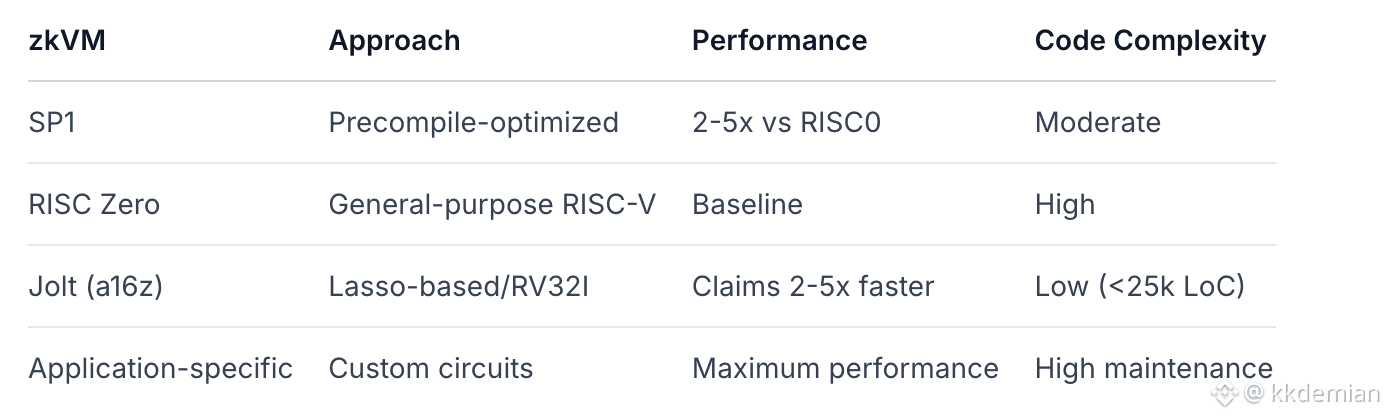
SP1 occupies a middle ground between general-purpose zkVMs (easier development) and application-specific circuits (maximum performance). The precompile system enables 5-10x cycle reduction for cryptographic operations common in blockchain workloads.
4. Proof Market Mechanism: Economics & Coordination
The Succinct Prover Network implements a novel market structure called Proof Contests - reverse all-pay auctions where provers compete for proof generation rights. Proof Contests
Auction Mechanics
Request Flow:
Requester submits program + inputs with max fee and deadline
Provers bid in reverse auction (lowest price wins)
Winning prover must complete proof before deadline
Payment split: Treasury (protocol fee), Stakers, Prover Owner
Pricing Structure:
Base Fee: Fixed cost per proof mode ($0.2 PROVE for compressed)
Auction Price: Market-determined bid per Prover Gas Unit (PGU)
Total Cost: Base Fee + (PGU × Auction Price)
PGU Innovation: Prover Gas Units represent a major advancement over simple cycle counts. PGU uses linear regression based on shard characteristics to accurately predict proving costs, accounting for the non-linear relationship between RISC-V cycles and actual proving time. PGU Docs
Staking Economics
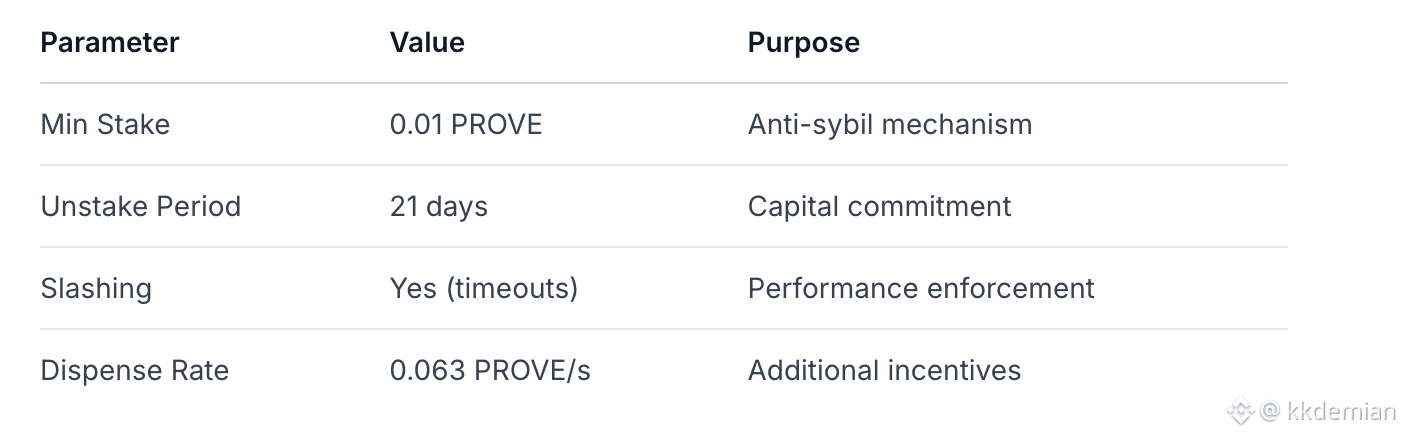
Current Staking Landscape (Dune Analytics):
~16-20M PROVE total staked
Top staker: 19.87% concentration risk
23,038 unique claimers - broad distribution
Staking dashboard shows increasing security budget
The auction design creates natural competition that should drive proving costs toward marginal cost over time. However, the all-pay structure requires provers to bear bidding costs regardless of outcome, potentially favoring well-capitalized operators.
5. Protocol Economics & Token Mechanics
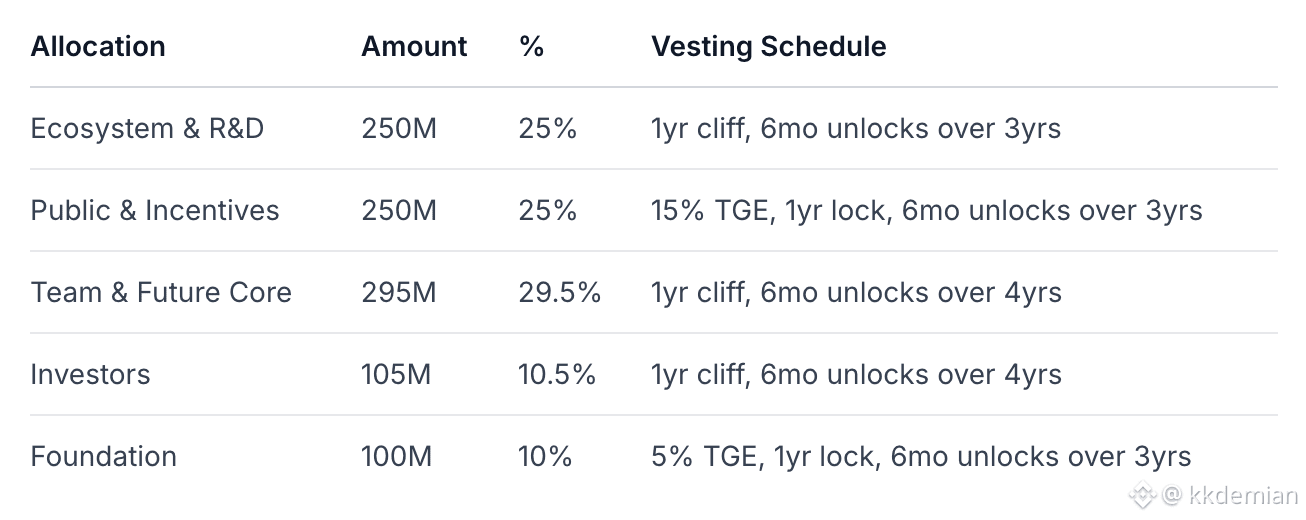
PROVE Token serves as the coordination mechanism and payment currency for the network. Tokenomics
Token Distribution:
Fee Flows:
Requesters pay in PROVE for proofs
Protocol treasury receives 1% fee (adjustable)
Stakers earn prover rewards (set at prover deployment)
Prover owners receive remaining fees
The economic model aligns incentives around cost reduction - provers must continuously improve efficiency to compete in auctions, while the protocol captures value through treasury fees.
6. Risk Analysis
Technical Risks
Cryptographic Implementation: Despite formal verification, novel proof systems carry implementation risk
Liveness Dependencies: Single-prover assignment creates latency risk if provers fail
Hardware Moats: Specialized hardware (FPGAs, ASICs) may centralize proving power
Economic Risks
Auction Centralization: All-pay auctions may favor capital-rich provers (Critique)
Staking Concentration: Top staker controls 19.87% of stake - governance risk
PROVE Volatility: Token-based payments expose users to price volatility
Governance Risks
Current Control: Security Council manages key parameters
Transition Path: Roadmap to permissionless proving not fully detailed
Upgrade Mechanisms: vApp architecture requires careful upgrade coordination
Mitigating Factors: Slashing mechanisms discourage malicious behavior, and the ability to withdraw funds directly from Ethereum reduces auctioneer dependency. The proving pool system allows smaller operators to participate collectively.
7. Adoption & Ecosystem Integration
Succinct has achieved significant early adoption across multiple ecosystem segments: Partners
Rollups & L2s:
Mantle: $2B+ TVL secured with OP Succinct
Celo: First L2 with OP Succinct Lite mainnet
Arbitrum: 1-year exclusive partnership with Tandem studio
Infrastructure:
Celestia: Blobstream migration to Succinct Prover Network
Across Protocol: v4 bridge powered by Succinct
Hyperliquid: USDC bridging via HyperEVM
Emerging Use Cases:
Automata: ZK proofs for software supply chain (Proof of Build)
Primus Labs: Proof of Reserves for institutions
C2PA: Content authenticity standards with ZK verification
Network Metrics (from Dune dashboards):
Cumulative proofs: Data incomplete in available sources
Active provers: Number not publicly disclosed
PGU volume: Growing but specific metrics limited
The diversity of integrations demonstrates Succinct's general-purpose capability, though rollup infrastructure remains the primary use case.
8. Strategic Trajectory & 2026 Roadmap
Succinct's 2026 trajectory focuses on making the protocol "systemically critical" through several key initiatives: Roadmap
Technical Milestones:
SP1 Hypercube Mainnet: Real-time Ethereum proving (<12s for 93% of blocks)
Hardware Diversification: FPGA acceleration (20x vs CPU with AntChain)
Formal Verification Completion: Full RISC-V constraint verification
Ecosystem Growth:
Ethereum L1 Integration: Enabling zk-based validation for base layer
Additional Precompiles: Expanding optimized operations (secp256r1, RSA)
Cross-chain Expansion: Beyond Ethereum to other ecosystems
Economic Evolution:
Permissionless Proving: Reducing barrier to prover participation
Fee Market Optimization: Dynamic base fee adjustment
Governance Transition: Moving toward community control
The successful implementation of these milestones would position Succinct as critical infrastructure for Ethereum's scaling roadmap, particularly if the transition to zk-based L1 validation accelerates.
9. Investment Assessment
Based on comprehensive analysis across multiple dimensions:
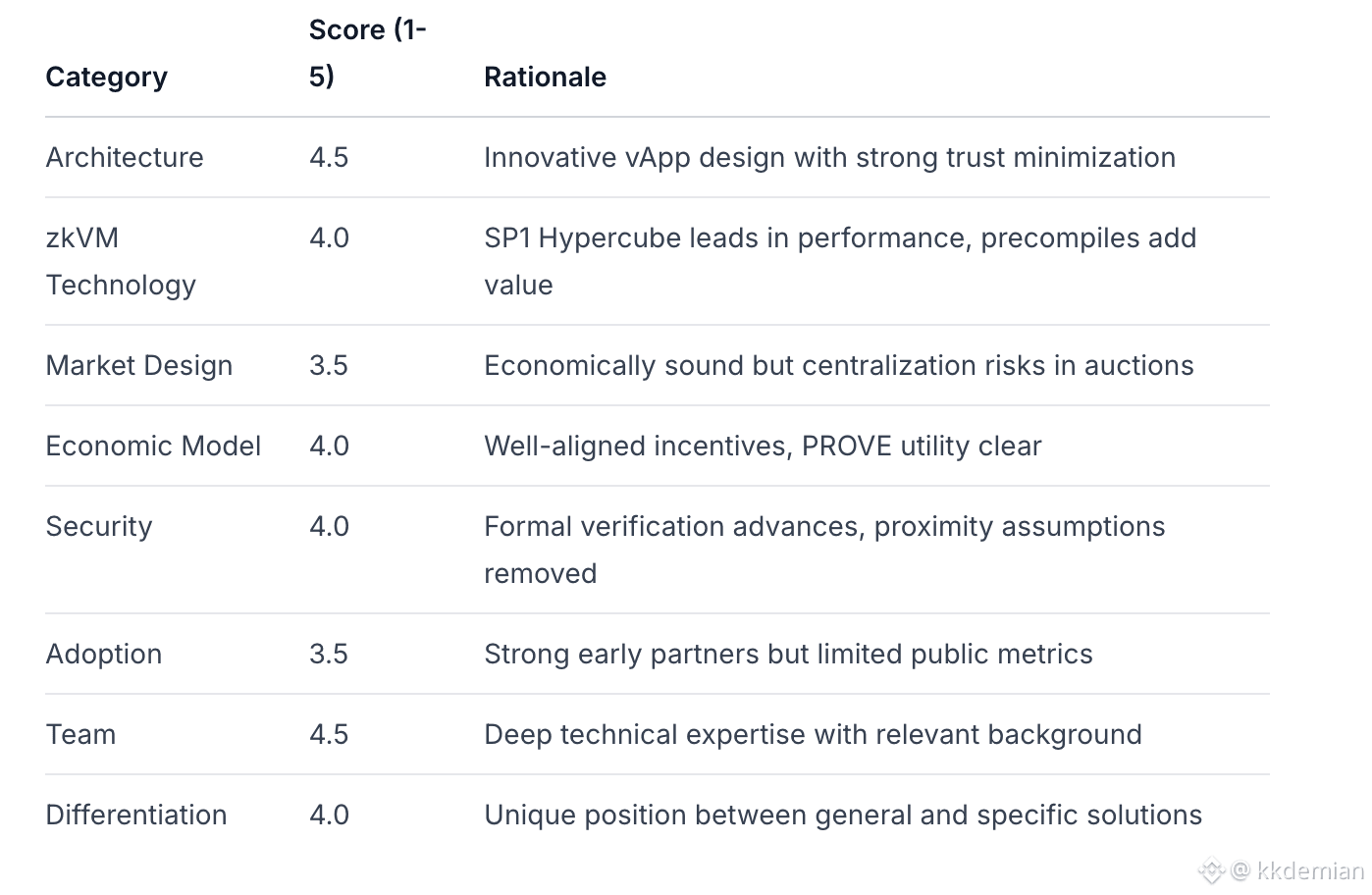
Overall Score: 4.0/5.0
Final Investment Verdict
SUCCINCT REPRESENTS A HIGH-CONVICTION INFRASTRUCTURE INVESTMENT for tier-1 crypto funds with a 3-5 year horizon. The protocol solves fundamental fragmentation in ZK proving infrastructure and aligns with Ethereum's scaling trajectory. However, investors should monitor:
Auction Centralization: Whether proof contests maintain sufficient decentralization
Adoption Metrics: Movement beyond current partners to broader ecosystem
Execution Risk: Delivery of 2026 technical milestones, particularly L1 integration
Recommendation: INVEST with position sizing reflecting the high-reward/high-risk profile. Succinct's technical differentiation and ecosystem positioning justify investment, but the proof market design requires careful observation for centralization tendencies.
The fundamental thesis remains compelling: as ZK proof generation becomes commoditized, coordination layers like Succinct will capture disproportionate value by enabling efficient market formation between proof supply and demand.