
For a long time, blockchains have been treated like digital ledgers. They record transactions, lock data in place, and prove that something happened at a specific time. This works well for ownership and transfers, but it starts to fall apart when applications become more complex.
As Web3 moves forward, blockchains are being asked to do more than store receipts. They are being asked to support automation, AI-driven decisions, real payments, and regulated assets. This is the problem space Vanar Chain is trying to address.
Vanar is not positioning itself as the fastest or loudest network. Instead, it is trying to become infrastructure that works quietly in the background, especially in a future where AI agents do most of the work.
Why Storing Data Is No Longer Enough
Most blockchains treat data as something static. You put information on-chain, verify it with a hash, and that is the end of the story. If you want to understand the data, you move it off-chain, load it into another system, and rebuild the context manually.
This model creates friction.
Imagine an invoice stored as a PDF on IPFS. The file is permanent, but it is still just a blob of data. The blockchain can prove it exists, but it cannot answer practical questions. Is the invoice paid? Does it comply with regulations? Is the user allowed to act on it? What changed since the last version?
These questions are about meaning, not storage. Traditional blockchains were never designed to answer them.
Vanar starts with the assumption that future applications will not rely on humans clicking buttons. They will rely on AI agents checking documents, verifying rules, settling payments, and updating states continuously. For that to work, data must be readable and usable by machines.
Neutron and the Idea of Usable Memory
Vanar introduces a concept called Neutron to solve the problem of dead files.
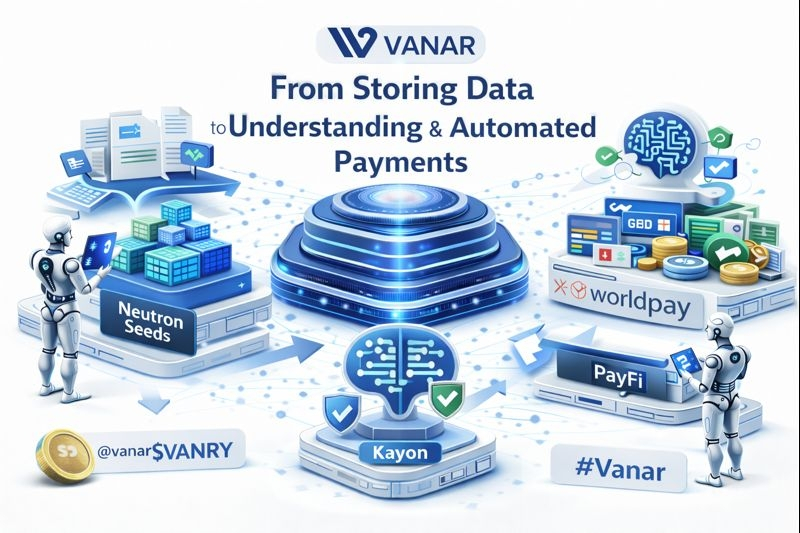
Instead of storing full documents on-chain, Neutron compresses unstructured data into small, verifiable units called Seeds. These Seeds are designed to retain meaning while becoming much smaller and easier to work with.
Think of it like turning a large book into a structured summary that software can query. The original content can still exist off-chain, but the important information lives on-chain in a form that applications and AI agents can use directly.
This changes what automation looks like. Instead of downloading files and parsing them externally, systems can query Seeds and make decisions immediately. Memory becomes a reference point, not a storage burden.
Kayon and Context-Aware Reasoning
Compression alone does not solve the problem. Data also needs interpretation.
This is where Kayon comes in. Kayon is designed as a reasoning layer that sits alongside Neutron. It allows applications and agents to ask questions, apply rules, and check compliance based on context.
Most blockchains rely on simple logic. If this happens, then do that. Kayon aims to move beyond this by enabling context-aware checks. It allows software to reason over structured data instead of just executing commands.
In simple terms, Kayon helps the blockchain understand what data represents and what action should follow. This is especially important for regulated workflows like payments, identity checks, and real-world assets.
PayFi as a Practical Distribution Strategy
Many blockchain projects talk about AI and automation in abstract terms. Vanar grounds its vision in payments.
PayFi focuses on settlement, compliance, and real commerce. Payments are where friction is felt immediately. If something breaks, users notice right away.
By designing the chain around predictable fees and integration with existing payment systems, Vanar is aiming to support automated payment flows that work in the real world. This includes stable settlement, rule checks, and the ability to move between crypto and fiat when needed.
This approach forces discipline. A payment-focused chain must be reliable, predictable, and compliant. Speed alone is not enough.
Why Fixed Fees Matter More Than They Seem
Vanar uses a fixed-fee model. At first glance, this may sound unexciting. But for automation, it is essential.
AI agents often perform many small actions. Verifying data, checking rules, updating states, settling micro-payments. If fees fluctuate wildly, automation becomes risky and unreliable.
Fixed fees allow systems to plan. Costs remain stable even when markets are volatile. This predictability is what real businesses and automated systems need.
It may not attract attention on social media, but it is exactly how infrastructure works in the real world.
From TVK to VANRY: A Shift in Direction
Vanar did not start under its current name. The transition from TVK to VANRY marked a deeper shift than a simple rebrand.
It represented a move toward a chain-first identity built around AI-native infrastructure. Neutron, Kayon, and PayFi define this new direction.
The token migration was done on a one-to-one basis, signaling continuity rather than disruption. The focus moved away from a single use case toward building a broader foundation for intelligent applications.
Treating Data Like Software
One of the most interesting ideas behind Vanar is how it treats data.
Instead of acting like an archive, the chain treats data as something functional. Data becomes small, testable, queryable, and reusable. It behaves more like software than storage.
Neutron Seeds are described as semantic objects. They are designed to be consumed by applications and AI agents directly. Data does not just exist on the chain. It does work.
This flips the traditional model. Instead of storing proof and computing meaning elsewhere, Vanar stores meaning and computes decisions on-chain.
How to Evaluate Vanar Without Hype
The real question is execution.
Are Neutron and Kayon usable tools for developers? Can real legal and financial documents be turned into Seeds reliably? Do AI agents retrieve and reason over them correctly? Does PayFi actually reduce friction in real payment flows?
These are the questions that matter.
If the answers are positive, Vanar begins to look less like a speculative project and more like infrastructure designed for a future where automation, AI, and compliance are normal.
Closing Thoughts
Vanar Chain is not trying to make blockchains louder. It is trying to make them smarter.
By focusing on usable memory, reasoning, predictable fees, and real payments, Vanar is building for a world where machines handle most on-chain activity. This is a slower path, but it is often how lasting systems are built.
In a future where value moves automatically and decisions are made by software, blockchains will need to understand data, not just store it.
Vanar is placing its bet on that future.
