
There are technologies that announce themselves loudly, chasing attention and demanding belief before they have earned it, and then there are technologies that grow quietly, shaped by patience, restraint, and a deep understanding of human systems. Dusk belongs firmly to the second kind. It does not try to shock the world or promise overnight transformation. Instead, it speaks to something far more enduring, the need for trust in a digital age that has slowly forgotten how fragile trust really is. At its heart, Dusk is a Layer 1 blockchain, but emotionally it feels like a response to a long ignored discomfort, the feeling that total transparency, while powerful, can also be invasive, unsafe, and incompatible with how real financial systems actually function.
Dusk was founded in 2018 at a time when the blockchain industry was celebrating radical openness as an unquestioned virtue. Every transaction public. Every balance visible. Every interaction permanently recorded. For experimentation, this worked. For real finance, it did not. Financial institutions are not secretive because they are dishonest, they are private because they are responsible. They protect clients, strategies, negotiations, and identities because exposure creates risk, not trust. The people behind Dusk recognized this mismatch early and chose to confront it head on. They asked a difficult question that many avoided. Can decentralization coexist with regulation, privacy, and accountability without compromising any of them. That question became the emotional foundation of the project.
Rather than building a system that forces institutions to abandon their safeguards, Dusk was designed to meet them where they are. It does not reject oversight. It does not attempt to bypass law. Instead, it integrates compliance into the very structure of the network. This is where Dusk begins to feel human, because it accepts that the world is complex and that trust is built through balance, not extremes. It understands that transparency is not the same as honesty, and that privacy is not the same as secrecy. In real life, trust comes from the ability to prove the truth when required, not from exposing everything at all times.
This philosophy is woven deeply into Dusk’s technical design. The network is built with a modular architecture that allows its core components to evolve as legal, technical, and institutional standards change. This flexibility matters because finance does not stand still, and infrastructure that cannot adapt eventually breaks. Dusk’s use of advanced cryptography is not about showing technical superiority, but about enabling something emotionally important, the ability to interact without fear. Through zero knowledge proofs, participants can demonstrate that transactions are valid, rules are followed, and ownership is legitimate without revealing sensitive details to the entire world. This restores a sense of control that many digital systems have taken away.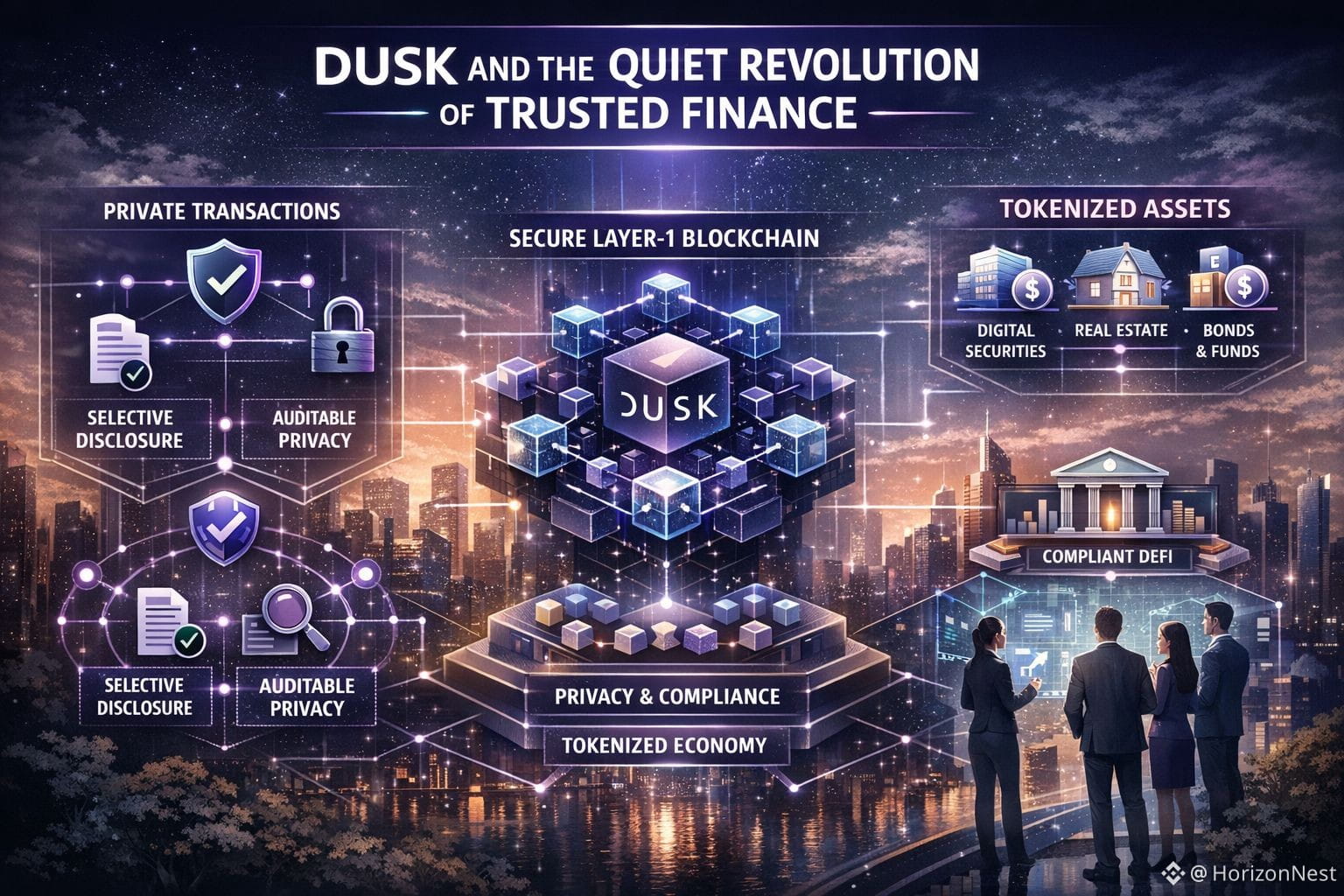
Privacy on Dusk feels less like hiding and more like boundaries. Boundaries are what allow people and institutions to operate confidently. They allow businesses to compete without being exposed. They allow individuals to participate without being permanently surveilled. They allow regulators to verify compliance without turning markets into glass boxes. In this way, Dusk reframes privacy as a cooperative tool rather than a rebellious one. It becomes a bridge between decentralization and responsibility, between innovation and law.
Maintaining trust on a private by design blockchain is not easy, and Dusk does not pretend otherwise. Where other networks rely on public visibility to discourage bad behavior, Dusk relies on cryptographic certainty and economic alignment. Its proof of stake based consensus mechanism ensures that validators are financially invested in the health of the network. Even when transaction details are not publicly visible, correctness is enforced through mathematical proofs and penalties for misconduct. Trust does not disappear. It simply moves from social observation to cryptographic assurance. This shift is subtle, but profound, because it shows that honesty does not require constant exposure.
The economic design of Dusk mirrors this calm, deliberate approach. The native token is not positioned as a spectacle or a promise of quick gains. It exists to secure the network, enable participation, and support governance. Fees are designed to be predictable rather than volatile. Incentives are structured to reward long term commitment rather than short term speculation. This restraint sends a quiet but powerful signal. Dusk is not trying to attract attention. It is trying to earn confidence. For institutions, this difference matters deeply, because stability feels safer than excitement when real capital and reputations are involved.
Where Dusk truly begins to resonate is in its real world applications. Tokenized assets that preserve confidentiality. Financial instruments that settle efficiently without revealing strategies. Markets where compliance can be proven without public exposure. Identity systems where people can prove eligibility without surrendering personal data. These are not abstract ideals. They are practical solutions to real pain points in modern finance. Dusk does not claim to replace existing systems overnight. Instead, it offers a path forward, a way to modernize financial infrastructure without tearing down the safeguards that keep it functional.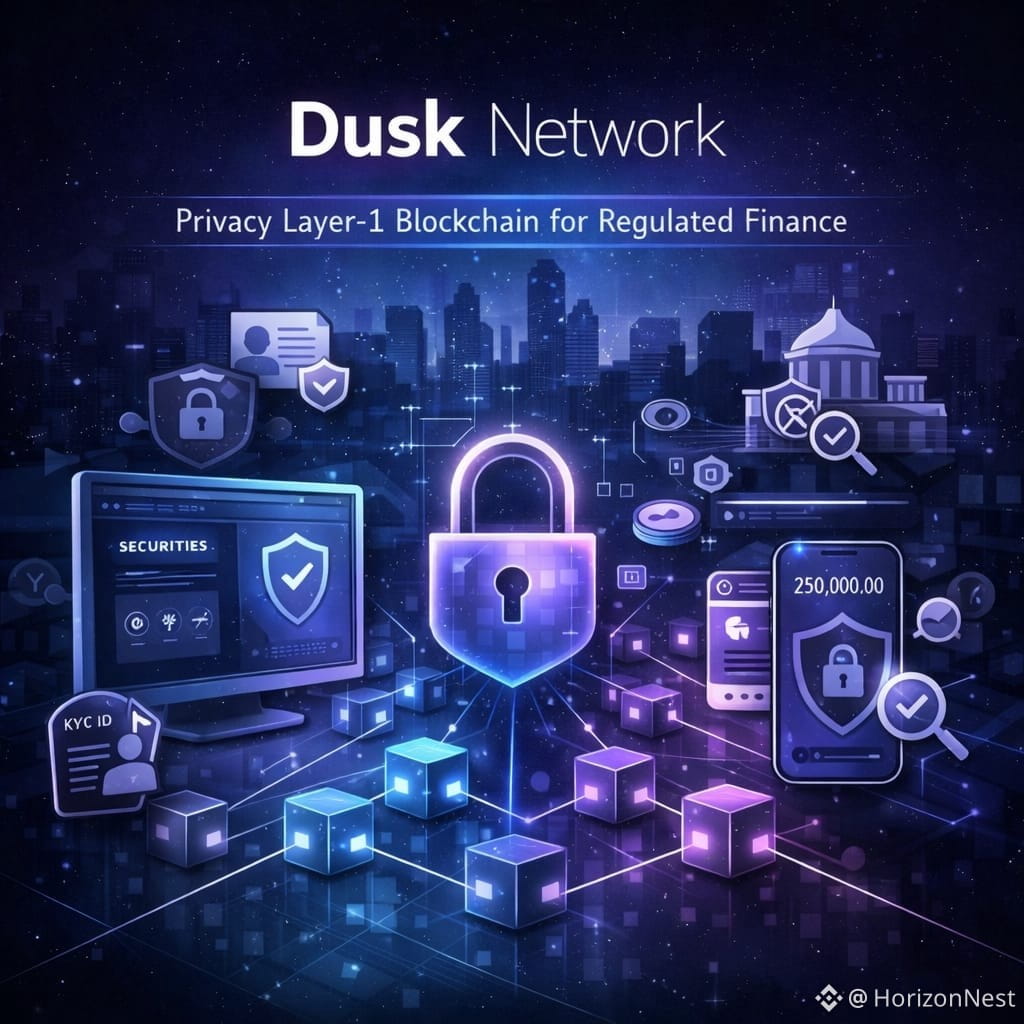
The signals that matter most for Dusk are not loud. They appear in consistent development, in research driven updates, in documentation that prioritizes clarity over hype. Its presence on Binance provides accessibility and liquidity, but the deeper story lies in who is paying attention. Builders interested in privacy preserving finance. Institutions exploring tokenization. Regulators beginning to understand cryptographic proofs. These signals suggest a project that is positioning itself for relevance, not popularity.
Of course, the road ahead is not without challenges. Privacy focused systems are complex. They require deep trust in cryptography and careful governance. Regulatory frameworks are still evolving, and adoption will take time. Interoperability with fully transparent ecosystems adds another layer of difficulty. But these challenges feel like the cost of doing something meaningful rather than something easy. Dusk does not avoid these realities. It builds within them.
What Dusk ultimately points toward is a future that feels calmer than the one we are used to imagining in crypto. A future where finance is digital but not exposed. Where decentralization does not mean chaos. Where compliance does not mean control. A future where technology serves human needs instead of reshaping them aggressively. This future will not arrive through noise or hype. It will arrive through trust, slowly earned and carefully protected.
In the end, Dusk feels less like a product and more like a philosophy expressed through code. A belief that privacy and accountability can coexist. A belief that financial systems can be decentralized without becoming reckless. A belief that dignity still has a place in digital infrastructure. In a space often driven by extremes, Dusk stands quietly in the middle, and sometimes that is exactly where real progress begins.
