@Walrus 🦭/acc In digital asset markets, the most meaningful long-term developments are not driven by short-term price movements, but by how value and information are transmitted across blockchain networks. Payments, settlement layers, and asset transfers all rely on infrastructure that can operate efficiently, at low cost, and without single points of failure. Recent years have made it clear that blockchains are evolving beyond simple token systems into foundational rails for applications, data exchange, and capital deployment. As financial activity increasingly migrates on-chain, the challenge extends beyond moving value to determining how data itself is stored, secured, and shared in a decentralized way.
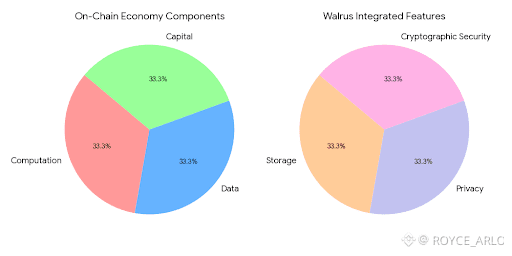
Walrus occupies this foundational segment of the crypto stack. Rather than targeting end users or speculative DeFi participation, Walrus is designed as backend infrastructure. The protocol centers on decentralized, privacy-focused data storage and transactions, with the WAL token functioning as an internal utility asset. Unlike traditional cloud models where storage exists outside the blockchain environment, Walrus integrates storage directly into the on-chain economy, allowing applications, users, and data to interact through cryptographic mechanisms instead of trusted intermediaries.
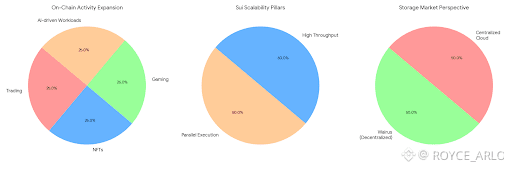
The protocol is built on the Sui blockchain, which emphasizes scalability through parallel execution and high throughput. From a market structure standpoint, this is critical. As on-chain activity expands across trading, NFTs, gaming, and AI-driven workloads, data storage increasingly becomes a limiting factor. Walrus positions itself as a decentralized replacement for centralized cloud providers, offering native blockchain compatibility rather than relying on off-chain APIs or external services.
From a technical perspective, Walrus leverages erasure coding combined with blob-based storage. Large datasets are segmented, encoded, and distributed across a network of independent nodes, ensuring that no single participant controls the complete file. Even if a portion of the network becomes unavailable, the data remains recoverable. This architecture enhances durability and resistance to censorship, which is particularly important for financial protocols and enterprises that cannot afford dependency on a single provider or legal jurisdiction.
The WAL token serves multiple operational purposes within the network. It is required for storage access, governance participation, and staking by node operators. This positions WAL as a functional utility token rather than a purely speculative asset. Its long-term value is tied to real network usage, such as data volume stored, application adoption, and sustained demand for decentralized storage services. For long-horizon investors, this shifts evaluation away from short-term liquidity and toward measurable adoption metrics.
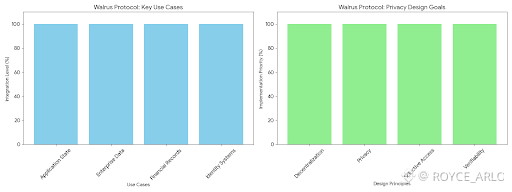
Privacy is a central component of the Walrus design. The protocol supports confidential interactions and is intended for use cases that require controlled data visibility, including financial records, enterprise data, identity systems, and application state. In an environment of increasing regulatory oversight, privacy does not imply secrecy, but rather selective access. Walrus aims to ensure that only authorized parties can view sensitive information while maintaining decentralization and verifiability.
From a security standpoint, the system relies on cryptographic guarantees and redundancy instead of trust in centralized operators. Data integrity and availability are enforced mathematically, not through contracts or institutional oversight. There is no central authority capable of censoring, altering, or removing stored data, which materially reduces counterparty risk an often overlooked vulnerability in crypto infrastructure.
That said, Walrus is not without challenges. Decentralized storage systems are inherently more complex than centralized cloud platforms. Performance is influenced by network conditions and node participation, and retrieval speeds may not always match traditional Web2 services. Additionally, the protocol’s success is closely tied to the broader adoption and security of the Sui ecosystem. Limited developer or enterprise traction at the base layer would introduce ecosystem-level risk.
Economic design is another potential constraint. Sustaining a decentralized storage network requires carefully balanced incentives for node operators. If rewards are insufficient, participation may decline; if costs rise too high, storage demand could weaken. This trade-off is a common issue across decentralized storage projects, and Walrus must manage it effectively to remain competitive.
From an analytical standpoint, Walrus should not be assessed in the same category as yield-driven DeFi platforms or trading-focused protocols. It more closely resembles base-layer infrastructure, similar to payment networks or data centers in traditional financial systems. Its significance lies in whether developers, protocols, and enterprises commit to storing meaningful data on-chain using decentralized solutions.
Over the long term, infrastructure projects like Walrus address a fundamental scalability issue in crypto markets. Financial systems cannot fully decentralize if data storage remains centralized while value transfer is not. By integrating storage, privacy, and cryptographic security into the blockchain stack, Walrus contributes to the development of a more complete on-chain economy one where computation, data, and capital operate together without reliance on trusted intermediaries. This is not a narrative-driven play, but a structural layer that becomes increasingly relevant as real-world economic activity moves on-chain.