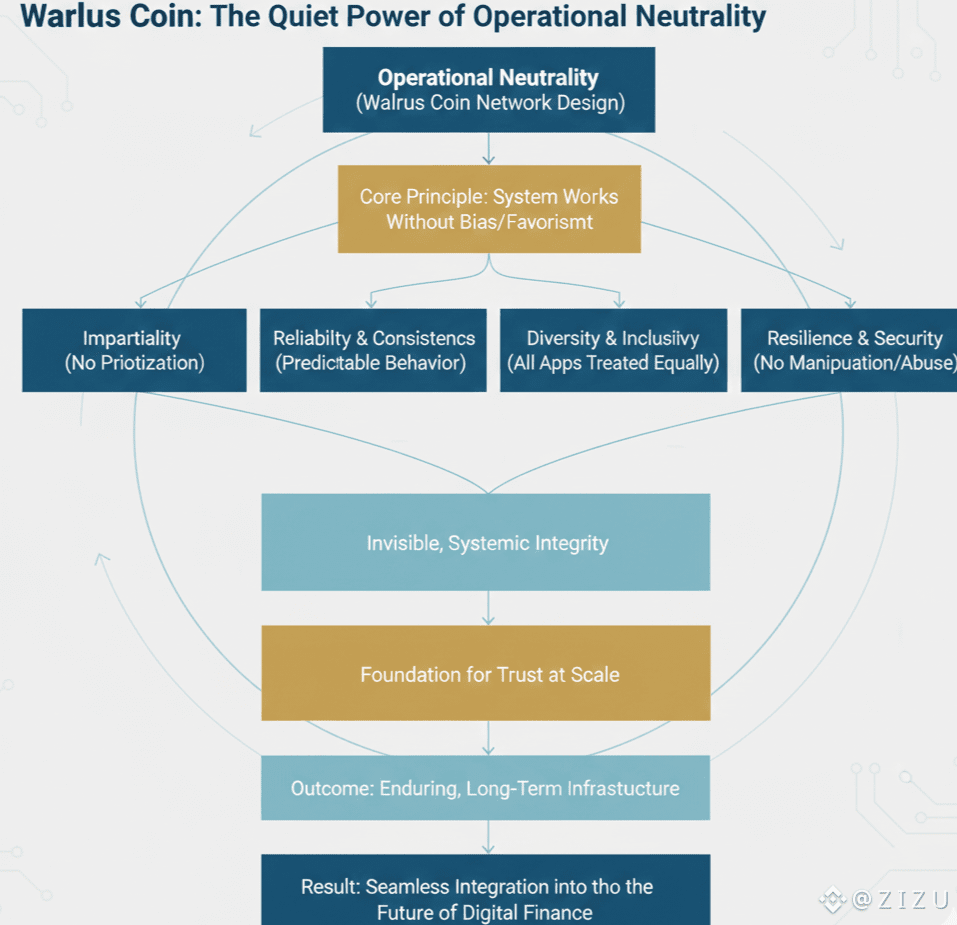
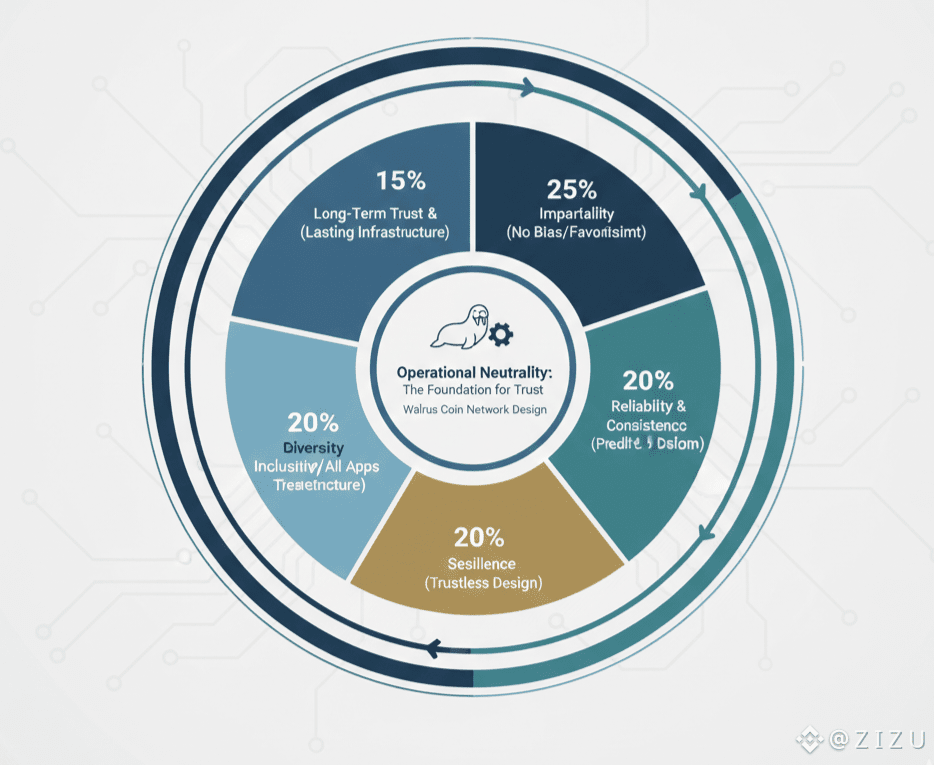
Operational neutrality is one of those ideas that doesn’t get nearly enough attention in discussions about decentralized systems. Yet, in my view, it’s absolutely critical for building technology that lasts. Walrus Coin, from what I’ve seen, truly embodies this principle, not through flashy features or big announcements, but through the quiet design of its network. Simply put, operational neutrality means the system works without bias, without favoritism and without interference. Everything runs as it should, consistently, for everyone.
When I think about traditional systems, whether in storage, finance or data management, I often notice how easy it is for neutrality to slip away. Administrators can prioritize certain users, favor specific types of data or fast-track particular transactions. Even small biases can build up over time, giving some participants advantages while leaving others behind. From my perspective, that’s where Walrus Coin stands apart. Its protocol ensures that every piece of verified data is treated equally, no matter its origin, size or perceived importance. This isn’t just a technical detail, it’s the foundation for trust at scale.
Neutrality also has a social side. Systems that allow influence by a single actor or a powerful group tend to create friction, conflict and uncertainty. Walrus Coin avoids this entirely. By design, no one can sway outcomes. From my point of view, this is crucial for true decentralization. Small participants and large institutions alike can rely on the network to act impartially, which is exactly the kind of environment needed for long-term adoption. People use systems they trust and trust comes from knowing there’s no hidden hand guiding the rules.
Consistency is another reason I value operational neutrality so highly. Sure, speed and flashy features grab headlines but they mean very little if the network’s behavior is unpredictable. Infrastructure only becomes meaningful when you can rely on it repeatedly. That’s what Walrus Coin offers. Its operations are stable and impartial, which allows participants to plan confidently, whether they’re storing research data, archiving cultural records or managing financial information. Personally, I’ve come to value this predictability far more than raw speed or efficiency. A system that works the same way every time is far more powerful than one that’s just fast.
Neutrality also enables diversity. In centralized or biased systems, one type of activity or data can dominate, while others get squeezed out. Walrus Coin avoids that trap. Its network treats every application fairly. Scientific research, financial records and cultural archives can all coexist on the same layer without one overshadowing the other. To me, this universality is rare but essential. A truly decentralized system shouldn’t favor any one purpose, it should support all of them equally.
Operational neutrality even strengthens security. By removing discretionary control from participants, the network removes opportunities for manipulation or abuse. Its impartiality isn’t just fair, it makes the system more resilient. From my perspective, this combination of fairness, reliability and resistance to interference is what gives Walrus Coin its quiet power. It’s a system you can trust without constantly checking its motives.
What strikes me most is how invisible this quality is. Neutrality doesn’t demand attention, doesn’t make headlines and doesn’t appear as a metric on a dashboard. Yet it’s the backbone of the network’s reliability. Many systems flaunt high throughput, flashy designs or short-term gains but few achieve the subtle, systemic integrity that operational neutrality provides. For me, this subtlety is what makes Walrus Coin remarkable.
Trust is another key piece of the puzzle. People engage with networks not just because they work but because they trust that they work fairly. In decentralized systems, trust is a product of design, not marketing. Walrus Coin’s neutrality fosters this trust naturally. When users know the network is impartial, they’re more willing to invest resources, experiment and collaborate. From my point of view, that trust is just as valuable as any technical specification, it’s the invisible glue that holds the ecosystem together.
Finally, neutrality reflects a long-term perspective. Many networks chase short-term gains, rapid adoption or hype. Walrus Coin chooses a different path: it prioritizes fairness and predictability. Infrastructure only succeeds if it can endure, scale and remain relevant over years or decades. Personally, I see this as a hallmark of thoughtful, forward-looking design.
In the end, Walrus Coin isn’t just another decentralized network, it’s an example of operational neutrality in action. From my perspective, this neutrality is the foundation of trust, fairness and long-term reliability. It ensures every participant is treated equally, enables a diversity of applications, strengthens security and gives users confidence that the system will behave as expected. I consider this one of the network’s most underappreciated qualities. It quietly works behind the scenes, supporting every interaction and decision and in doing so, builds the kind of lasting infrastructure the decentralized world so desperately needs.