
Vanar did not begin as an idea meant to impress anyone, and that is exactly why it feels different, because it was shaped by people who had already seen what happens when technology forgets the humans it claims to serve. Long before Vanar became a blockchain, the minds behind it were deep inside games, entertainment worlds, and brand ecosystems where emotions matter more than buzzwords and where users leave the moment something feels slow, confusing, or dishonest. They watched excitement turn into frustration when fees spiked without warning, when systems broke under pressure, and when curiosity was punished with complexity. That experience leaves a mark, and Vanar grew out of that quiet exhaustion, out of the feeling that Web3 could be something warmer, calmer, and more respectful if it stopped trying to prove itself and started trying to belong.
What Vanar understands at a very deep level is that mass adoption is not a technical problem, it is an emotional one. People do not reject blockchain because they hate innovation, they reject it because it often makes them feel small, confused, or excluded. Vanar exists because the team refused to accept that discomfort as the cost of progress. Instead of asking billions of people to learn new rules, new language, and new risks, Vanar asked how blockchain could adapt to the way people already live, play, and connect. That single shift in perspective quietly changes everything, because it reframes technology as a support system rather than a test.
Underneath the surface, Vanar is a Layer One blockchain built for consistency rather than spectacle, and that choice reflects a deep respect for human attention. In real life, moments matter. A second of lag can break immersion in a game. A confusing transaction can kill trust forever. Vanar focuses on high throughput, fast finality, and predictable costs not to win arguments online but to protect those moments when people are emotionally invested. Smart contracts are designed to behave reliably, even when activity spikes, so users never feel punished for showing up at the same time as everyone else. It is the kind of engineering that rarely goes viral but quietly earns loyalty, because people remember how safe and smooth something felt even if they cannot explain why.
One of the most meaningful choices Vanar makes is choosing to step back. The blockchain is not meant to be the star of the experience. It is meant to disappear. Developers are encouraged to hide complexity, not expose it. Ownership does not interrupt the journey, it blends into it. Users are not forced to understand wallets before they can feel joy, curiosity, or belonging. This is not about dumbing things down, it is about honoring the truth that most people want to feel something before they want to understand something. When technology respects that order, adoption stops feeling forced and starts happening naturally.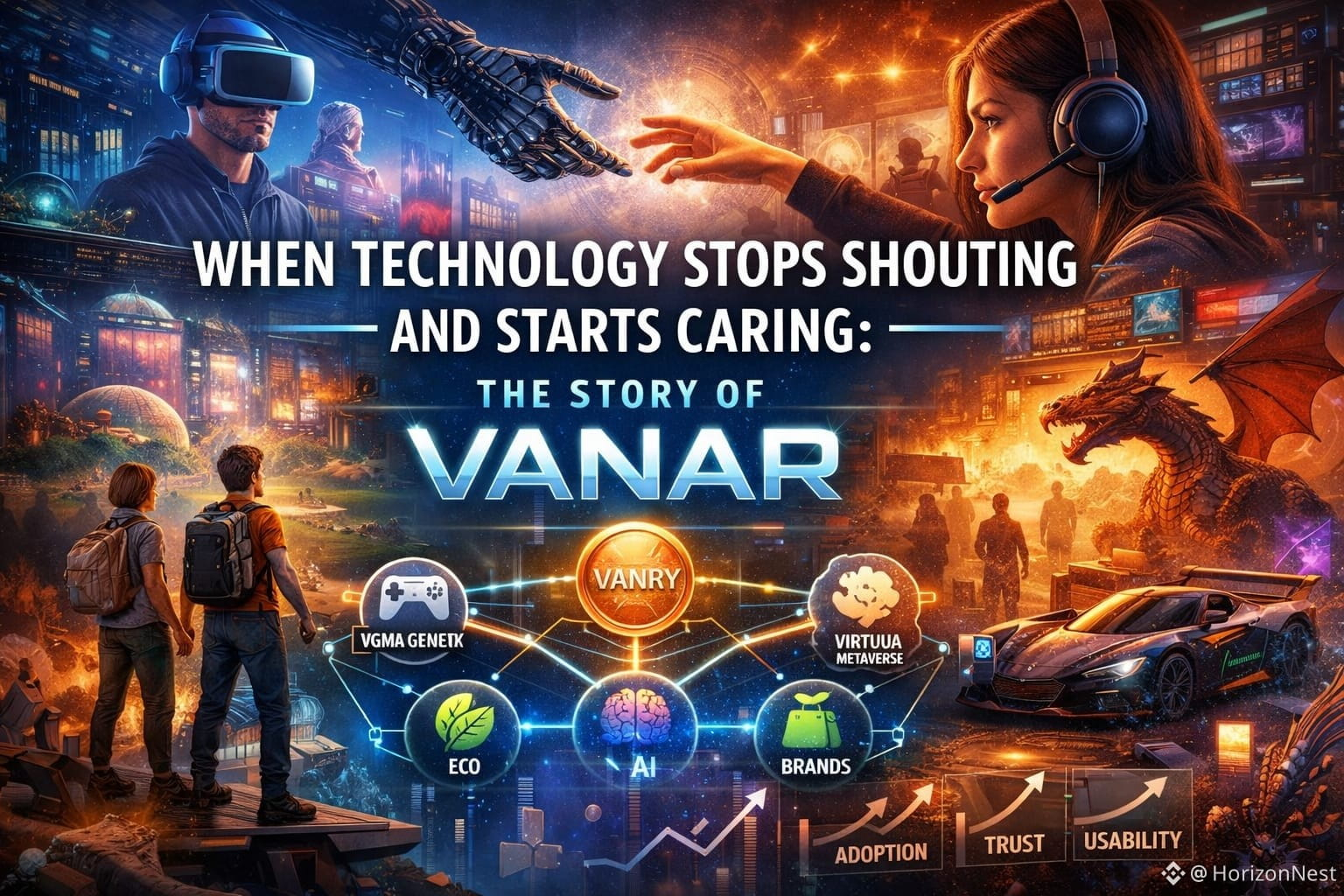
At the center of this ecosystem is the VANRY token, and its role is quietly misunderstood by those who only see numbers on a screen. VANRY is not designed to be loud, it is designed to be steady. It secures the network, enables transactions, and aligns everyone who participates in the system, from builders to validators to everyday users. Its value grows through use, through commitment, through people choosing to stay and contribute rather than pass through chasing momentum. Over time, VANRY becomes less about speculation and more about trust, and that transition is essential if Web3 is ever going to feel safe enough for ordinary life.
The emotional heart of Vanar reveals itself most clearly through the worlds and experiences built on top of it. In Virtua Metaverse, people do not feel like they are interacting with infrastructure, they feel like they are inside a living environment where identity, ownership, and imagination coexist naturally. Exploration feels rewarding rather than transactional. Ownership feels intuitive rather than intimidating. Alongside this, the VGN games network supports developers who want to build games that respect players’ time and emotions, proving that blockchain can enhance play instead of disrupting it. These are not proofs of concept, they are proofs of care, and they exist because Vanar understands that people adopt technology through experience, not explanation.
Growth inside Vanar is measured in a quieter way. It is seen in uptime that never makes headlines because nothing went wrong. It is seen in developers who keep building because the tools do not betray them under pressure. It is seen in users who return not because they were promised something later, but because what they experienced felt good. This kind of growth does not explode, it accumulates, and while it may not dominate attention in the short term, it creates something far more resilient in the long term, which is belief rooted in lived experience.
None of this means the path is easy. Vanar exists inside an industry that moves fast and forgets faster. Competition is relentless, expectations are unforgiving, and regulation remains uncertain. Building for mainstream users leaves very little room for error, because trust once broken is rarely repaired. There is also a constant tension between making things simple and preserving the principles that make decentralization meaningful. Vanar does not escape these realities, but it faces them with patience and intention, understanding that shortcuts often lead to disappointment.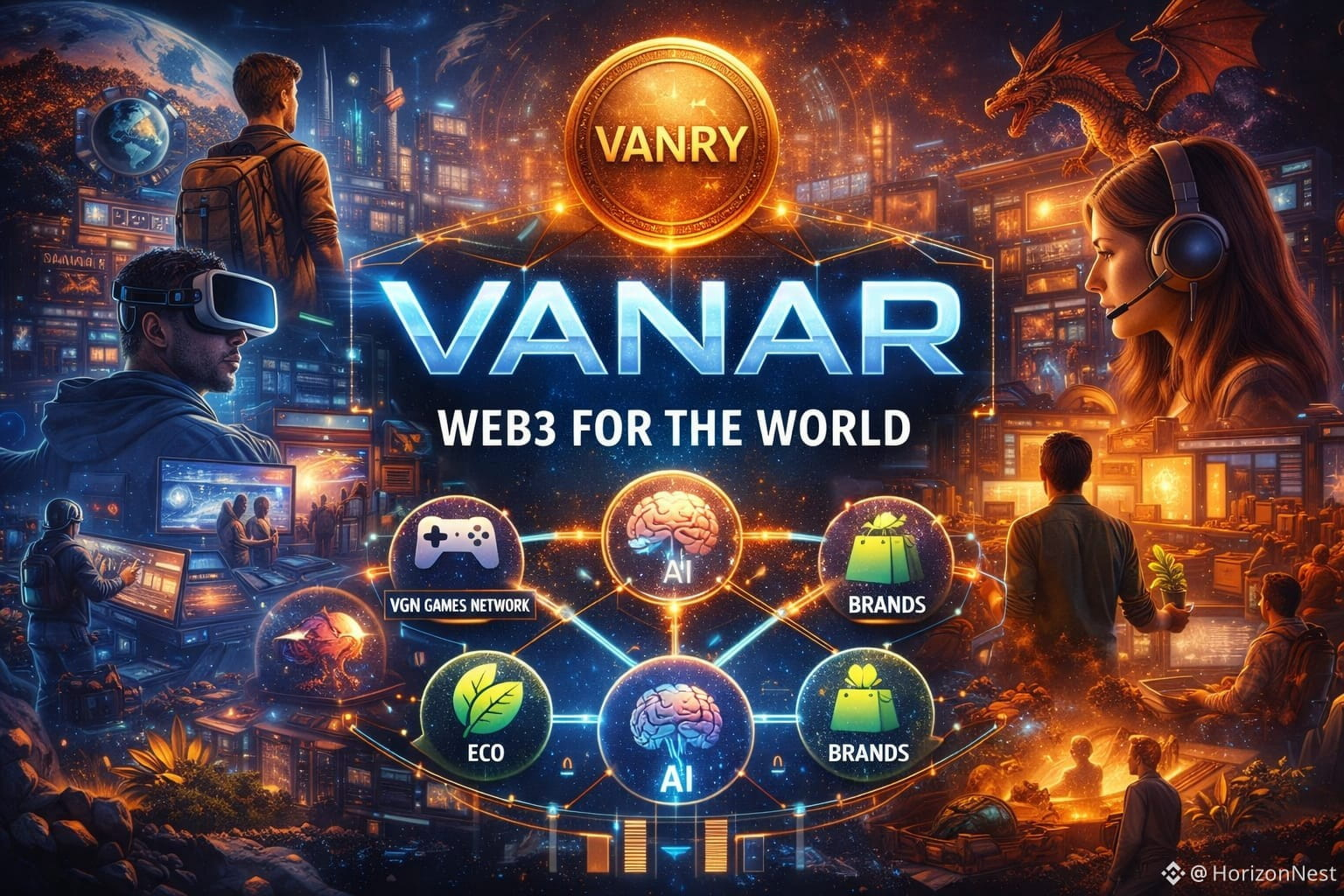
For those who encounter VANRY through platforms like Binance, that first touchpoint is only the beginning. Exchanges can offer access, but they cannot create connection. Connection happens inside worlds, inside games, inside moments where technology supports emotion instead of competing with it. Vanar’s future does not depend on where the token is listed, it depends on whether people feel something worth staying for once they arrive.
The future Vanar gestures toward is not loud or dramatic. It is a future where blockchain stops being a destination and becomes part of the landscape. Games feel richer. Brands feel closer. Digital identity feels more human. People may never say they are using Web3 at all, and that may be the greatest success of all. Because when technology finally disappears into everyday life, it means it has learned how to serve without demanding attention.
Vanar feels like a quiet promise in a noisy industry, a reminder that the most powerful systems are not the ones that shout the loudest, but the ones that listen the deepest. It does not rush, it does not overpromise, and it does not ask people to change who they are. It simply makes room for them, and sometimes that is how real change begins, not with spectacle, but with care that lingers long after the screen goes dark.
