

Crypto loves momentum. Price moves get mistaken for progress, and visibility gets confused with viability. The common assumption is simple: if a chain is loud, liquid, and fully transparent, it must be winning. That assumption breaks the moment you try to run a real business on it.
Full transparency sounds virtuous, but in finance it’s often destructive. A fund manager cannot broadcast positions in real time without being front-run. A treasury desk cannot expose every transfer without inviting adversarial trading. Even basic corporate actions, vesting, internal settlements, strategic reallocations, become liabilities when every detail is public by default. This isn’t a philosophical debate about openness. It’s a structural deadlock between how blockchains work and how financial systems survive.
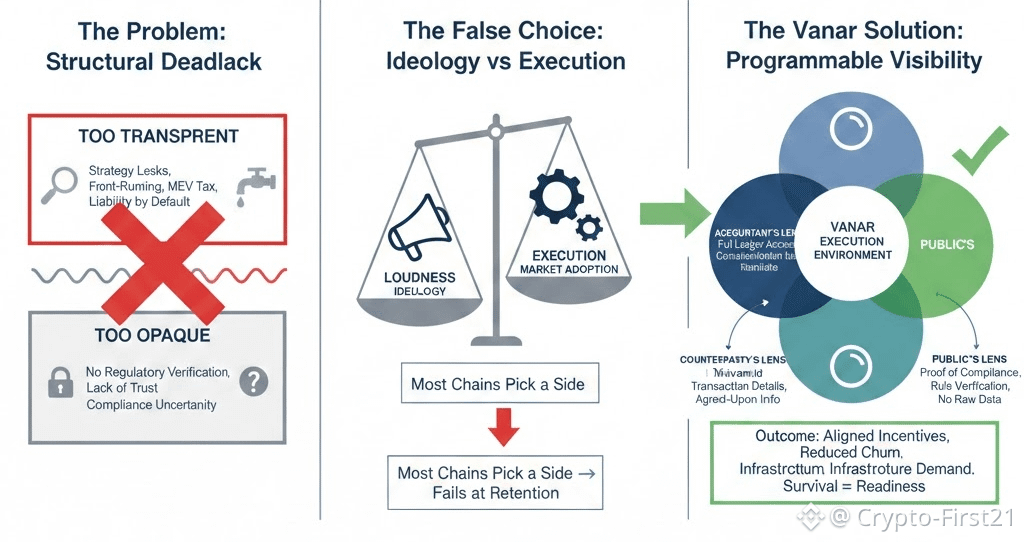
The deadlock looks like this:
Too transparent, and serious actors leak strategy, signal intent, and absorb MEV as a tax.
Too opaque, and regulators, auditors, and partners cannot verify compliance or trust outcomes.
Most chains pick a side and call it ideology. Markets don’t care about ideology, they care about execution.
The practical solution is neither total darkness nor full exposure. It’s programmable visibility, the ability to decide what is visible, to whom, and when, without breaking settlement or trust. Think of it like sharing a document: your accountant sees the full ledger, your counterparty sees only what’s relevant, and the public sees proof that rules were followed, without the raw data. Same system, different lenses.
This is the lens through which Vanar makes sense. Vanar’s bet isn’t on short-term hype or maximal transparency. It’s on readiness, building an execution environment where applications can behave like real businesses without abandoning the benefits of public infrastructure. That means fewer fragile add-ons, fewer external dependencies, and fewer moments where decentralized becomes a synonym for unusable.
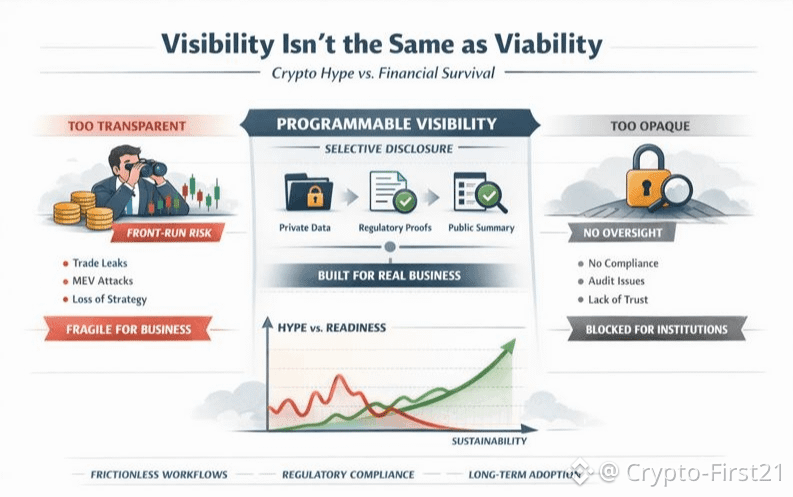
Why does this matter for survival? Because adoption doesn’t fail at the demo stage, it fails at retention. Teams leave when workflows feel unsafe, unreliable, or strategically exposed. They don’t rage quit crypto, they quietly move activity back to spreadsheets, private databases, and closed systems. The chain remains live, but irrelevant.
Vanar’s approach reduces that churn by treating privacy and control as features of execution, not bolt ons. Selective visibility isn’t about hiding wrongdoing; it’s about aligning incentives so participants can act rationally. Regulators still get proofs. Counterparties still get assurances. Validators still verify rules. What disappears is unnecessary leakage.
This distinction is where long term survival is decided. Momentum can buy attention. Readiness earns repetition. Repetition is what turns a token from a theme into infrastructure demand.
For crypto native readers, the implication is straightforward: stop evaluating chains solely by noise, and start evaluating them by friction. How many steps does it take to ship something compliant? How many assumptions must developers make about user behavior? How often does transparency turn into an attack surface?
Vanar may not win every narrative cycle. That’s fine. Infrastructure that lasts rarely does. If programmable visibility becomes the norm rather than the exception, the chains that survive won’t be the loudest, they’ll be the ones that let real workflows run without breaking.
