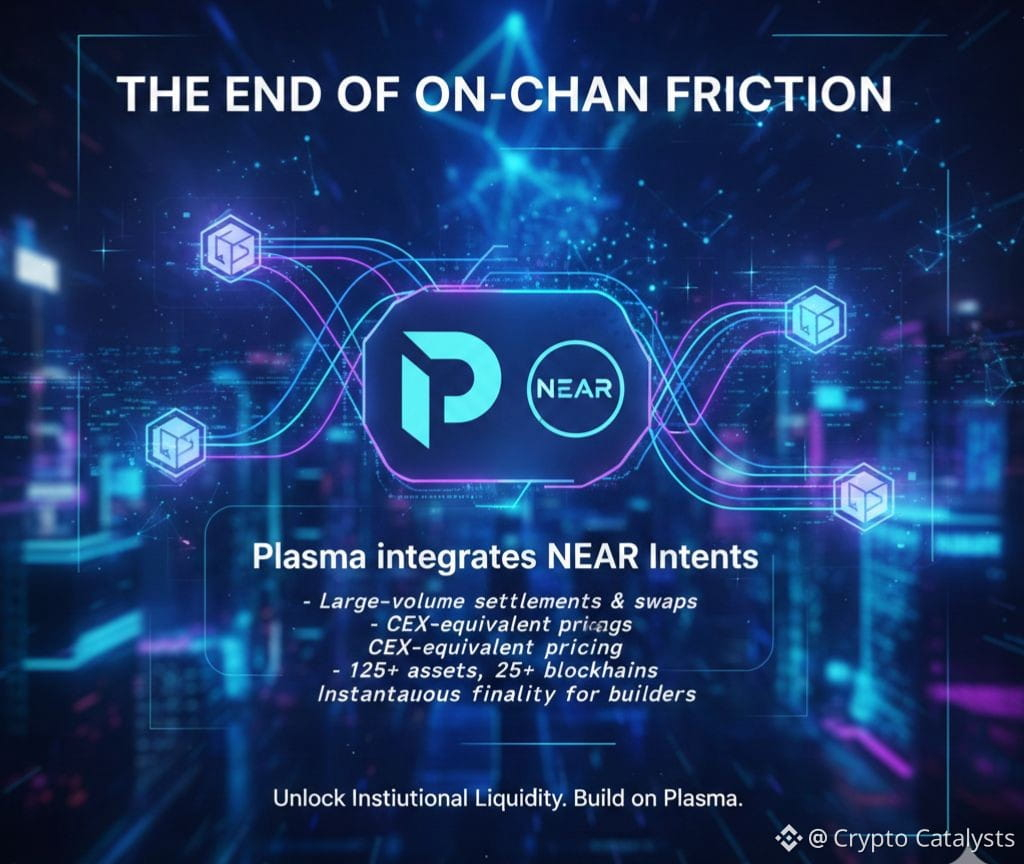
In an era where decentralized finance often feels like a fragmented puzzle of bridges and high-fee hurdles, the recent synergy between Plasma and NEAR Intents marks a genuine turning point for the industry. This isn’t just a simple technical update; it represents a fundamental shift in how we think about moving money across blockchains. By integrating NEAR Intents, Plasma has effectively dissolved the walls that used to separate high-performance on-chain activity from the deep liquidity and tight pricing of centralized exchanges.
For a long time, builders and institutional traders faced a frustrating trade-off. You could have the sovereignty and transparency of on-chain trading, but you had to pay a "friction tax" in the form of slippage and complex bridging steps. Or, you could stick to centralized exchanges for better pricing but lose control of your assets. The integration of NEAR Intents into the Plasma ecosystem effectively kills this dilemma. It allows for the execution of large-volume settlements across more than 125 assets with pricing that actually rivals a CEX.
What makes this work so seamlessly is the concept of "intents." In the old model, if you wanted to swap a massive amount of XPL for an asset on another chain, you had to manually map out every step of the journey, often falling victim to thin liquidity pools along the way. With NEAR Intents, you simply state your end goal—your intent—and a sophisticated network of "solvers" competes to find the most efficient path to fulfill it. This competition drives prices down and ensures that even million-dollar trades can happen without crashing the market or draining the user's wallet through inefficiency.
At the heart of this movement is Plasma XPL itself. Built on a high-performance execution layer and secured by periodic anchoring to the Bitcoin blockchain, Plasma was already designed to be a heavy-hitter for stablecoin throughput. Now, with this new connectivity, assets like USDT0 have become central players in the cross-chain economy. It is a staggering statistic that USDT0 already accounts for nearly 40% of the cross-chain USDT flow via NEAR Intents. This tells us that the market isn't just watching this technology—it’s actively migrating to it.
For the developers and "builders" on the ground, the impact is immediate. Through tools like the 1Click Swap API, they can now build applications where a user in one corner of the crypto world can settle a transaction with a user in another, using different assets on different chains, all in a single click. The complexity is hidden, the pricing is institutional-grade, and the settlement is near-instant.
We are finally entering a phase of "chain abstraction," where the technical plumbing of the blockchain becomes invisible. The integration between Plasma and NEAR Intents is a major leap toward that future. It proves that decentralized infrastructure is no longer just a playground for small retail swaps; it is now a robust, global settlement layer capable of handling the heavy lifting of modern finance. As this ecosystem grows, the distinction between "on-chain" and "high-performance" will likely disappear entirely, leaving us with a financial system that is as open as it is efficient.
We are finally entering a phase of "chain abstraction," where the technical plumbing of the blockchain becomes invisible. The integration between Plasma and NEAR Intents is a major leap toward that future. It proves that decentralized infrastructure is no longer just a playground for small retail swaps; it is now a robust, global settlement layer.