
The deeper I get into Web3, the more I realize that storage is one of the most underrated parts of the entire ecosystem. Everyone talks about tokens, DeFi, trading, and hype cycles, but very few people stop to think about where all the actual data lives. Photos, NFTs, game assets, AI datasets, personal files, creative work — all of this needs a home. That’s exactly why what @Walrus 🦭/acc is building feels so important right now.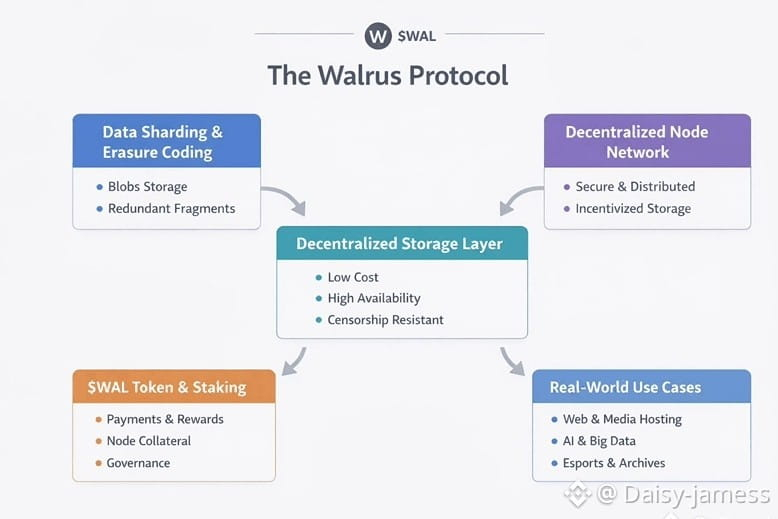
Walrus is focused on decentralized data storage, and honestly, this is the kind of infrastructure play that can quietly become massive. Instead of relying on centralized cloud providers where outages, censorship, or account bans can make your data disappear, Walrus is working toward a system where data remains available, secure, and distributed. That shift from “company-owned servers” to “network-powered storage” is a big deal.
Think about how much of our digital life depends on trust. We trust platforms to keep our files safe. We trust that our content won’t get removed. We trust that services won’t suddenly change rules. But history shows that centralized control always comes with risk. That’s where decentralized storage changes the game. With Walrus, the idea is to create a more resilient layer where data does not rely on a single point of failure.
What makes this even more interesting is how this fits into the broader Web3 vision. Blockchains handle value and transactions, but they are not designed to store large amounts of data efficiently. That’s the gap storage networks fill. Walrus is stepping into this role, supporting applications, creators, developers, and entire ecosystems that need reliable off-chain data solutions that still align with decentralization.
The $WAL token plays an important role in powering this ecosystem. Incentives matter in decentralized networks. Storage providers need to be rewarded, participants need alignment, and the network needs a way to sustain itself. That’s where token utility becomes practical rather than just speculative. As usage grows, the economic layer helps keep the system running smoothly.
Another thing I appreciate about @Walrus is that this is not just a short term narrative. Storage demand is only going to increase. Web3 gaming, NFTs, metaverse projects, AI tools, and social platforms all generate massive amounts of data. The more digital our lives become, the more critical storage infrastructure becomes. In that sense, Walrus is positioned in a sector that naturally grows with the entire industry.
From a builder perspective, having decentralized storage options opens new doors. Developers can design apps that are more censorship resistant and durable. Creators can feel more confident that their work will remain accessible. Communities can build platforms that are not entirely dependent on a single corporation’s policy decisions. That is a powerful shift in how the internet can function.
What excites me most is that infrastructure projects like this often grow steadily rather than explosively. They are not always the loudest, but they are essential. Roads are not flashy, but every city needs them. Storage is similar for Web3. Without it, the ecosystem cannot scale properly.
At the end of the day, Walrus represents something bigger than just another crypto project. It represents the move toward a more open, resilient, and user controlled internet. As more people start understanding why data ownership and availability matter, solutions like @Walrus 🦭/acc will likely get more attention.
I’m personally keeping a close eye on how $WAL and the ecosystem evolve. If Web3 is truly about decentralization, then storage networks like Walrus are not optional — they are foundational. And foundations are what determine how strong everything built on top will be. #Walrus 🦭