

The moment this usually clicks is not when you read a whitepaper. It’s when something quietly breaks. A file fails to load. An audit log is missing. A system that worked in theory suddenly feels fragile in practice. That’s when people realize that in real markets, data availability matters more than slogans about decentralization.
Crypto likes to talk about permissionless settlement, and for good reason. Anyone can validate, anyone can participate, and no single party can halt the system. That property is powerful. But it runs into a hard wall once real businesses enter the picture. Law, risk management, and basic commercial reality all require permissioned behavior at the workflow level. Not because institutions want control for its own sake, but because they are accountable to regulators, clients, and counterparties.
This creates a design problem, not an ideological one:
How do you keep the network open, while allowing applications to enforce rules, privacy, and access when required?
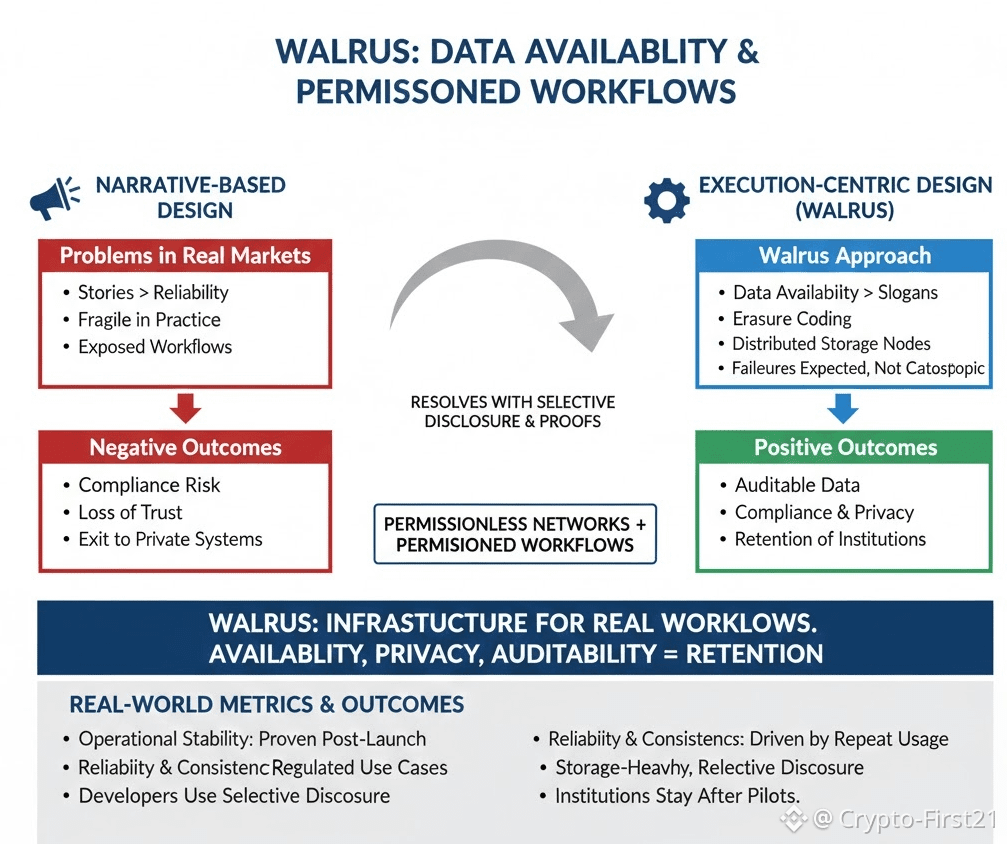
A common mistake is assuming that permissioned must mean private network. That’s not how mature systems work. Markets don’t need closed validator sets; they need controlled execution. Eligibility checks, access rights, audit trails, and selective disclosure all live above the base layer.
This is where the idea of permissioned workflows on a permissionless network becomes essential. The network remains open and neutral, but applications define who can do what, under which conditions, and what information is revealed to whom. Confidential execution and verifiable proofs allow rules to be enforced without broadcasting sensitive data to the entire world.
Think of it like enterprise software, not ideology. Regulators need visibility. Counterparties need assurances. The public does not need to see every intermediate state.
This is where Walrus becomes useful as a concrete example. Walrus is not trying to be loud. It is trying to be dependable.
At its core, Walrus uses erasure coding to split data into many pieces and distribute them across independent storage nodes. Only a subset of those pieces is needed to reconstruct the original data. This means availability does not depend on any single operator staying online. Failures are expected, not catastrophic.
For regulated financial workflows, this matters more than throughput headlines. Data that cannot be reliably retrieved cannot be audited. Data that disappears breaks compliance. Walrus treats availability as a guarantee, not a best-effort promise.
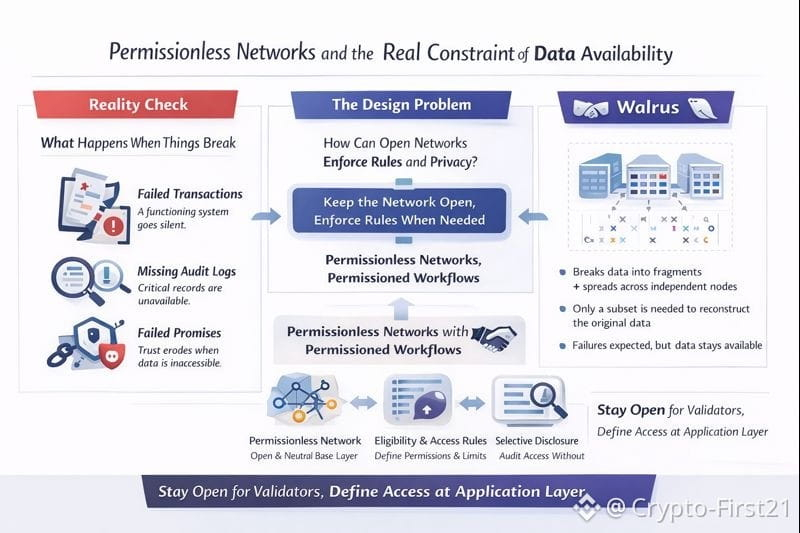
Built in the Sui ecosystem, Walrus aligns this storage model with programmable logic that can support confidentiality and access control. The result is infrastructure that can remain open at the network level while supporting restricted behavior at the application level.
Why Institutions Leave and What Keeps Them
Institutions don’t leave blockchains because they hate transparency. They leave because workflows feel exposed. Broadcasting positions, counterparties, or operational data in real time introduces risk that no compliance team will sign off on. When that happens, activity quietly moves back to private databases and spreadsheets. The chain becomes a demo environment, not a system of record.
Retention comes from the opposite dynamic. Privacy where it’s required. Auditability where it’s mandatory. Availability everywhere. When systems offer selective disclosure backed by cryptographic proof, institutions can stay onchain without feeling naked.
Midway through this discussion, market data starts to matter,not as hype, but as context. Stablecoins now represent hundreds of billions of dollars in circulation. Tokenized assets continue to grow steadily. These are not speculative experiments; they are operational systems searching for infrastructure that won’t break under scrutiny.
If you care about adoption rather than narratives, the signals are unglamorous:
Are storage heavy, regulated use cases actually using the system repeatedly?
Does data remain available during stress, outages, or partial failures?
Are developers building workflows that rely on selective disclosure instead of full transparency?
Do institutions stay after pilots, or quietly stop transacting?
Invalidation is just as clear. If availability guarantees fail, if confidentiality mechanisms are unreliable, or if workflows leak sensitive data, trust erodes fast. No amount of branding fixes that.
Walrus is best understood not as a story about decentralization, but as an answer to a boring, critical question: Can open networks support real workflows without forcing users to choose between exposure and exit? If the answer continues to be yes, retention follows. And in infrastructure, retention is what compounds.

