


Most decentralized systems are designed around a comfortable lie. The lie is that networks behave predictably.
Messages arrive on time. Nodes stay online. Delays are rare exceptions.
In real networks, I’m watching this assumption fall apart immediately.
Reality Doesn’t Care About Your Assumptions
Latency jumps all over the place. Nodes disconnect without warning. Messages show up late, in the wrong order, or never at all. Network partitions happen constantly. Churn is the baseline, not the exception.
These aren’t edge cases. This is just what decentralized infrastructure actually looks like when it’s running.
Most storage protocols see this uncertainty as a bug to fix. I’m watching Walrus do the complete opposite.
They’re Not Fighting Chaos
Instead of fighting uncertainty, Walrus embraces it. Instead of trying to eliminate unpredictability, it builds security on top of it.
What other systems treat as a fatal weakness, Walrus turns into a structural advantage.
I’m going to walk through how Walrus transforms network unpredictability from a liability into a core security feature. And why I think this represents a fundamental shift in how we should be thinking about decentralized storage.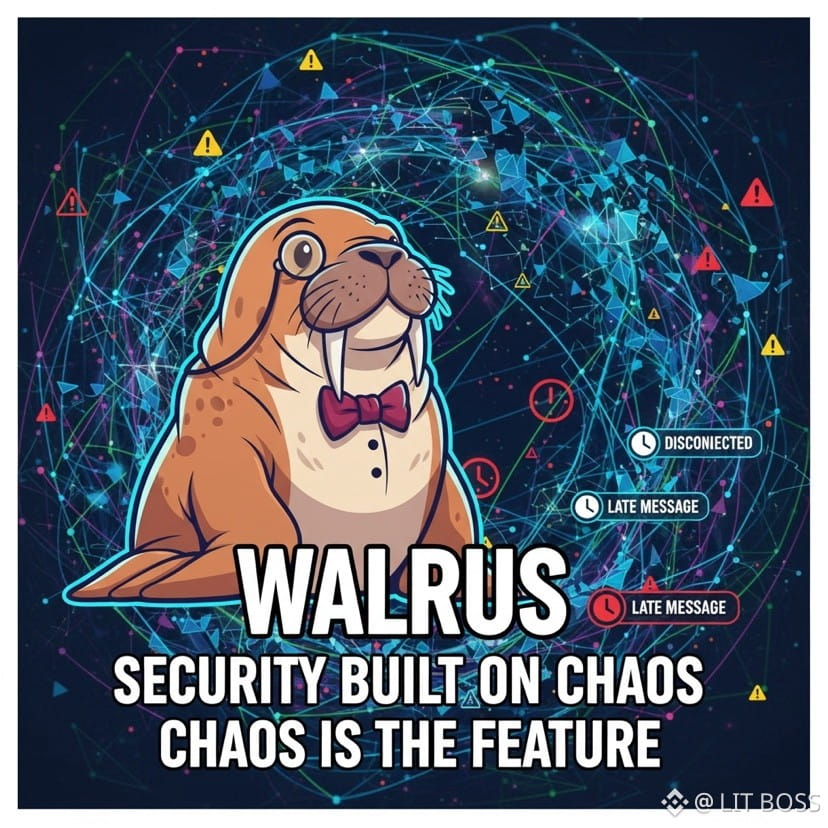
Why Everyone Fears Asynchrony
In traditional distributed systems theory, asynchrony is treated like poison. When there’s no reliable global clock and no guaranteed message delivery time, it becomes really hard to tell the difference between a slow node, a dead node, and a malicious node.
Most protocols respond to this ambiguity by imposing timeouts, synchronized rounds, and strict response windows. If a node doesn’t respond on time, it gets flagged as faulty.
This works okay in controlled environments. It breaks spectacularly in open permissionless networks.
I’m seeing honest nodes get penalized just because of latency. Attackers exploit timing assumptions. Security gets tangled up with network performance, which is an incredibly fragile dependency.
Walrus throws out this entire approach.
Stop Trusting Time
The most important shift in Walrus is simple. Time is not a reliable security signal.
If your security depends on synchronized responses, then your security collapses under real world conditions. Walrus bases security on structure, redundancy, and having enough evidence. Not on punctuality.
In Walrus, I’m seeing late responses aren’t treated as suspicious by default. Missing responses get tolerated up to a threshold. Correctness gets determined by cryptographic evidence, not speed.
This one change reshapes how uncertainty gets handled.
From Chaos to Guarantees
Network uncertainty has three main dimensions I’m tracking. Latency variability, node churn, and unreliable communication.
Most systems try to smooth over these issues. Walrus designs around them.
Instead of requiring all nodes to respond, responses to arrive in a fixed window, and global coordination, Walrus asks a simpler question.
Is there enough independent evidence that the data exists in the network?
Once that question gets answered, the exact timing of responses stops mattering.
Asynchronous Challenges Change the Game
At the heart of Walrus’s approach is the asynchronous challenge protocol.
Traditional challenge systems work in rounds. A challenge gets issued, nodes respond within a deadline, results get evaluated synchronously. This design assumes stable connectivity.
I’m watching Walrus remove this assumption completely.
Challenges in Walrus don’t require synchronized participation. They don’t depend on strict deadlines. They don’t punish slow but honest nodes.
Nodes respond independently using whatever data they have locally stored. Proofs get aggregated over time. As long as enough valid proofs eventually show up, the system is secure.
Network delays don’t weaken verification. They just get absorbed by the protocol.
Uncertainty Actually Improves Security
This design creates a counterintuitive effect I find fascinating. Greater network uncertainty can actually improve security.
Here’s why I think this works.
Attackers rely on predictability. They exploit known timing windows, synchronized rounds, and coordination assumptions. When verification depends on exact timing, attackers can strategically wake up and look responsive only when it matters.
I’m seeing Walrus remove these attack surfaces entirely.
Because challenges are asynchronous, attackers can’t just wake up at the right moment. There’s no single critical instant to exploit. There’s no advantage to coordinated behavior.
Security becomes probabilistic and structural instead of time based.
Structure Beats Speed
Walrus encodes data to ensure availability through redundancy rather than responsiveness.
Instead of depending on one node responding quickly, Walrus relies on many nodes storing interdependent fragments.
The system doesn’t care which specific nodes respond. Only that enough correct fragments exist somewhere.
This is a massive shift in my view. Individual failures become irrelevant. Delays don’t undermine correctness. Adversaries have to compromise the structure itself, not just exploit timing.
Uncertainty becomes background noise instead of a threat.
Security Stops Depending on Performance
One of the most dangerous design choices in decentralized systems is tying security to performance.
If security depends on low latency, then congestion becomes an attack vector. DDoS attacks become security attacks. Honest nodes suffer during peak load.
I’m watching Walrus sidestep this trap completely.
Because verification is asynchronous, high latency doesn’t reduce security. Congestion affects speed but not correctness. Performance problems don’t cause false penalties.
This separation makes the system way more resilient when things get messy.
Churn Becomes Normal
Node churn, nodes constantly joining and leaving, is just how decentralized networks work. Many protocols struggle to keep security guarantees when participation fluctuates.
I’m seeing Walrus treat churn as completely expected behavior.
Because storage responsibility is distributed, proofs don’t depend on fixed participants, and challenges don’t require everyone to show up, nodes can come and go without breaking anything.
Actually, churn can improve decentralization by preventing long term data concentration.
They Add Chaos on Purpose
Walrus goes even further by actively introducing controlled unpredictability through dynamic shard migration.
As stake levels change, I’m watching shards move between nodes. Storage responsibility shifts around. Long term data control gets disrupted constantly.
This ongoing movement makes it really hard for any participant to build up lasting influence over specific data.
Walrus doesn’t just tolerate uncertainty. It deliberately creates it to strengthen security.
Uncertainty Fights Centralization
Centralization feeds on stability. If data placement is static, powerful actors can optimize around it. If responsibilities are predictable, influence concentrates over time.
I’m seeing Walrus break this pattern.
Because network conditions fluctuate, storage assignments change, and verification is asynchronous, there’s no stable target to capture.
Uncertainty prevents the system from hardening into predictable patterns. It keeps power fluid and distributed.
Incentives Work Without Clocks
Even the economic incentives and penalties in Walrus are designed to work under uncertainty.
Nodes don’t get punished for being slow. They get punished for being wrong.
This distinction matters a lot to me.
Penalties are based on failure to provide valid proofs, structural absence of data, and cryptographic evidence. Not on missed deadlines, temporary disconnections, or network hiccups.
Economic security stays fair even when networks behave badly.
This Matters More as Things Scale
As decentralized storage grows, I’m watching data sizes increase, global participation expand, and network diversity explode.
Under these conditions, predictability vanishes completely.
Protocols that depend on synchrony degrade. Protocols designed for uncertainty thrive.
Walrus is built for that future.
A Different Philosophy
At a deeper level, I think Walrus represents a philosophical shift.
Instead of asking how do we control the network, Walrus asks how do we stay secure even when we lose control.
This mindset matches reality. Open systems can’t be controlled. They have to be resilient.
Fragile Versus Robust
Traditional systems offer strong guarantees under narrow perfect conditions. Walrus offers slightly weaker guarantees when everything’s ideal, but much stronger guarantees under real messy conditions.
This tradeoff strikes me as deliberate and smart.
Security that fails under stress isn’t really security at all.
Building for Reality
I’m watching Walrus turn network uncertainty into a security feature by refusing to fight the fundamental nature of decentralized systems.
By eliminating timing assumptions, embracing asynchrony, building on structural redundancy, and decoupling security from performance, Walrus creates a storage protocol that gets stronger as conditions get more chaotic.
In a decentralized world, certainty is fragile and temporary.
Walrus proves that uncertainty, when you design for it correctly, becomes strength.