
Crypto has never suffered from a lack of stories. Every cycle produces new slogans, new buzzwords, and new promises about how the next chain, the next token, or the next “revolutionary” design will change everything. Yet when the noise fades and real usage is examined, a simple truth keeps resurfacing: financial systems do not succeed because of narratives, they succeed because of infrastructure. Plasma ($XPL) sits precisely at this intersection, not as a loud storyteller, but as a system deliberately engineered for one job that crypto still struggles to do well—make stablecoins work like real money at global scale.
Stablecoins are no longer an experiment. They are already one of the most widely used products in crypto, moving hundreds of billions of dollars in value every year. Traders use them as settlement assets, individuals use them for remittances, and businesses increasingly rely on them for cross-border payments. Despite this adoption, the infrastructure supporting stablecoins remains fragmented, inefficient, and often hostile to everyday users. Plasma’s core thesis is that stablecoins do not need more marketing, they need rails that are purpose-built, reliable, and invisible to the end user.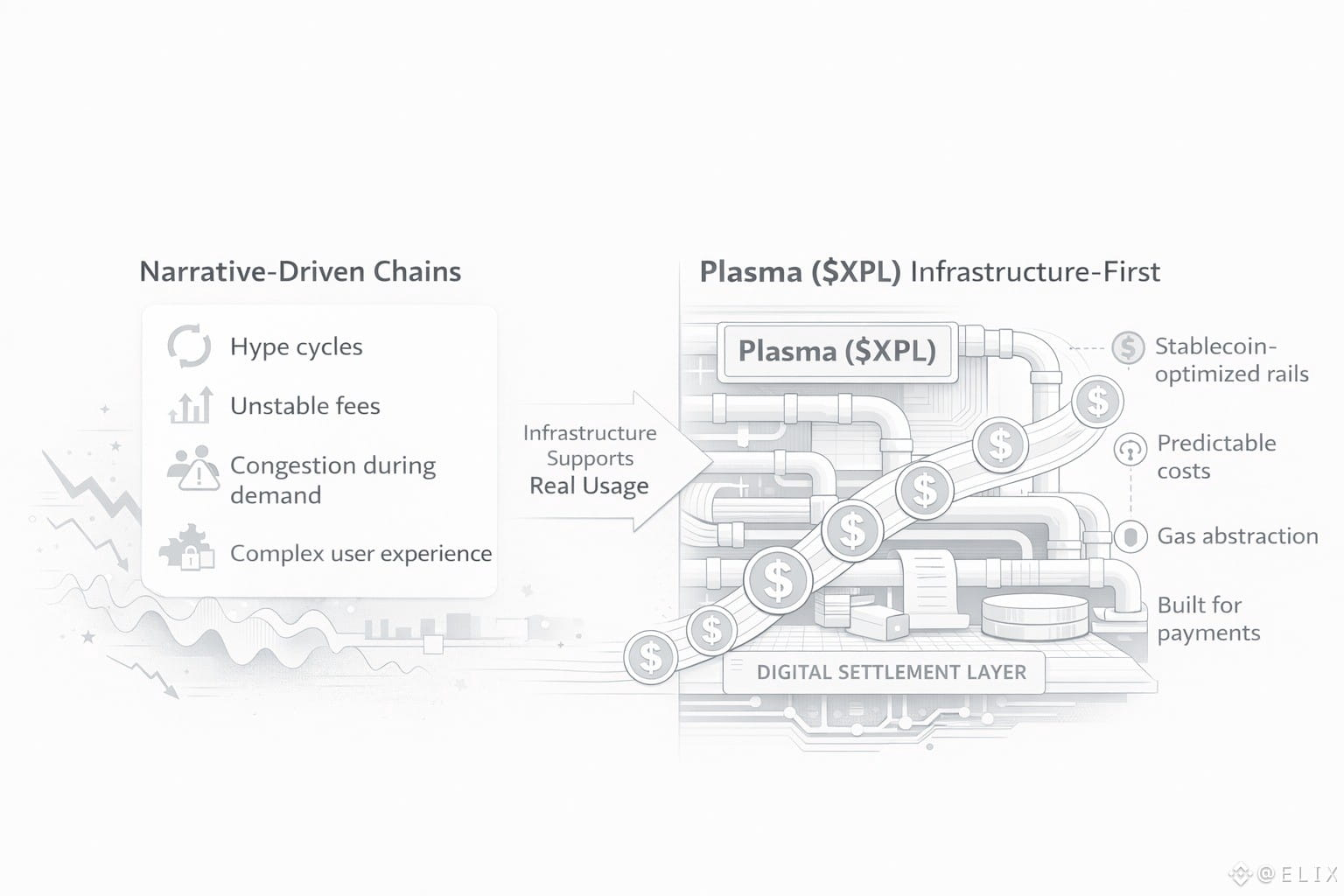
Most blockchains treat stablecoins as just another token. They live on general-purpose networks designed for everything from NFTs to gaming to governance experiments. This flexibility is powerful, but it comes at a cost. Fees fluctuate unpredictably, congestion spikes during market volatility, and users are forced to understand gas tokens, wallets, bridges, and network choices. For speculative activity, this complexity may be acceptable. For payments and savings, it is a structural flaw. Plasma starts from the opposite direction: if stablecoins are meant to behave like digital cash, then the network itself must be optimized around their movement.
At the heart of Plasma is the idea that fees are not revenue, they are friction. Traditional blockchains often celebrate high fee revenue as a sign of demand, but from a payments perspective, this is equivalent to celebrating long queues at a bank. Plasma reframes transaction costs as “user experience debt.” Every unexpected fee, every failed transaction, and every moment of uncertainty pushes stablecoins further away from mass adoption. By subsidizing transfers through protocol-level paymasters and abstracting gas away from the user, Plasma makes stablecoin transfers feel closer to Web2 payments than to traditional crypto transactions.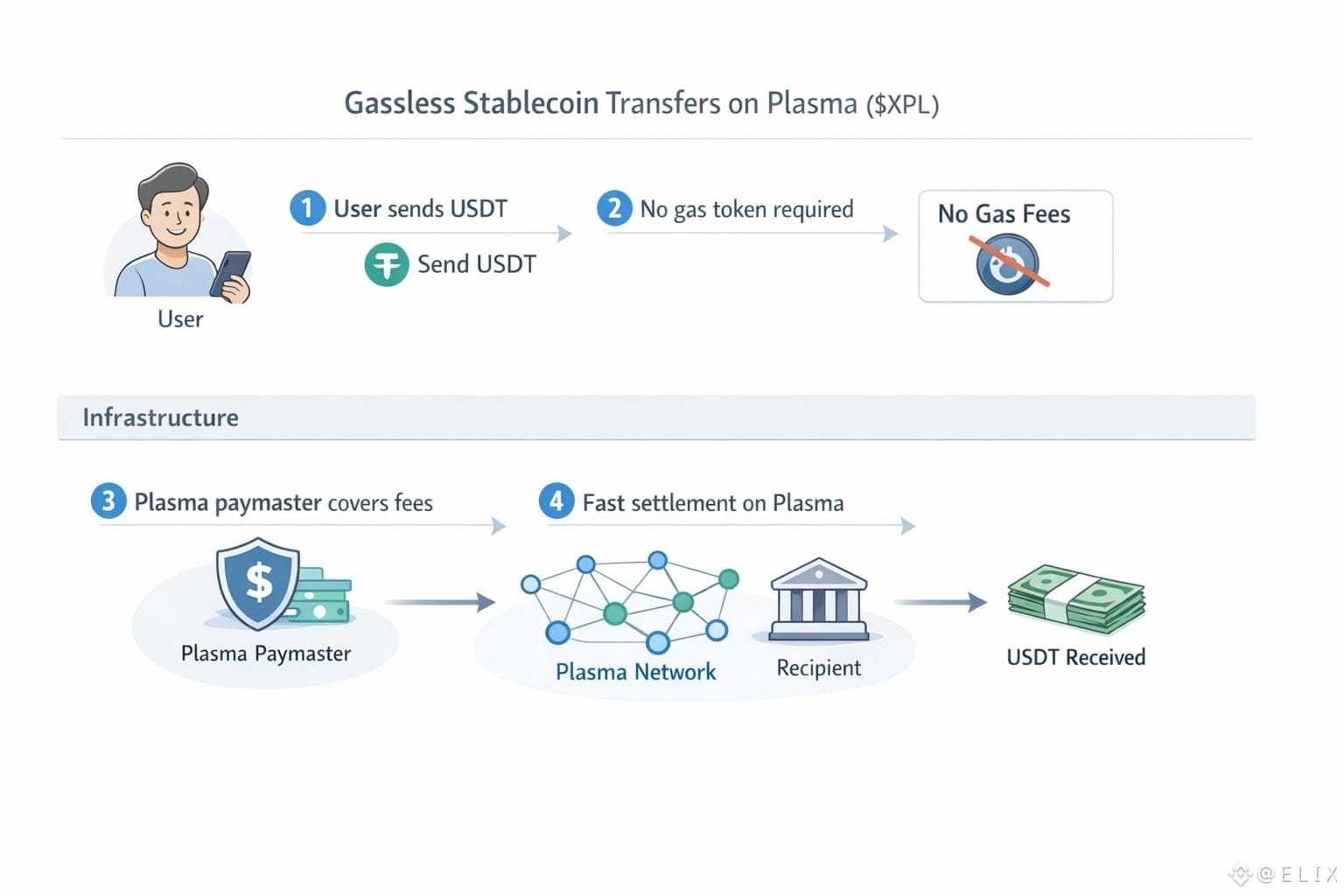
This design choice is not cosmetic; it is foundational. A payment network cannot depend on users holding a volatile gas token just to move a stable asset. Plasma removes this dependency entirely. Users interact with stablecoins directly, while the complexity of transaction execution is handled at the infrastructure layer. The result is a system where sending USDT or other stable assets does not require technical knowledge, timing the market for low fees, or worrying about failed transactions due to congestion.
Scalability is another area where Plasma’s infrastructure-first mindset becomes clear. Stablecoin usage is bursty by nature. During periods of market stress, geopolitical events, or regional currency instability, transaction volumes can spike dramatically. General-purpose chains often struggle under these conditions, leading to higher fees and slower confirmations precisely when reliability matters most. Plasma is engineered to handle high-throughput stablecoin flows with predictable performance, ensuring that usage spikes do not translate into degraded user experience.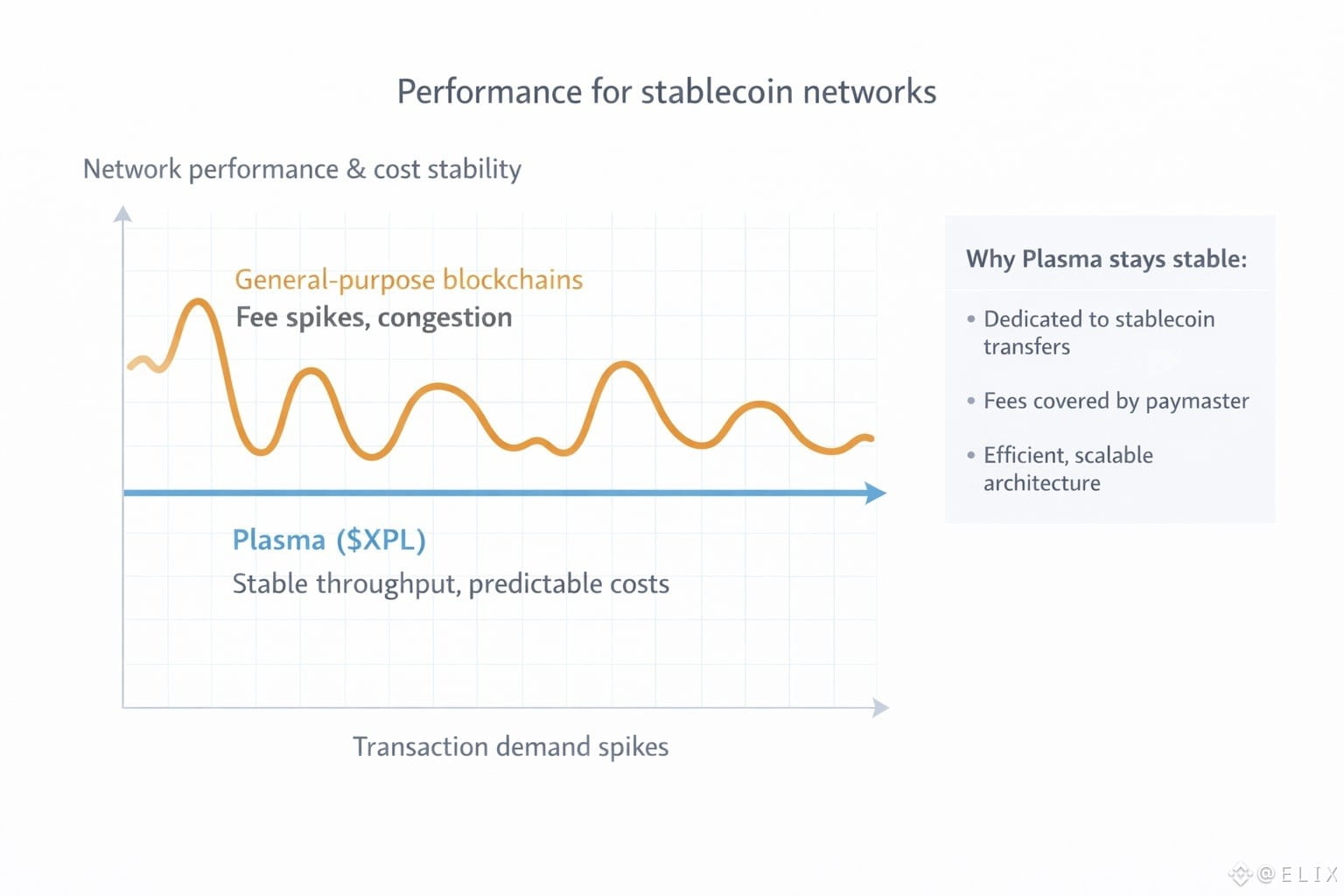
Equally important is compliance, a topic that many crypto projects either avoid or address superficially. Stablecoins exist at the boundary between crypto and traditional finance, and this boundary is regulated by necessity. Plasma acknowledges this reality instead of fighting it. Its architecture is designed to support compliant privacy, where transactions can remain confidential while still enabling necessary AML and KYT checks through integrated partners. This balance is crucial for institutional adoption, where privacy, auditability, and regulatory alignment are non-negotiable requirements.
Plasma’s approach to compliance does not undermine decentralization; it reframes it. Rather than treating regulation as an external enemy, Plasma treats it as a design constraint, similar to scalability or security. By embedding compliance capabilities into the infrastructure layer, Plasma allows applications built on top to operate in regulated environments without forcing developers to reinvent the wheel. This makes the network particularly attractive for fintechs, payment providers, and on-chain financial services that want the efficiency of stablecoins without regulatory ambiguity.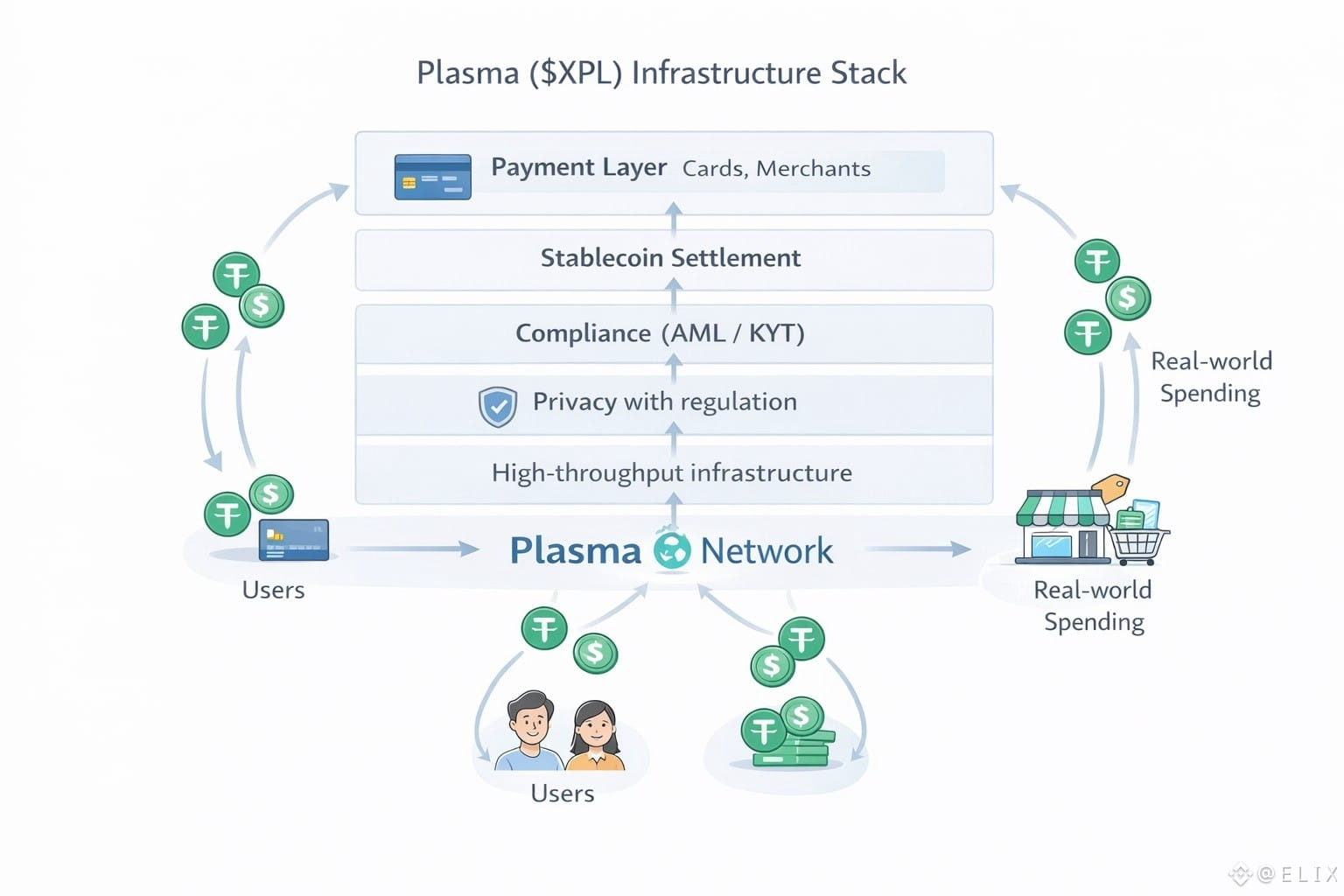
The $XPL token plays a subtle but important role in this ecosystem. Instead of being positioned as a speculative centerpiece, it functions as a coordination and security asset within the network. Its value is tied less to hype cycles and more to the actual usage of the infrastructure it supports. This alignment matters. When a network’s economic incentives are directly connected to real transaction flow rather than narrative-driven demand, its long-term sustainability improves significantly.
Another distinguishing feature of Plasma is its focus on real-world spending, not just on-chain transfers. Through partnerships and card integrations, stablecoins held on Plasma can be used directly for merchant purchases, with conversions happening seamlessly in the background. This closes one of the longest-standing gaps in crypto: the leap from holding digital dollars to actually spending them in everyday life. By reducing this gap, Plasma turns stablecoins from a parking asset into a functional medium of exchange.
This emphasis on usability reveals a broader philosophical difference. Many crypto projects aim to build platforms and hope that compelling use cases emerge later. Plasma inverts this process. It starts with a clear use case—stablecoin payments at scale—and then designs every layer of the system around that goal. Features that do not serve this purpose are deprioritized, while features that improve reliability, cost predictability, and user experience are elevated. The result is a network that may look less flashy on the surface, but far more robust underneath.
In a market driven by constant storytelling, Plasma’s relative quietness can be misleading. It does not promise to reinvent finance overnight, nor does it rely on viral narratives to justify its existence. Instead, it focuses on the unglamorous work of building financial plumbing that actually works. History suggests that this is where real value accumulates. The most important financial infrastructures in the world—payment rails, settlement systems, clearing networks—are rarely discussed in headlines, yet they underpin entire economies.
Plasma ($XPL) represents a bet that the future of stablecoins will be decided not by who tells the best story, but by who builds the most reliable infrastructure. As stablecoins continue to move from speculative tools to everyday financial instruments, this distinction will only become more important. In that future, narratives will fade quickly, but infrastructure will endure.

