Founded in 2018, does not present itself as a rebellion against finance, nor as a cryptographic experiment chasing novelty. Instead, it reflects a more deliberate ambition: adapting distributed systems to the permanent constraints of regulated financial markets. This distinction is foundational. Many blockchain platforms implicitly treat regulation, auditability, and supervision as temporary frictions—problems to route around rather than conditions to design for. Dusk appears to begin from the opposite assumption: that any infrastructure handling real capital, tokenized securities, or institutional workflows will eventually face scrutiny—and must survive it.
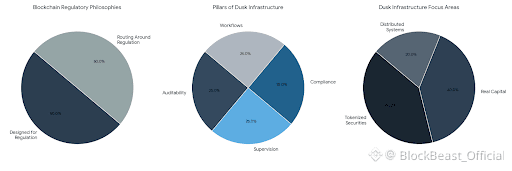
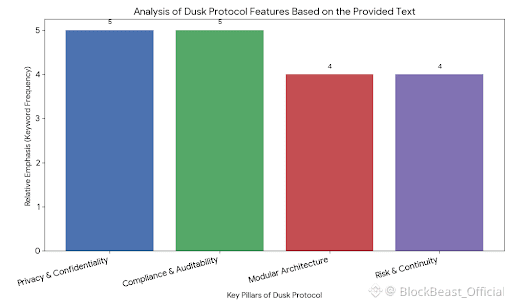
That assumption is most visible in Dusk’s approach to privacy. Rather than framing privacy as total opacity, the protocol treats it as conditional and contextual. This mirrors how privacy functions in real financial systems. Banks do not provide anonymity; they provide confidentiality with obligations. Transactions are shielded from public view but can be disclosed to regulators, auditors, or counterparties when required. Dusk’s emphasis on selective disclosure and programmable auditability reflects this reality. Privacy is not positioned as defiance of oversight, but as a controlled mechanism that coexists with compliance. This framing acknowledges an uncomfortable truth: financial infrastructure that depends on permanent invisibility is unlikely to endure.
Architecturally, the system’s modular design reinforces this conservative posture. Separating consensus, execution, and application layers is less about elegance than containment. Traditional financial infrastructure has long favored decoupling to reduce systemic risk—payment rails, messaging networks, and settlement systems evolve independently to limit failure propagation. Dusk’s structure follows similar logic, enabling upgrades or regulatory adaptations without destabilizing the entire system. For environments that value continuity over experimentation, this kind of compartmentalization is not optional—it is expected.
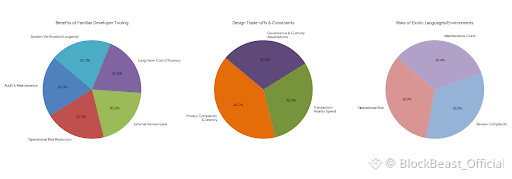
The platform’s preference for established developer tooling and familiar programming paradigms further signals restraint. In regulated settings, software is not only built—it is audited, maintained, and inherited by teams that did not write the original code. Exotic languages and bespoke environments increase operational risk, complicate external reviews, and inflate long-term maintenance costs. Dusk’s apparent prioritization of familiarity over novelty reduces these risks. Innovation may progress more slowly at the margins, but systems become easier to understand, verify, and operate years after deployment.
These design choices carry trade-offs. Privacy-preserving computation introduces complexity and can affect latency. Finality may be slower than on chains optimized solely for throughput. Cross-chain interactions and asset transfers rely on governance and custody assumptions that cannot be eliminated, only managed. From an institutional perspective, these are not deal-breakers—they are variables to be measured and priced. The real danger lies not in acknowledging such constraints, but in ignoring them.
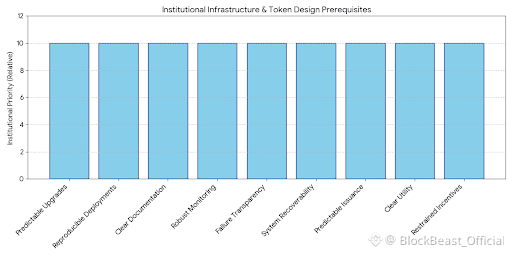
Operational maturity ultimately determines whether infrastructure can move beyond pilots. Predictable upgrade paths, reproducible deployments, clear documentation, and robust monitoring are not secondary concerns in regulated environments—they are prerequisites. Risk committees and compliance teams ask unglamorous questions: How disruptive are upgrades? How transparent are failure modes? How recoverable is the system under stress? Dusk’s long-term relevance will depend less on feature announcements than on its ability to answer these questions consistently.
Even the token design reflects this subdued philosophy. From an institutional viewpoint, liquidity is not about speculation—it is about orderly entry and exit. Predictable issuance, clear utility, and restrained incentive structures reduce misalignment between network operators and application builders. Tokens that function as infrastructure components rather than narrative-driven assets are more compatible with balance-sheet constraints and risk management frameworks.
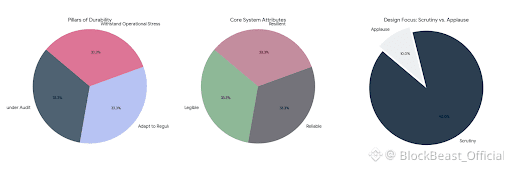
Taken together, Dusk reads as infrastructure designed with the expectation of scrutiny, not applause. Its philosophy suggests that success in regulated finance is measured not by visibility or velocity, but by durability—by the ability to function under audit, adapt to regulatory change, and withstand operational stress. Systems built for this world do not need to be loud. They need to be legible, reliable, and resilient. If Dusk succeeds, it will likely do so quietly—by working as intended, under conditions that others prefer to postpone or ignore.