
“Done” usually means the workflow can advance.
Execution is permitted. The state commits. Downstream systems prepare the next step before anyone reconciles what just became binding. In most stacks, visibility is a present-tense concern. If nothing is being asked, nothing is owed.
That assumption doesn’t survive contact with Dusk Foundation.
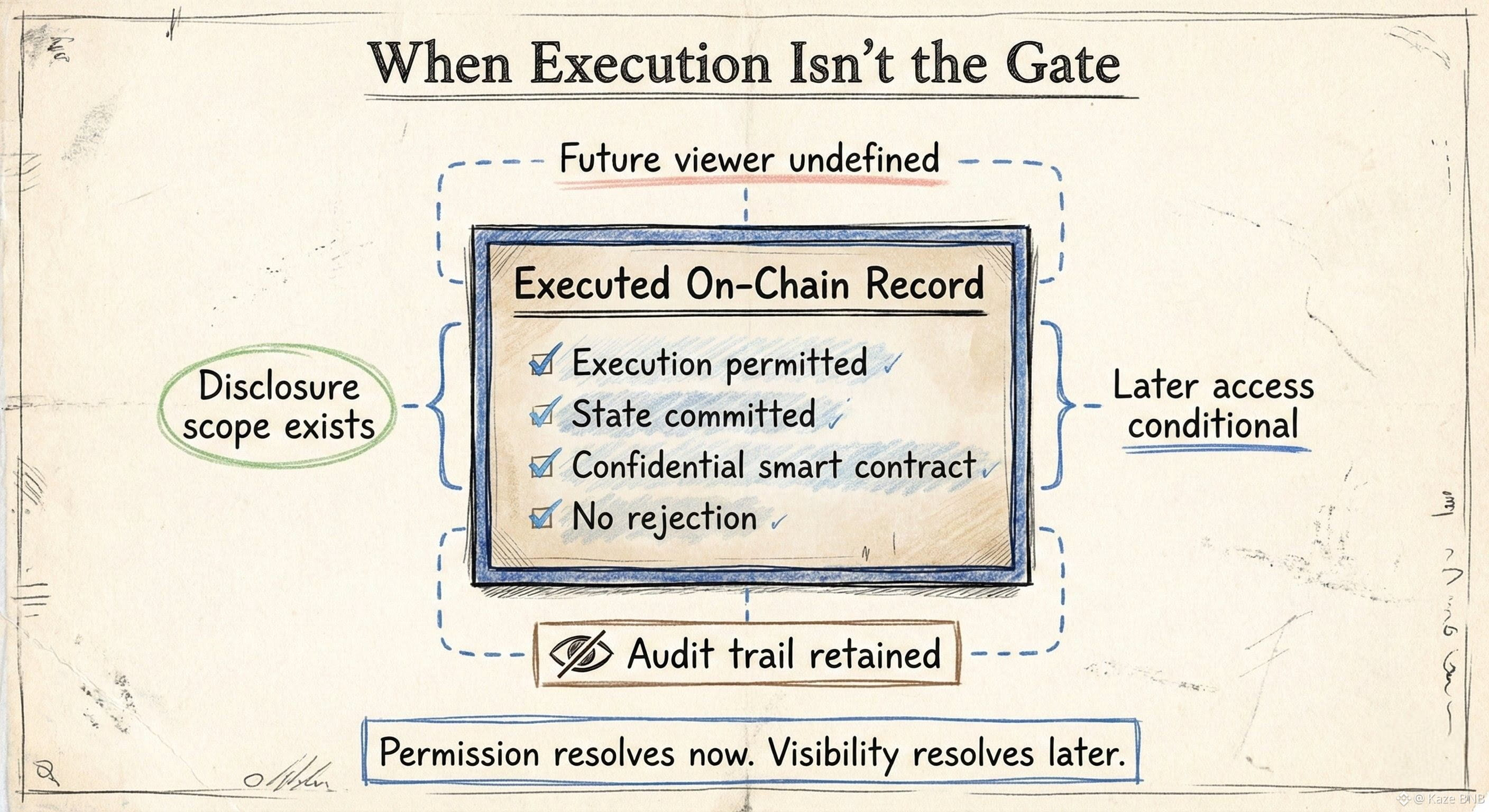
It shows up at a routine handoff inside Institutional finance on-chain, where a Privacy-focused blockchain is expected to behave like Bank-grade financial infrastructure instead of a public default. Permission exists and execution is available. Nothing blocks. Nothing rejects. The record looks complete enough to move forward. And yet the flow slows—before any request appears, before any inquiry is scheduled, inside Dusk Foundation.
Nothing failed.
Downstream is ready. Upstream dependencies are clear. The stall isn’t caused by denial or escalation. It’s caused by the absence of certainty about future visibility, who will be able to see this later, and under what scope, inside a Regulated finance blockchain posture where Regulatory compliance is assumed, not negotiated, as it is on Dusk Foundation.
On Dusk Foundation, execution and memory run in parallel. The present moves cleanly while records persist under Data privacy with audit trails, carried through a Modular architecture that keeps later reconstruction in scope even when nothing is invoked. One rhythm answers “can this run?” The other waits with a quieter condition about later access. Neither interrupts the other. Their coexistence does the work.
That pressure reshapes the workflow.
A sign-off is delayed without objection. A handoff is reread instead of forwarded. Someone asks about later access rather than current permission. The question isn’t emotional or urgent; it’s procedural, the kind that only shows up once Permissioned flows are treated as normal inside Dusk Foundation.
“We can mark it complete.”
The sentence functions like a routing instruction, but it doesn’t satisfy the dependency that matters. Confidential smart contracts keep confidentiality intact, but the workflow still assumes later review. The moment stays calm, yet closure is withheld because the shape of the record matters more than the speed of the step on Dusk Foundation.
No authority appears. No boundary is declared. Accountability aligns without announcement. Auditability by design doesn’t interrupt the run; it sits alongside it, shaping how teams treat closure, especially when the record is expected to survive later scrutiny under a Phoenix transaction model that doesn’t rely on visibility as proof, the posture Dusk Foundation keeps.
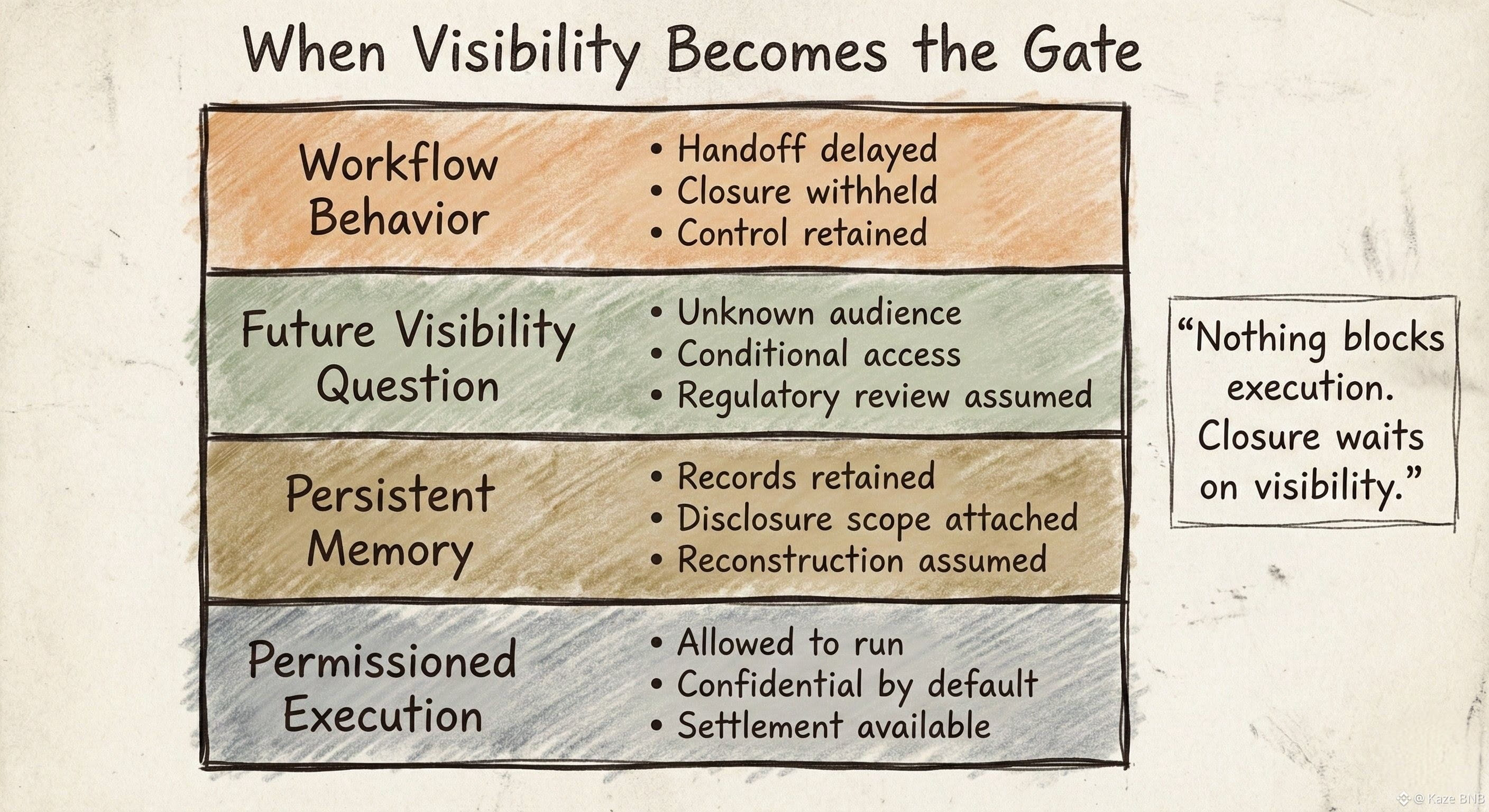
Under load, the pattern compounds. More decisions hinge on the same question about future viewers. Different teams assume different later audiences. Institutional execution remains available. Regulated settlement holds its posture. Waiting accumulates, not as blockage, but as control, because once you’re planning for €300M+ tokenized securities on-chain, “who can see later” stops being a detail and becomes the gating question.
The governing question shifts.
Not “can we execute?”
Not “is this allowed?”
Instead:
“Who will be able to see this later and under what conditions?”
No answer arrives.
The system doesn’t request disclosure, clarify access, or accelerate review. It keeps memory intact. It keeps visibility conditional. It keeps operating the same way.
And the workflow learns to slow before anyone asks, because on Dusk Foundation, future visibility is already present.