
Failure usually arrives late.
Not as an error, not as a warning, but as a realization that something everyone assumed would still be there quietly isn’t. Most storage systems are built to postpone that moment. They depend on someone staying present, renewing, pinning, checking, remembering. As long as attention holds, persistence feels real.
That assumption breaks the moment attention leaves.
Walrus starts from that exit.
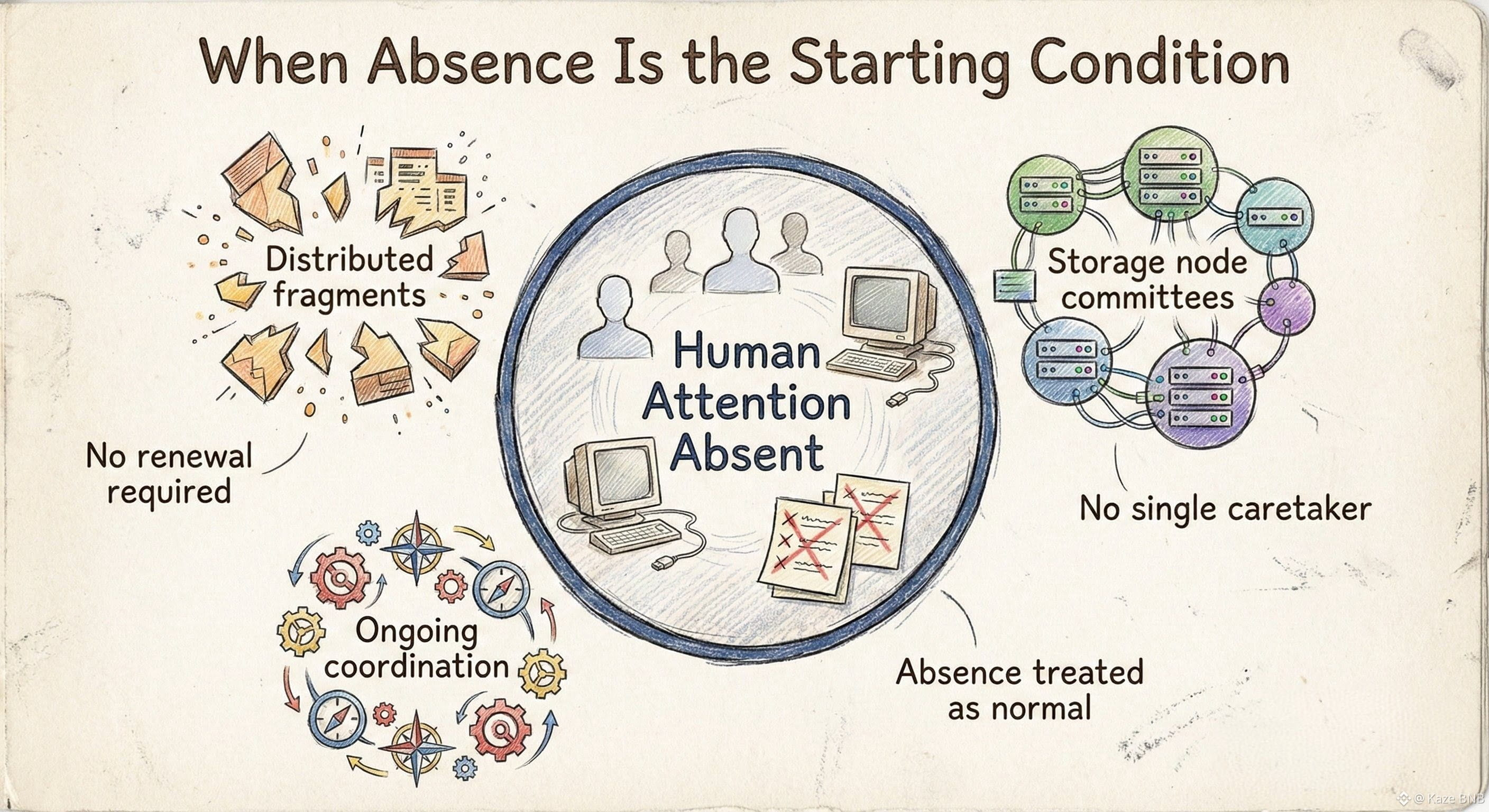
In Walrus, disappearance isn’t treated as a corner case. It’s assumed upfront. The system doesn’t wait to see who will stay responsible. It spreads responsibility immediately, across decentralized data distribution, so absence becomes survivable rather than catastrophic. When no one is watching, coordination still happens. That’s not a recovery mode. It’s the baseline.
Pinned storage tells a different story.
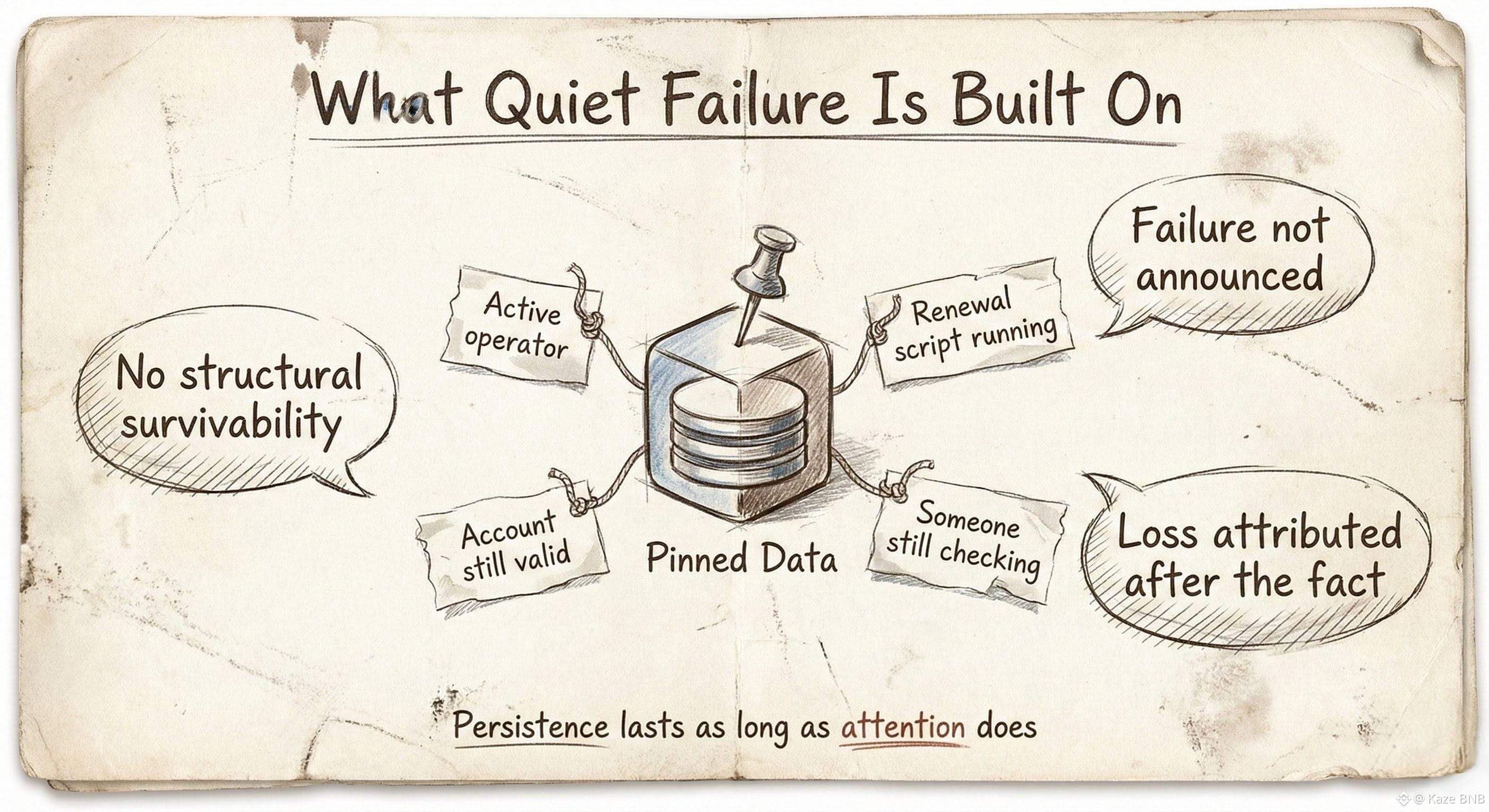
“Pin it somewhere” sounds durable until the operator changes jobs, the script stops running, or the account expires quietly. Nothing fails loudly. Nothing announces loss. The data just becomes dependent on a promise that no longer has a keeper. Persistence exists only as long as someone remembers to keep caring.
Both approaches claim resilience.
Only one admits what it’s actually relying on.
Walrus doesn’t hide behind convenience. It doesn’t compress responsibility into a dashboard or a reminder. It expresses censorship resistance structurally, by refusing to make any single actor essential for survival. When fragments persist and coordination continues, it’s obvious what’s working—and what was never guaranteed in the first place.
That honesty is uncomfortable.
When something goes missing in a pinned system, it’s unclear where to look. Was it the node? The operator? The process? Failure dissolves into ambiguity. With Walrus, failure modes surface as part of normal operation. If something can’t survive distributed coordination, the system doesn’t mask it. It lets the boundary show.
This isn’t about uptime or performance.
It’s about whether storage admits the moment human attention leaves.
Walrus continues coordinating even when no one is checking logs or renewing commitments. Storage node committees don’t pause to ask who’s accountable now. Responsibility isn’t reassigned. It was never centralized to begin with. The system keeps moving under the assumption that no one will come back to rescue it.
Pinned systems behave politely until they don’t.
They fail quietly, because quiet failure preserves the illusion longer.
Walrus fails honestly. Not by breaking contracts, but by honoring the one it actually made: that survival should not depend on someone staying present. When data persists, it’s because the structure allowed it. When it doesn’t, the system doesn’t pretend otherwise.
That difference matters most after the operator disappears.
One system survives absence because it planned for it.
The other survives only as long as absence hasn’t happened yet.
Walrus doesn’t promise permanence through care.
It promises survivability without it.