
These past few days, the crypto market has been rocking like a small boat pushing into a headwind. I sit there watching the charts, and I keep coming back to a question that sounds old—but somehow never stops being irritating: after all these years of repeating “blockchain will change the world,” how many projects have actually changed the human experience?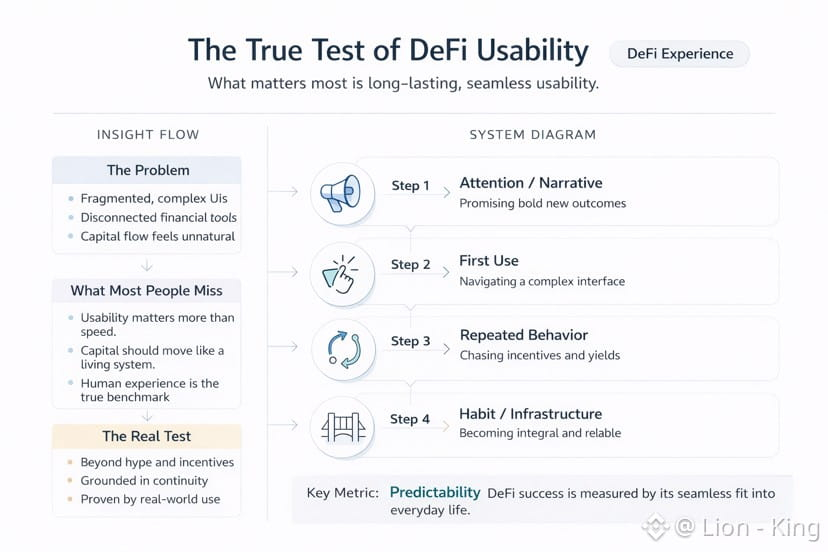
Not changed it with slides, with TVL, with a pretty APR number—changed the feeling of opening a wallet, of using a financial product, of sending and receiving, saving and investing, without feeling like you’ve wandered into a freezing server room full of cables.
The irony is that DeFi once promised financial freedom—an open system anyone could access. But the longer I’ve stayed, the more DeFi feels like a machine running at full speed, getting faster and faster while forgetting why it exists in the first place.
Liquidity gets chopped into crumbs, every chain becomes its own “island,” and capital stops flowing naturally like water. It starts moving like someone pumping it through a hose: bridge here, farm there, swap over there, then rush back the moment incentives change.
And the user? The user gets thrown into a maze of wallets, bridges, farms, swaps… an experience that feels almost inhuman—so dry that sometimes I catch myself thinking: this isn’t finance, it’s a UI game.
I don’t think DeFi’s problem is a lack of tools. It has more tools than it knows what to do with. The problem is something painfully ordinary: continuity, warmth in the experience, and a “natural” logic to how capital should move. And then I started reading about Dusk Network—not in a hype-hunting mood, but the way you read when you’re tired of hearing promises.
Dusk doesn’t scream that it’s the fastest or cheapest ZK chain on some comparison chart. What it suggests feels like a different angle: instead of only talking about “speeding up money,” it talks about programming liquidity so it can move, adapt, and regenerate.
It sounds poetic, but in plain words it’s this: they don’t just want to build a highway for capital to run on—they want liquidity to behave like a living organism, something that can move to where it’s needed most. In their ecosystem, you run into terms like Programmable Liquidity, Vanilla Assets, maAssets, and EOL (Ecosystem-Owned Liquidity).
If you ask me, “So what makes it different from other ZK chains?”—maybe it’s that Dusk doesn’t treat ZK as just a technical layer for proof optimization or security. It treats ZK as the foundation for building a kind of circulatory system for DeFi.
Vanilla Assets, put gently, are like “original” assets in the system—simple, understandable, not wrapped in too many layers. maAssets feel more like assets that have been “wrapped” with extra logic so they can move, interact, and carry state according to the ecosystem’s mechanics.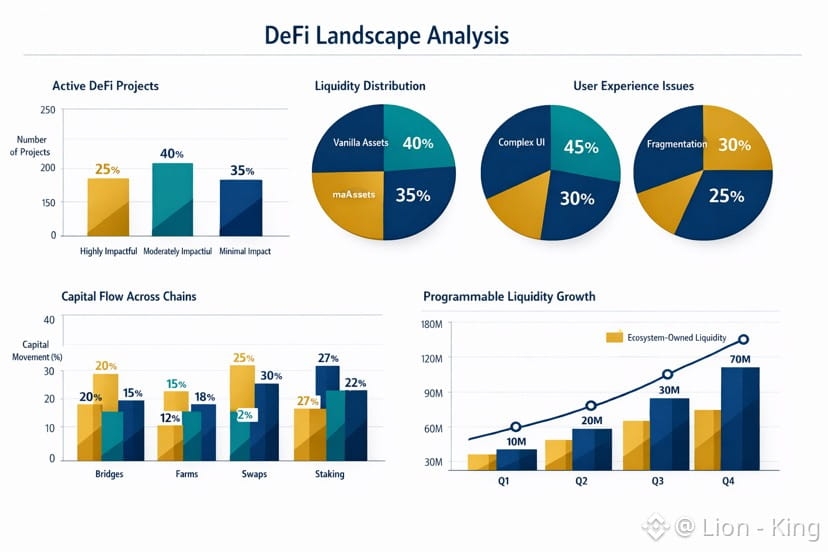
Programmable Liquidity, at least to me, is the idea that liquidity shouldn’t just sit in a pool waiting to be withdrawn. It should be programmable—able to decide where it goes, what it does, how it reacts when demand shifts. And EOL—Ecosystem-Owned Liquidity—is a pretty blunt idea: instead of an ecosystem depending entirely on “mercenaries” chasing incentives, liquidity can gradually belong to the ecosystem itself, like part of its body—not a temporary guest.
Maybe what made me pause wasn’t a “wow.” Honestly, I didn’t feel wow. I just exhaled, like, “Yeah… that makes sense.” A quiet, mature kind of logic. It doesn’t try to package itself as DeFi 2.0 or dress things up. It feels like a project laying groundwork slowly—asking the right questions before chasing numbers. And strangely, inside the usual coldness of technical writing, I felt a hint of something like blockchain learning how to have a heartbeat. Each unit of capital like a cell that can split, connect, regenerate—forming a new circulatory system for DeFi, at least at the level of an idea.
But I also don’t want to lie to myself. Dusk Network, like any project, still has to answer very real questions: can liquidity truly “regenerate,” or will it still depend on long-term incentive injections? Will EOL become real support, or just a pretty slogan? Will the economic loop hold when the market stops being generous? I’ve seen too many projects start with the right idea and fail in execution, or fail because nobody uses it since UX is still painful, or fail because tokenomics runs out of patience before the product has time to mature. The irony is that in crypto, what kills an ecosystem isn’t always technology—it’s psychology.
Still, if there’s one reason I want to keep watching Dusk, it’s that it feels like they’re starting from “human experience,” not just technical promises. While so many projects try to prove they’re “more decentralized,” “more optimized,” “more ZK,” Dusk seems to choose something else: being more connected—between people, capital, and the system itself. And I think… that’s what DeFi has been missing for a long time. Not another yield formula, but a mechanism that lets capital behave more naturally—less forced, less driven by the whistle of incentives.
Maybe blockchain doesn’t need more speed. Maybe it needs more heartbeat. DeFi doesn’t need more yield recipes. Maybe it needs more breath. Seen that way, Dusk Network feels like an organism learning to breathe—like a cell dividing to regenerate a network. It may not be perfect yet, and it will have to prove itself through real products and real users.
But if blockchain can truly become something that lives, then this… might be one of the places where it starts to breathe. @Dusk $DUSK #dusk
