


On Plasma, finance doesn't 'discover' fee policy in a forum thread.
They discover it after close.
USDT sales cleared on Plasma Network all day with no visible gas prompt. The counter stayed smooth. Receipts printed like nothing had to negotiate.
Then the reconciliation export landed.
Execution cost sitting inside the same stablecoin flow everyone had been calling frictionless. Not huge. Just... there. Every time.
Or... most days. You notice it when you stop looking away.
That’s where stablecoin-first gas lives on a layer-1 payments rail like Plasma. Not in debates. In checkout habits. In receipts. In settlement logs. In end-of-day totals that don’t ask permission.
No native token balance check. No "top up" detour. No separate tollbooth screen to remind anyone that fees are a choice.
A payment moves, USDT clears... and the cost shows up in the same accounting view merchants already live in. Operationally, it is one motion. You don’t get a second screen.
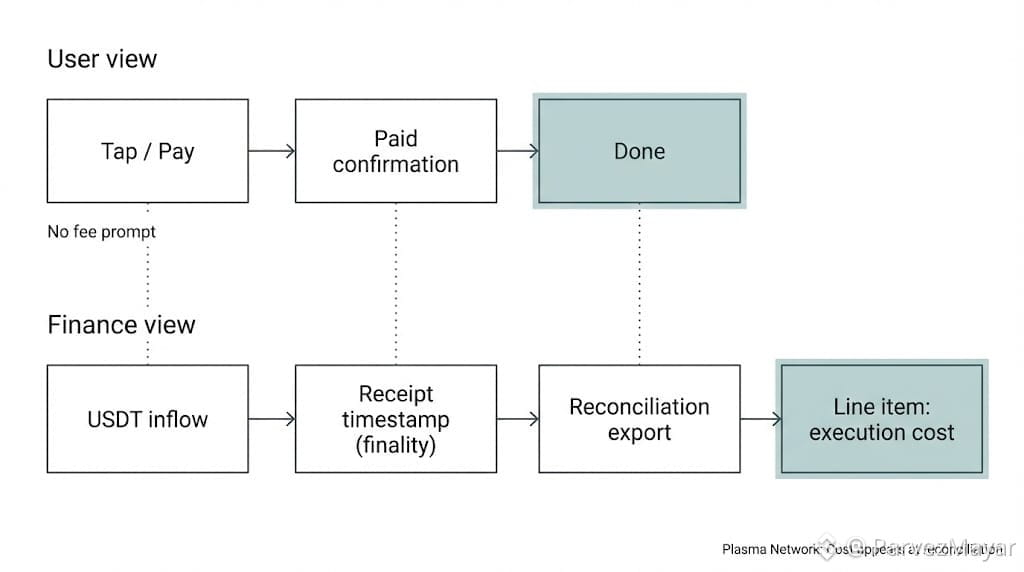
The strange part is who experiences that as governance.
Not the user. They never see it. Not support either, tickets don’t open over gas when gas never interrupts the flow.
It hits treasuries and operators first. And whoever owns the merchant settlement reconciliation pipeline. Because that's where the decision lands: upstream, embedded.
On tollbooth chains, visible gas does a blame job. If something fails, someone can point at the fee layer and say, "you didn't have enough'. Annoying, but useful. Responsibility gets sprayed across the edge.
On Plasma, the edge stays quiet.
Blame moves. Cost moves. Same direction.
So "who pays" becomes a default. And defaults decide things even when nobody writes them down. Especially then.
You see it in the messy flows, not the happy path.
Refunds don’t reverse state. They ship as new transactions.
Disputes don’t rewind finality. They show up as accounting work and support procedure.
The question stops being "who paid gas?" and turns into something uglier:
Who absorbs cost when the payment already finalized with PlasmaBFT sub-second finality though... and the business wants to undo it anyway?
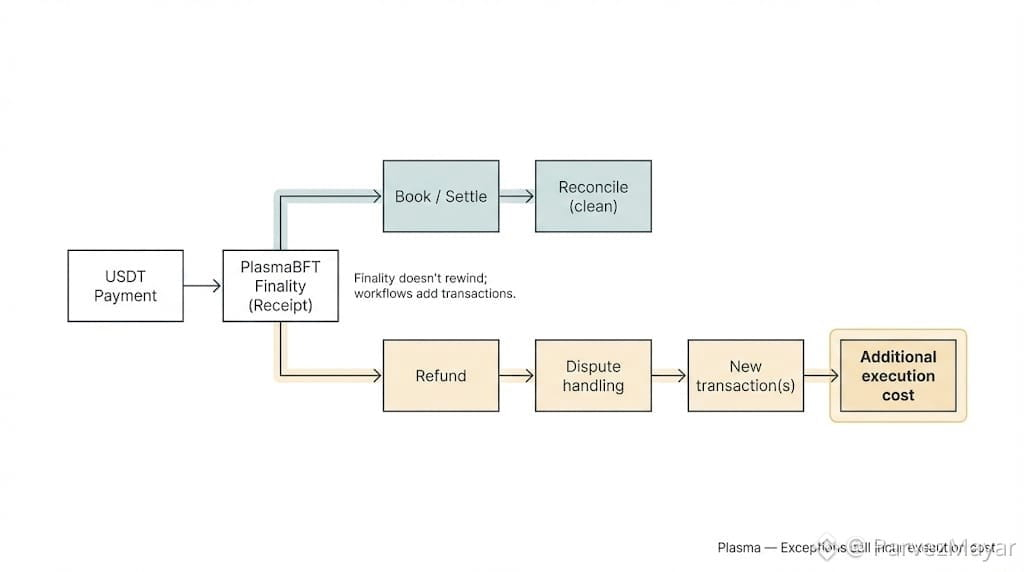
Merchants don’t ask that at checkout. They can’t. There’s no prompt to trigger the thought. No moment where the UI invites responsibility.
Later... when a retry happens, or a receipt prints twice, or the POS cached the wrong state, the fee question has nowhere to surface except ops. Someone reconciles. Someone explains why "nothing weird happened" and yet ledger-compatible receipts show extra edges.
It’s almost too clean.
In the user flow, Plasma's stablecoin payments execution and settlement arrive together. You don’t separate them. You don’t get a friction knob to turn down as dissent.
Power’s a dramatic word.
Defaults, then.
And incentives follow. Boringly. Operators aren’t competing on who can externalize fee pain better. Protocol incentives don’t need to drag users into holding something volatile just to keep stablecoin payments alive. Predictability wins because merchants punish surprises at the counter, not on a dashboard.
Plasma's EVM compatibility makes it slip in faster too. Reth gives teams familiar surface area, so integrations ship like muscle memory.
Which is good.
Also... it means the policy can become real before anyone writes the policy doc. Nobody schedules a governance debate about a thing that never bothered the user.
Until it hits a ledger.
A shop closes out. The cashier swears nothing "extra" happened... no prompts, no holds, no weird screens. Two refunds went out as separate transactions because that’s the only shape they have after finality.
Finance pulls the report and sees the execution costs stacked exactly where the flow was supposed to be quiet.
They don’t ask what gas is.
They ask why they paid it. And who decided they would.
And the answer isn’t a person. It’s the rail. Plasma Network's Stablecoin-first gas bakes fee policy into the act of paying. It decides who never has to think about fees, and who has to own them when something goes sideways.
Support can point at a receipt-grade finality timestamp all day.
Refunds still cost. Retries still cost. Disputes still cost.
And on Plasma tomorrow’s payments will clear the same way, quietly... while the default keeps charging, transaction by transaction.