
Vanar approaches cross-chain liquidity from a fundamentally different perspective than most blockchain projects. Instead of chasing fragmented liquidity across dozens of isolated chains, Vanar’s long-term vision is built around a simple but powerful idea: liquidity should flow freely without breaking the user experience, developer tooling, or economic coherence of the network. “Liquidity Without Fragmentation” is not a slogan—it is a design principle that shapes how VANRY is positioned in a multi-chain world.
In today’s blockchain ecosystem, liquidity fragmentation is one of the most damaging structural problems. Assets are scattered across multiple chains, bridges, wrapped representations, and liquidity pools, each introducing friction, risk, and inefficiency. Users are forced to understand bridges, wrapped tokens, chain-specific wallets, and varying fee models. Developers must manage liquidity incentives on multiple networks while dealing with inconsistent standards. Vanar recognizes that global adoption cannot be achieved if liquidity remains fractured and difficult to access.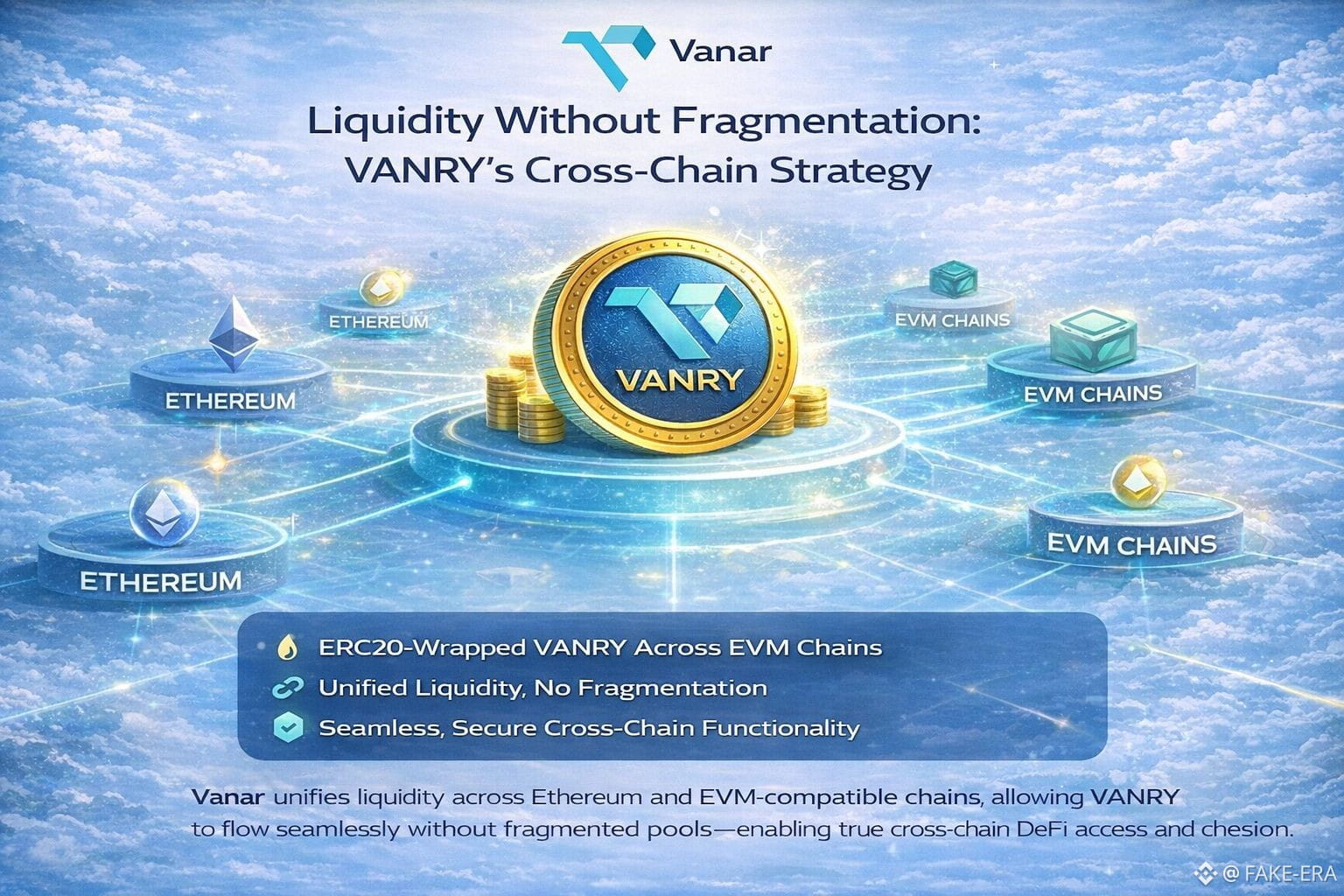
VANRY’s cross-chain strategy begins with a clear understanding that multi-chain is a reality, but fragmentation is a choice. Vanar does not attempt to isolate itself as a closed ecosystem, nor does it attempt to compete by creating proprietary standards. Instead, it aligns itself with the dominant execution and liquidity environment of Web3: the Ethereum Virtual Machine (EVM). By doing so, Vanar ensures that liquidity does not need to be reinvented or duplicated—it can be extended.
A critical pillar of this strategy is the introduction of ERC20-wrapped VANRY. Rather than treating cross-chain compatibility as an afterthought, Vanar deliberately designs VANRY to exist natively on its own chain while also being accessible within Ethereum and other EVM-compatible ecosystems. This dual existence allows VANRY to function as both a protocol-native gas token and a liquid, composable asset within the broader DeFi landscape.
The importance of ERC20 compatibility cannot be overstated. ERC20 is not just a token standard; it is the liquidity language of Web3. The majority of decentralized exchanges, lending protocols, liquidity aggregators, and yield platforms are built around ERC20 assumptions. By making VANRY available in ERC20 form, Vanar ensures immediate compatibility with this existing financial infrastructure without requiring custom integrations or new standards.
However, Vanar’s strategy goes far beyond simply wrapping a token. Many projects create wrapped assets that exist in isolation, resulting in multiple versions of the same token across chains, each with thin liquidity and inconsistent pricing. Vanar avoids this trap by treating ERC20-wrapped VANRY as an extension of the same economic system, not a separate asset competing for attention.
The bridge infrastructure supporting VANRY is designed with security, predictability, and scalability as core requirements. Cross-chain movement of VANRY is not intended to be speculative or chaotic; it is intended to be functional and utility-driven. Users and protocols can move value between Vanar and Ethereum-based environments with confidence, knowing that the underlying supply constraints, issuance rules, and economic assumptions remain consistent.
This approach directly addresses one of the most common failures of cross-chain systems: uncontrolled liquidity duplication. When assets are minted freely on multiple chains without strict accounting, price divergence and trust erosion quickly follow. Vanar’s cross-chain model ensures that VANRY’s supply remains coherent, regardless of where it is used. Wrapped representations are always backed, verifiable, and tied to the same hard-capped economic model.
Liquidity without fragmentation also has profound implications for developers. Builders on Vanar do not need to bootstrap liquidity from scratch or incentivize users to abandon existing ecosystems. Instead, they can tap into existing EVM liquidity, integrate with familiar DeFi primitives, and offer users a seamless experience that feels continuous rather than isolated. This dramatically lowers the barrier to entry for new applications and accelerates ecosystem growth.
For users, the benefits are even more tangible. A user holding VANRY is not locked into a single chain or forced to navigate complex migration paths. They can interact with DeFi protocols on Ethereum, participate in liquidity pools, or move assets back to Vanar for low-cost, high-performance transactions. The asset remains the same; only the execution environment changes. This flexibility is essential for mainstream adoption, where users expect assets to be portable, intuitive, and reliable.
Vanar’s strategy also avoids the common mistake of turning bridges into speculative chokepoints. In many ecosystems, bridges become targets for attacks or points of systemic risk. Vanar mitigates this by integrating bridge logic into its broader security philosophy, including rigorous audits, conservative design choices, and clear economic constraints. Cross-chain functionality is treated as critical infrastructure, not an experimental feature.
Another key aspect of VANRY’s cross-chain design is its alignment with predictable fee economics. Because Vanar uses fixed, dollar-denominated transaction fees, users are shielded from the unpredictable cost dynamics that often plague cross-chain interactions. This predictability extends to DeFi integrations, allowing developers to design cross-chain applications without fear of sudden fee spikes disrupting user flows.
Liquidity fragmentation is not only a technical problem—it is also a governance problem. When assets are scattered across chains, governance participation becomes diluted and disjointed. Vanar’s approach ensures that governance power remains unified, even as liquidity moves across environments. Staking, delegation, and voting rights remain anchored to VANRY’s core economic model, preventing governance from splintering alongside liquidity.
This unified approach to liquidity and governance reinforces long-term network stability. Validators, delegators, developers, and users all operate within the same economic framework, regardless of which chain they are interacting with at any given moment. This alignment is critical for building trust and avoiding the governance chaos seen in many multi-chain ecosystems.
From an institutional perspective, liquidity without fragmentation is a prerequisite for serious adoption. Enterprises require clarity around asset representation, supply guarantees, and settlement risk. Vanar’s cross-chain strategy provides this clarity by ensuring that VANRY behaves as a single, consistent asset across environments, rather than a collection of loosely related tokens.
The long-term vision extends beyond Ethereum alone. While EVM compatibility is the immediate focus, Vanar’s architecture is designed to support future integrations with additional EVM-based networks as the ecosystem evolves. This ensures that VANRY remains relevant and accessible as the multi-chain landscape expands, without sacrificing economic coherence.
Importantly, Vanar does not view multi-chain expansion as a race to be everywhere at once. Instead, it prioritizes depth over breadth. Each integration is designed to preserve security, liquidity integrity, and user experience. This disciplined approach contrasts sharply with ecosystems that aggressively expand across chains only to suffer from thin liquidity and operational risk.
Liquidity without fragmentation also supports Vanar’s broader goal of making blockchain infrastructure invisible. Users should not need to think about which chain they are on or where liquidity resides. They should simply interact with applications, move value, and participate in the economy. VANRY’s cross-chain strategy abstracts complexity rather than amplifying it.
Over time, this approach creates a powerful network effect. As more applications integrate VANRY across chains, liquidity deepens rather than disperses. Price discovery becomes more efficient. Slippage decreases. User confidence increases. The ecosystem grows organically, driven by utility rather than artificial incentives.
In contrast to many cross-chain strategies that prioritize short-term liquidity mining, Vanar focuses on structural liquidity resilience. Incentives are aligned with real usage, not transient yield opportunities. This ensures that liquidity remains stable even as market conditions change.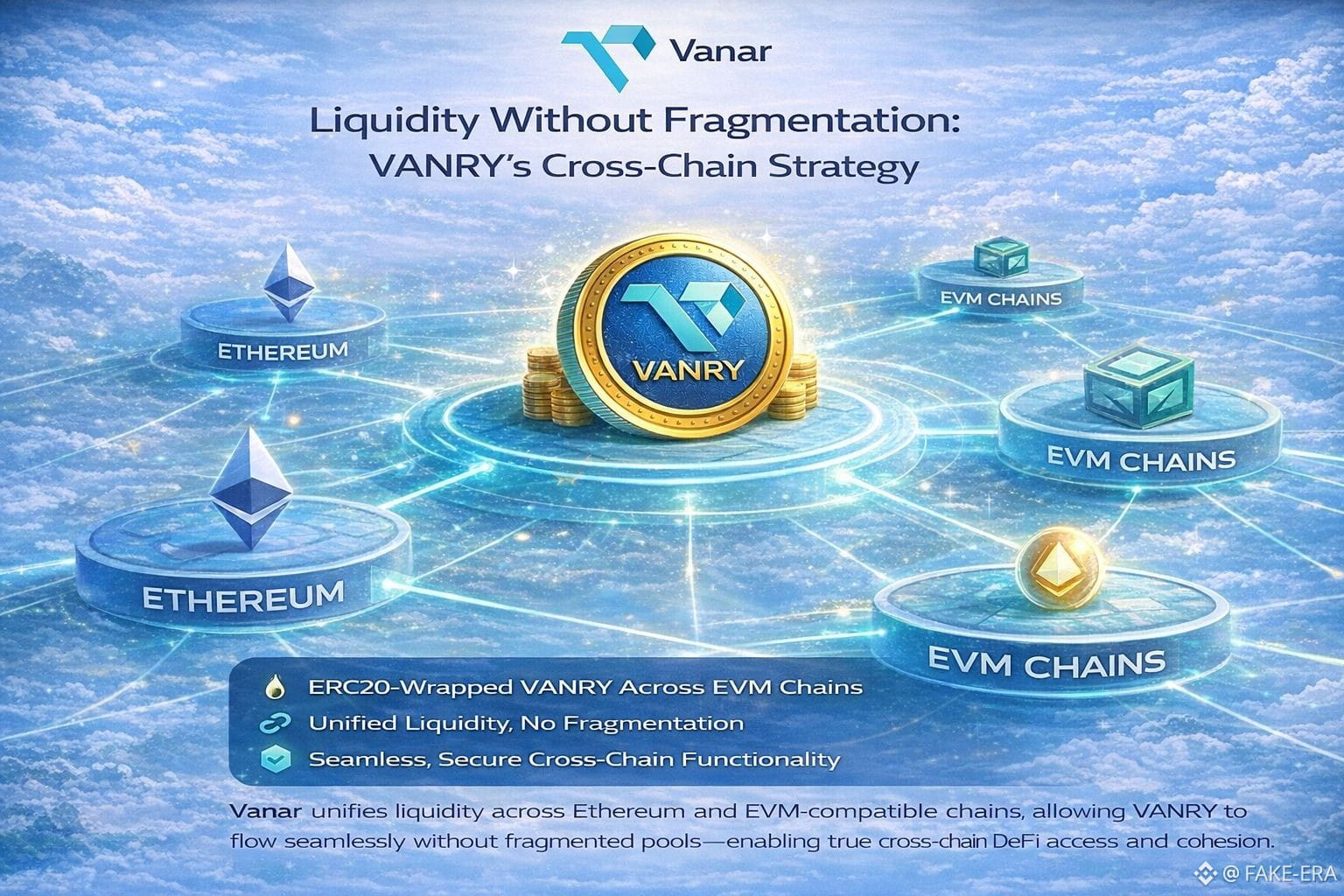
The result is a token that behaves less like a speculative instrument and more like financial infrastructure. VANRY becomes a medium of value that can move across environments without losing coherence, trust, or usability. This is essential for a future where blockchain supports payments, gaming, digital commerce, and enterprise workflows at scale.
Ultimately, “Liquidity Without Fragmentation” reflects Vanar’s broader philosophy: blockchain should reduce complexity, not introduce it. By designing VANRY as a cross-chain asset rooted in EVM compatibility, secure bridging, predictable economics, and unified governance, Vanar positions itself for a future where liquidity flows freely without breaking the system.
In a fragmented multi-chain world, coherence is a competitive advantage. Vanar’s cross-chain strategy ensures that VANRY remains whole, liquid, and functional—no matter where it is used. This is not just a technical achievement; it is a foundational step toward global, sustainable Web3 adoption.