

If you squint at the crypto landscape of 2026, the noise starts to blur into a familiar pattern. Chains are still competing on speed, ecosystems on size, and tokens on the dazzle of their utility promises. It’s a race to be the most feature-rich platform in a world where features are abundant and trust is still scarce.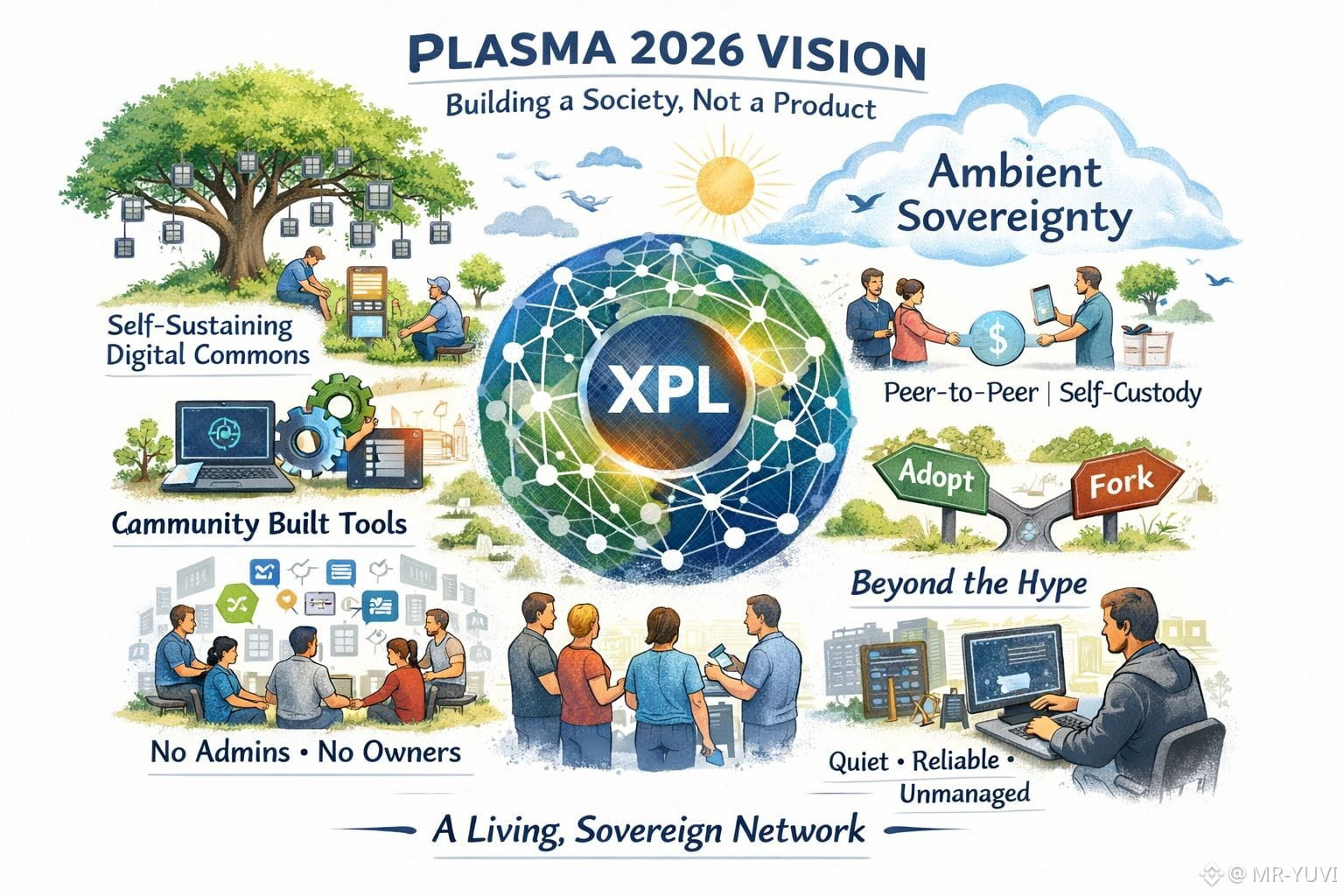
Amid this, PLASMA (XPL) feels different because it stopped racing. Instead of asking, “What can we build next?” it’s asking a far deeper question as we look toward 2026: What can we allow to grow?
The vision for XPL isn’t a new roadmap of technical milestones. It’s a cultural and philosophical commitment—to evolve from a protocol into a proving ground for a new kind of digital society. One where the rules aren't written by a foundation, but lived by its participants.
The 2026 Goal: The Self-Sustaining Digital Commons
By 2026, PLASMA’s success won't be measured by its TVL or even its swap volume alone. The core metric will be agency distribution. How many people are running nodes not for rewards, but for resilience? How many tools and interfaces have been built by the community, for the community, without a central grant or directive? How many disputes have been resolved through transparent code and social consensus, not through admin intervention?
The vision is an ecosystem that operates with the quiet, persistent logic of a public park maintained by its visitors, not a theme park operated by a corporation. The code is the land. The users are the gardeners. XPL is the shared understanding—the common law—of that space.
The New Theme: "Ambient Sovereignty"
Forget "Web3" or "DeFi 2.0." The theme emerging for PLASMA is Ambient Sovereignty.
This means a state where self-custody and peer-to-peer interaction aren’t conscious, difficult choices you make—they are the background conditions of the environment. Like the air you breathe. It’s not a feature you toggle on; it’s the physics of the place.
By 2026, the goal is for the experience to feel like this:
· A developer integrates PLASMA’s swap protocol into their app not because it’s the trendiest, but because it’s the most logically neutral and secure option—like choosing TCP/IP.
· A user seeking to move value across chains encounters a PLASMA-facilitated route as the default “clean” option, free of hidden custody layers, the way people might now seek out an end-to-end encrypted message.
· The community’s governance happens not in quarterly votes on token-weighted proposals, but in the continuous, ambient process of which software forks gain adoption, which documentation becomes canonical, and which behaviors are upheld as standard practice. It’s governance by idiom and habit, not by ballot.
The Human Challenge: Embracing the "Unmanaged"
This vision’s greatest obstacle isn't technical. It’s psychological.
We are conditioned to seek leaders, roadmaps, and customer support. PLASMA’s 2026 future requires unlearning that. It proposes a system that is unmanaged, but not unordered. The order emerges from shared principles (sovereignty, directness, transparency) and the immutable logic of the base protocol.
This means accepting that progress might be slower, less linear, and less predictable. A breakthrough might come from a lone developer in a forum post, not a press release from headquarters. A network upgrade might spread organically over months as node operators individually choose to adopt it. This can feel chaotic, but it’s a sign of a truly living system.
The Quiet Benchmark for 2026
So, as other ecosystems chase hyper-scalability and mainstream adoption through compromise, PLASMA’s 2026 will be judged by a different set of questions:
· Has it become more boring? Its reliability should be assumed, not announced.
· Has it become more silent? Its public communication should be dominated by technical contributions, not marketing.
· Has it become more indispensable to those who value its core tenets? Its user base should be smaller, more dedicated, and more capable than ever.
In essence, the 2026 vision for PLASMA is to be the answer to a growing sense of fatigue. For the users, builders, and thinkers who are exhausted by the noise, the hype cycles, and the recurring failures of centralized points of control, PLASMA aims to be a place of quiet competence.
It won't shout about building the future. It will simply be a piece of it that works, unchanged in its principles, a testament to the power of doing less on purposeso that people can do more, on their own terms. The future it’s building isn't a product you buy. It's a society you choose to join, and a standard you choose to uphold.