

The digital experiences had long-term expiration date. Brands emerged, were popularized, and became forgotten in a short time. Communities moved on. Games shut down. The virtual worlds were deserted and incomplete cities. Individuals were taught, in a non-verbal manner, not to become too fond. However, in the last couple of years, there has been a change in something fundamental. Digital spaces are no longer spaces that we pay short-lived visits to, but spaces to which we come back, invest, and even base our lives upon. It was not a shift made due to a single breakthrough. It occurred due to the maturation of expectations. And Vanar Chain was made with this maturity.
In Vanar Chain, the concept was not initiated with any performance charts or technical maneuvering. It started with a mere observation: individuals have developed the expectation of digital environments to act as real places. The actual locations do not resett because of the annual change of place. They do not fade due to the shift of attention. They develop, evolve and are still in use despite the world around them evolving. Those who created Vanar understood that to sustain sustainable digital worlds, games and entertainment platforms and AI-driven environments and virtual economies, the infrastructure underpinning them needed to cease acting like an experiment, and start acting like a foundation.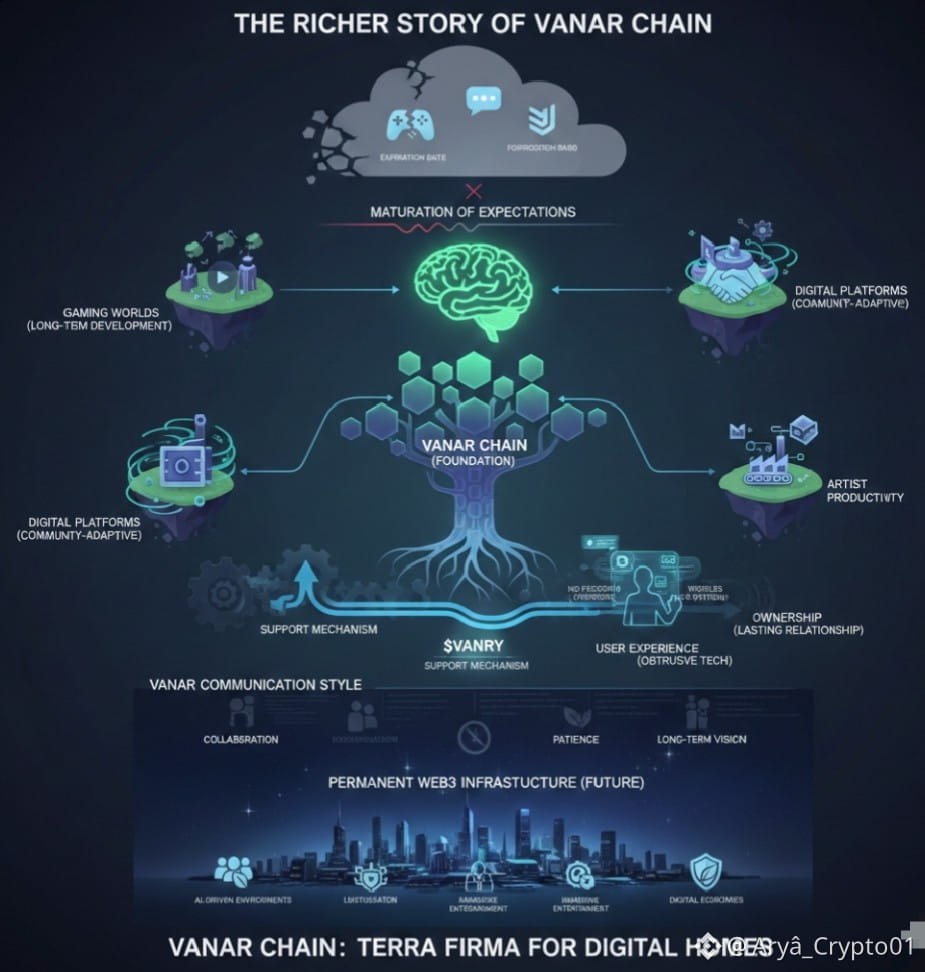
This assumption influenced the building of Vanar Chain quietly but significantly. They were not only maximizing to the short-term thrill, but instead the emphasis was to be on consistency and resiliency. Constructors wanted a chain that would not compel them to re-design their projects each time. Artists had to be assured of their productivity as their output was to expand with the increasing numbers of their audience. The users required autonomous and stable experiences rather than temporary and frail ones. Vanar Chain was developed to fulfill these requirements by eliminating friction at the infrastructure scale, enabling experiences to develop instead of always re-initiating.
With the development of projects based on Vanar on it, there emerged another rhythm. Teams were not in a hurry to grab hype, they were strategizing long term. The gaming worlds were created with an idea of further development rather than the exit strategy. The digital platforms were designed so that they could adapt to the communities rather than following the trends. The notion of ownership was addressed as a lasting relationship and not a new one. With time, Vanar Chain ceased to appear a launchpad, and began to seem like terra firma, something upon which a builder could depend even after years of trial and error.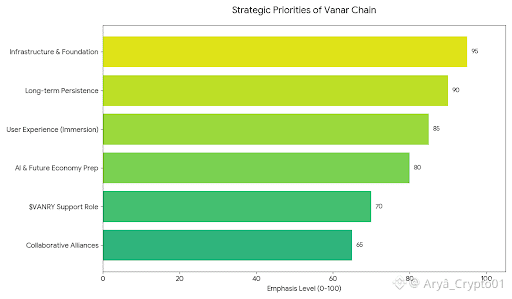
The core of this ecosystem belongs to Vanry, although this role is deliberately downplayed. Rather than placed in the position of the story, it serves as a support mechanism to all other things in the network without taking the focus off of the experiences it facilitates. Its worth increases with actual usage as opposed to false momentum. This is built with a more profound philosophical idea in mind but the ecosystems are not made to require constant stimulation but rather alignment. Incentives, when congruent with long-term behavior, will be a natural result and not an imposed one.
This strategy is very much in line with the way individuals deal with technology in the contemporary world. Users are no longer tolerant of drag or clarification. They do not feel like knowing systems they would rather be in worlds. Any mismatch, time slip or misunderstanding is a death knell to immersion. Vanar Chain is expectant of this fact, by making sure that blockchain is not conscious to the final customer. The experience comes first. The technology remains unobtrusive in the background and performs its duties without any attention. This is not merely simplicity, but is arranged.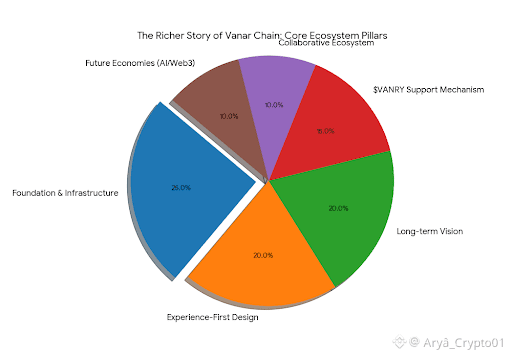
This way of thinking is reflected in the communication style of Vanar. They are not in a hurry to take control of discussions and run timelines. Advancement is done in a collaborative manner. Alliances are selected selectively. Promises are silent compared to development. Such moderation may be foreign in an industry where speed and spectacle are so common yet it augurs something significant. It implies that it will take a team building in the years to come, and not in the present to be validated. Long-termed thinkers will see this at first glance, and they will be attracted towards ecosystems which demonstrate this level of forbearance.
The necessity of reliable infrastructure in the context of further digitalization of life is bound to increase. AI-driven environments will be twenty four hour services. The continuous performance will be required by immersive entertainment. Digital economies will be based on continuity and trust. The most vociferous and the most experimental chains that never become too unstable with the addition of a new emphasis somehow cannot endure when the others draw the focus. Vanar Chain is gearing up to this kind of future in silence so that it can be able to sustain the experiences that are yet to be thought of.
Web3 will not come with one announcement and defining moment to the future. It will come with a slow pace, platforms that are familiar, worlds that continue and communities that remain. When that occurs, the majority of users will not inquire as to what chain enabled them to do so. However, behind the scenes, infrastructure such as Vanar Chain will be working, consistent, unnoticed and dependable. Travel with Vanar, see the way the role of $VANRY evolves, and follow how we eventually start building permanent Web3 infrastructure that will influence our preference of our digital homes to remain.
