


Web2 storage works so well that most people stop thinking about it. Files upload quickly. Data loads instantly. Everything feels reliable until the moment it isn’t. When something breaks in Web2 storage, it rarely fails loudly. It degrades quietly. A policy changes. A service is deprecated. An account is flagged. A region goes down. The data is still “there,” but no longer reachable in the way the application expects.
@Walrus 🦭/acc competes with Web2 storage by addressing that quiet failure mode rather than trying to beat Web2 on raw speed or familiarity.
The core difference is not performance. It’s ownership and durability. Web2 storage is optimized for convenience under centralized control. Walrus is optimized for persistence under decentralized accountability. Those are fundamentally different goals, and they lead to very different economic and architectural choices.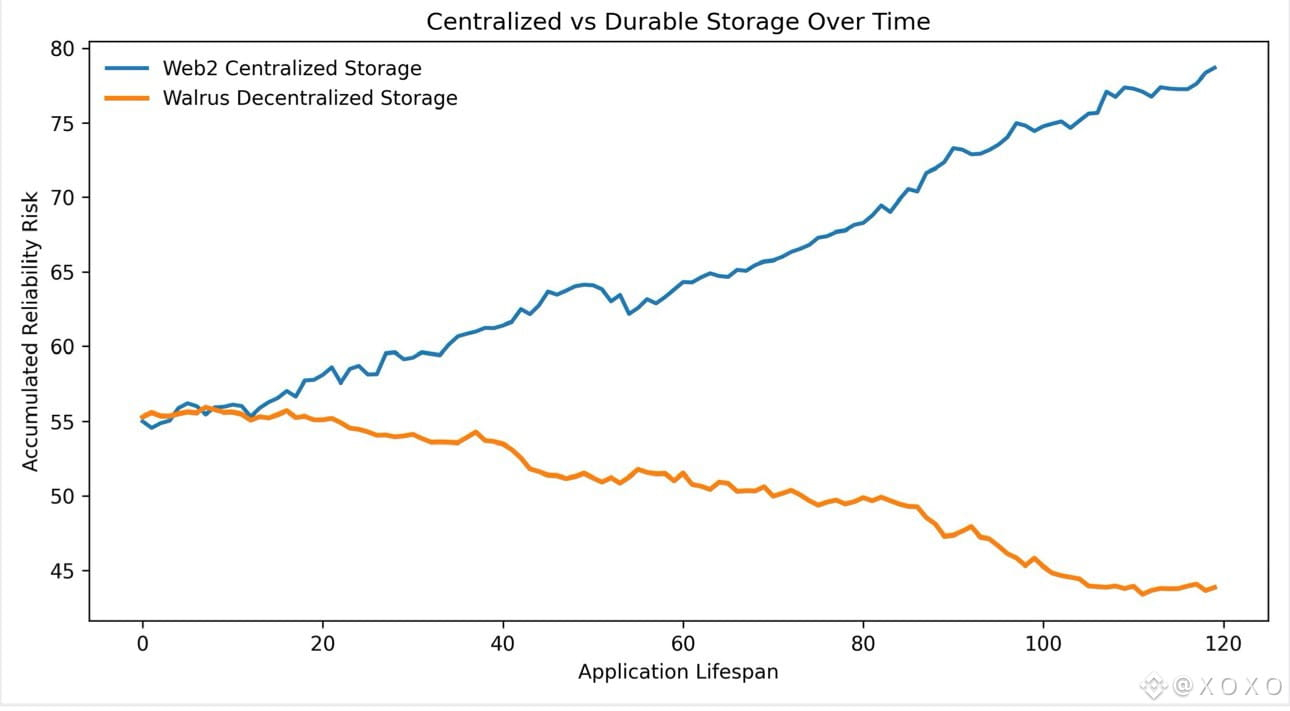
In Web2, storage durability is contractual. You trust that the provider will continue operating, continue honoring your agreement, and continue making your data available under the same terms. This works well until scale, regulation, or business incentives change. At that point, durability becomes conditional. Your data exists, but your access to it becomes fragile.
Walrus removes that conditionality by separating storage reliability from any single operator. Data is stored as blobs, broken into fragments using erasure coding, and distributed across many independent operators. No one party holds the full file. No one failure removes availability. Recovery does not depend on trust, it depends on math and incentives.
This is where Walrus begins to compete seriously with Web2. Not by pretending centralized systems are bad, but by solving the one thing they cannot guarantee indefinitely: neutral, long-term availability.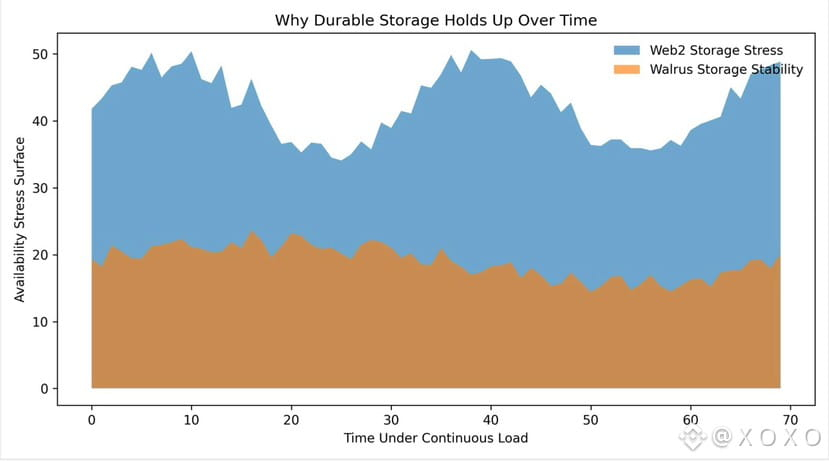
Another key difference is how incentives are structured over time. Web2 providers are paid for storage capacity and bandwidth, not for persistence itself. Long-lived data is a liability. Old files generate little revenue but still consume resources. This creates subtle pressure to de-prioritize, archive, throttle, or eventually remove rarely accessed data.
Walrus flips that incentive. Operators are continuously rewarded for keeping data available and participating in repairs as time passes. Durability is not an afterthought—it is the product. Long-lived data is not a burden; it is the reason the system exists.
This matters deeply for applications that rely on retention rather than novelty. Games with evolving worlds. NFTs whose images must exist years later. AI systems that depend on historical datasets. Governance systems that require permanent records. In these cases, the cost of losing data is not inconvenience it is existential.
Web2 storage also centralizes failure modes. When something goes wrong, the blast radius is large. Entire regions, services, or ecosystems can be affected at once. Walrus reduces this risk by design. Failures are localized. Repairs are routine. Availability degrades gracefully rather than catastrophically.
Importantly, Walrus does not require applications to abandon performance. Storage is off-chain but verifiable. Retrieval is fast enough for real usage. Sui acts as a coordination and verification layer, not a bottleneck. This allows Walrus to compete on reliability without forcing everything onto a blockchain where costs explode.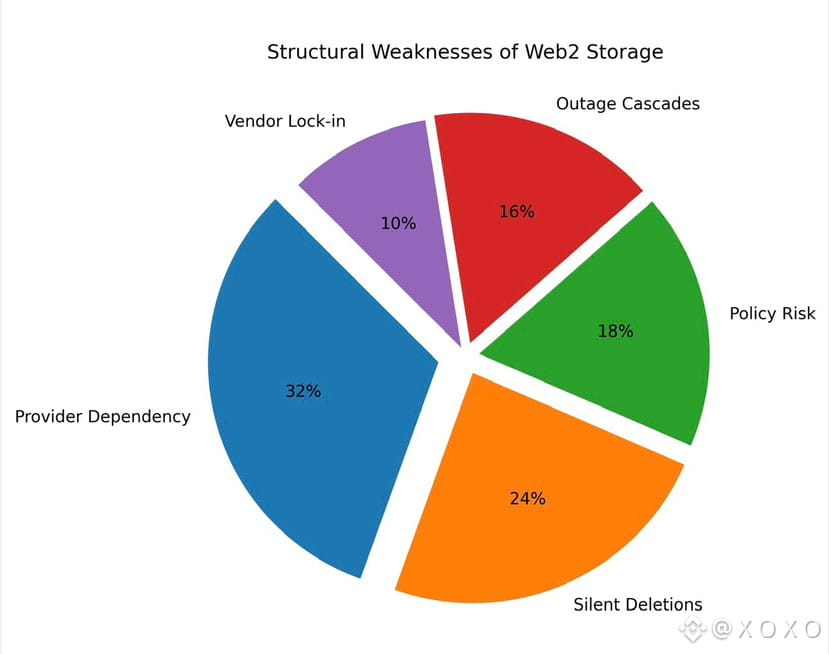
The competition, then, is not about replacing Web2 outright. It is about offering an alternative when data must outlive platforms, companies, or narratives. Web2 is excellent for short-to-medium-term convenience. Walrus is built for long-term continuity.
Over time, that difference compounds. As applications mature, retention becomes more important than speed. Users stop caring how fast something loads and start caring whether it loads at all. This is where Walrus gains ground not through hype, but through absence of failure.
If Walrus succeeds, it will not feel like a revolution. It will feel boring. Files will still be there. Links will still work. Data will still load years later. And that quiet reliability is exactly how it competes with Web2 storage.