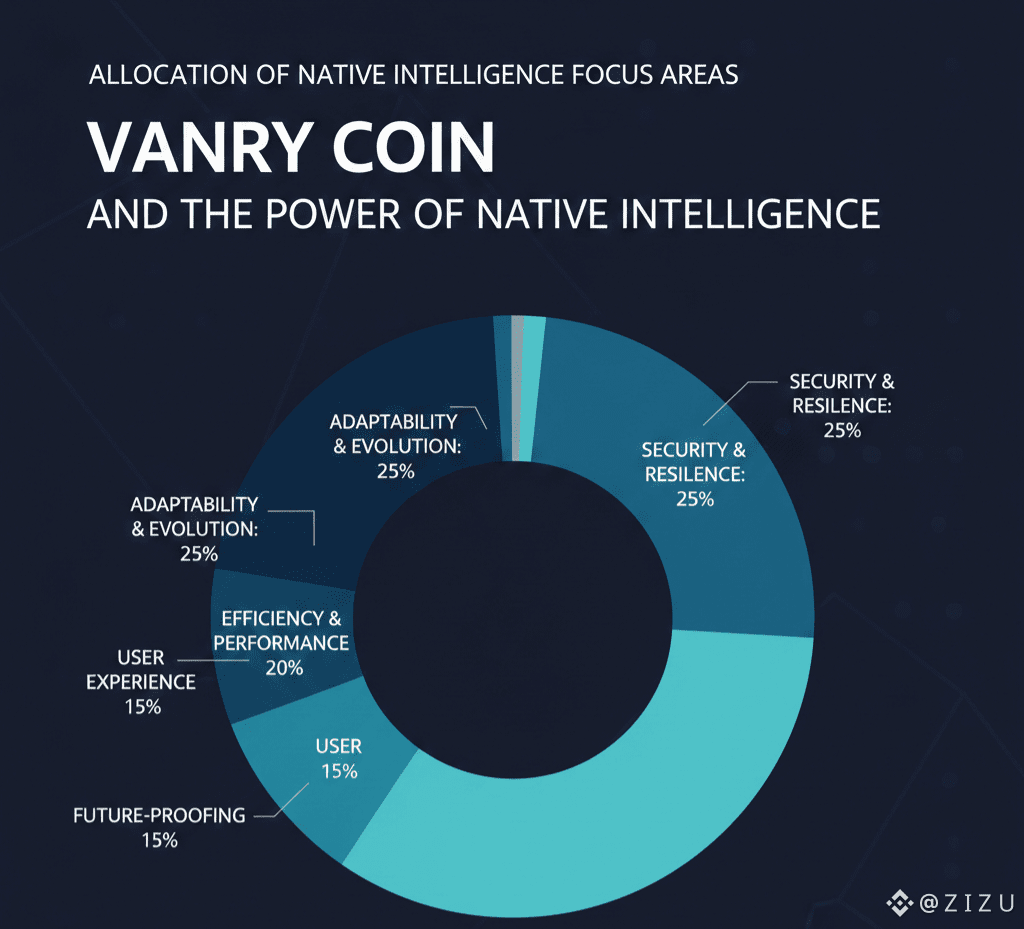
In the world of blockchain and decentralized finance, AI is everywhere or at least, it’s talked about everywhere. Most projects showcase AI as a feature or an add-on. A smart contract might “learn” to adjust fees or a platform might use AI to predict trends. These features sound impressive but at the end of the day, they’re just layers slapped on top of systems that weren’t built with intelligence at their core. They’re like putting a high-performance engine on an old, rusty car, it might go faster but the car itself isn’t fundamentally upgraded.
Vanry Coin approaches things differently. It isn’t trying to attach intelligence as a shiny add-on. Instead, it’s built with native intelligence, intelligence that is woven into the very fabric of the network. This isn’t marketing fluff. It’s a real, practical difference. When you interact with Vanry Coin, the network itself operates in a way that feels thoughtful, adaptive and almost self-aware. Transactions aren’t just processed; they’re handled efficiently, securely and intelligently, all without requiring external AI patches or updates.
From my perspective, this distinction is huge. AI as a feature reacts, it waits for input, processes data and tries to optimize results. But native intelligence in Vanry Coin anticipates. It adapts. It’s like comparing a person following a recipe to a chef who can improvise, adjust and create something better in real time. Every node, every transaction, every interaction contributes to the system learning and optimizing on its own. The intelligence is baked into the protocol, not layered on top.
This design choice has real implications. Many blockchains struggle with delays, conflicts or inefficient resource allocation. They weren’t designed to handle dynamic conditions intelligently. Vanry Coin doesn’t just react to problems, it mitigates them before they even occur. Resource management is smart, state changes are smooth and the network as a whole behaves predictably and reliably. From my point of view, this is what makes it feel different from most other chains. You notice it not in flashy demos but in how naturally and effortlessly it works.
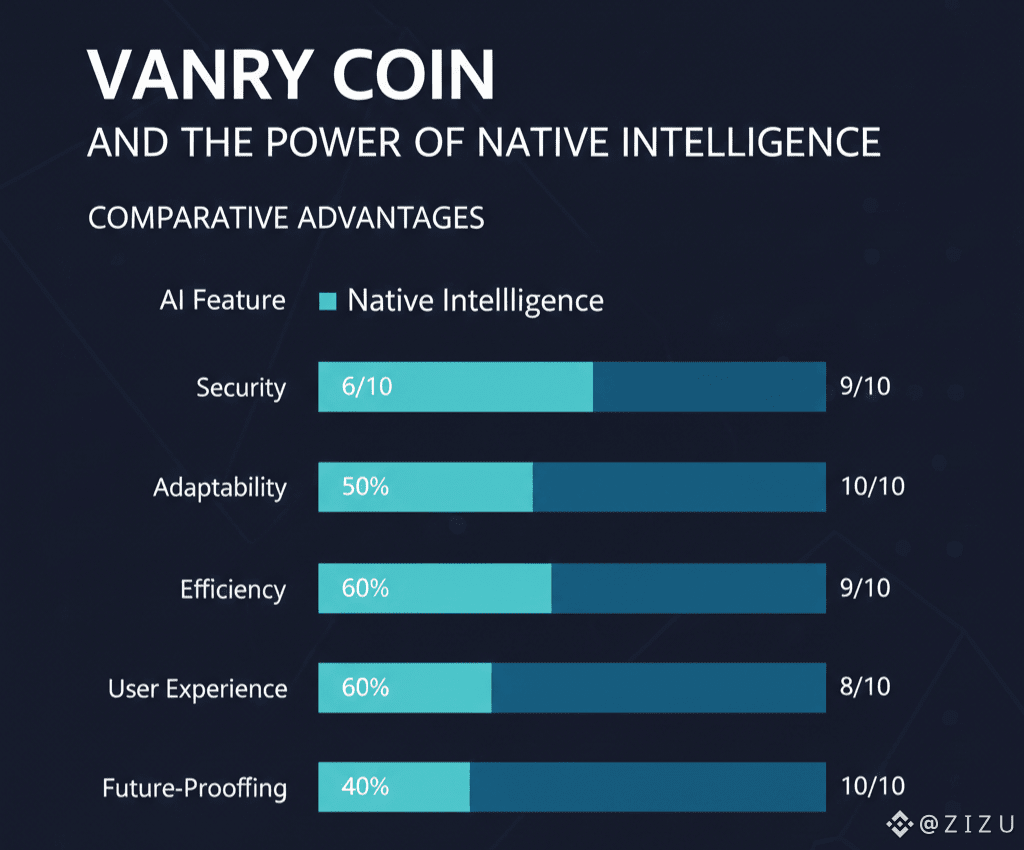
Security is another area where native intelligence shines. Traditional AI add-ons often need centralized computation or pooled data, which can create vulnerabilities. Vanry Coin’s intelligence is distributed and intrinsic. That means the network isn’t just fast and adaptive; it’s also resilient against attacks that exploit weak points in external AI systems. Personally, I see this as one of the most important advantages of native intelligence. It’s not just about convenience or efficiency, it’s about building a system that can be trusted to do its job under pressure.
Another benefit is adaptability. AI as a feature is limited by its programming and the data it’s trained on. But Vanry Coin grows organically. Each transaction and each block contribute to an evolving system. Over time, the network becomes more capable, more efficient and more intuitive, without needing constant retraining or manual intervention. To me, this is the future of blockchain: a system that doesn’t just survive in changing conditions, it thrives.
The impact on user experience is subtle but profound. With AI as an add-on, improvements are usually tied to specific tools or services. With native intelligence, everything feels smoother and smarter. Transaction confirmations happen seamlessly, state changes are predictable and the network seems to “understand” what’s happening. You don’t need to know how it works, you just notice that it works, and it works well. From my perspective, this is exactly what blockchain should feel like: powerful under the hood, effortless on the surface.
Native intelligence also enables capabilities that most AI add-ons can’t match. Think dynamic fee structures that respond to network conditions in real time, predictive state validation that prevents errors before they happen and consensus mechanisms that adjust intelligently as the network grows. These aren’t hypothetical advantages, they’re practical features that make the system more efficient for everyone. From my viewpoint, this is where Vanry Coin sets itself apart: the intelligence is structural, not cosmetic.
Finally, native intelligence makes Vanry Coin future-proof. Most AI add-ons require updates, patches and retraining to stay relevant. Vanry Coin evolves naturally as the network grows. The more the network is used, the smarter it becomes. This is critical for long-term sustainability. In my opinion, this is what differentiates a blockchain that is impressive today from one that will remain relevant for years to come.
In conclusion, the difference between AI as a feature and native intelligence is more than technical, it’s philosophical. AI as a feature can enhance, optimize or impress. Native intelligence, as Vanry Coin demonstrates, defines the system itself. From my perspective, this is not just a technical innovation; it’s a rethinking of what a blockchain can and should be. Vanry Coin doesn’t just perform better because it has AI, it performs smarter because intelligence is at its core. And that, in my view, is the future of decentralized networks.