If you’ve ever tried sending money on a blockchain, you probably know the pain. Slow confirmations, sky-high fees and uncertainty about whether your transaction will even go through during network congestion. Early blockchains gave us amazing things: security, decentralization, transparency. But when it came to moving money quickly and cheaply, they often fell short.
Enter Plasma Coin, a blockchain that doesn’t just tinker around the edges, it’s purpose-built for the one thing the old networks struggle with most: fast, low-cost stablecoin payments. From my perspective, this is a game-changer. It’s not trying to be everything for everyone; it’s laser-focused on making digital dollar transfers instant, predictable and essentially free. And that focus is exactly what the crypto space needed.
Why the Old Systems Struggle
Let’s be honest: most Layer 1 blockchains, like Ethereum or Bitcoin, are incredible feats of engineering. They protect your funds with ironclad security and keep the network decentralized, which is why so many projects are built on them. But these same strengths create a big trade-off: speed and cost.
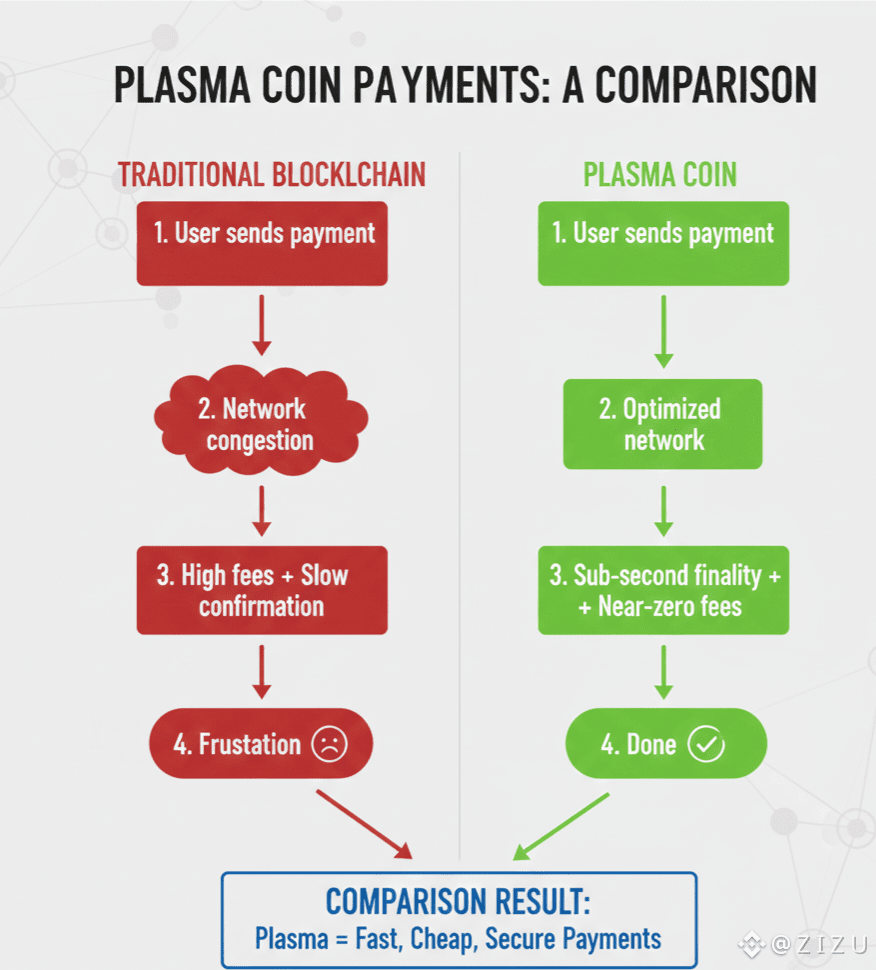
When more people use the network, transactions slow down. Fees rise because users are competing for block space. For small payments or everyday transfers, this is a nightmare. You end up paying more in fees than the value of what you’re sending and the waiting game can be frustrating. It’s one of the main reasons mainstream adoption has lagged because nobody wants to wait or pay extra just to send money.
Layer 2 solutions tried to fix this by building networks on top of the base layer, processing transactions off-chain and settling them later. It worked… but only partially. Bridges, sequencers, and multiple L2 ecosystems introduced complexity and users still had to trust someone to handle the transactions correctly. Not exactly smooth.
Plasma: A Different Approach
Plasma Coin takes a different path. Instead of patching speed onto an existing network, it’s built from scratch to handle payments quickly and cheaply. Think of it like this: if traditional L1s are highways designed for trucks carrying everything, Plasma is a dedicated bullet train for money transfers, optimized for speed, efficiency and reliability.
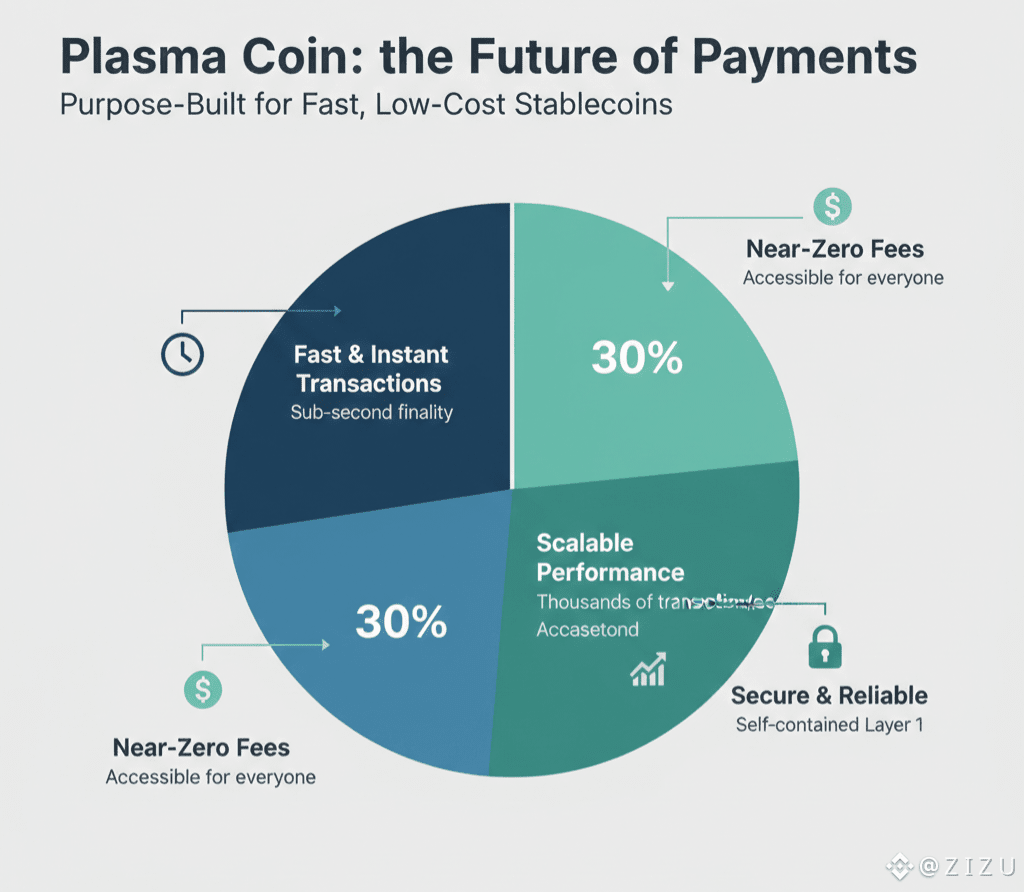
By focusing on stablecoins and digital dollars, Plasma can handle thousands of transactions per second, with sub-second finality. That means money moves almost instantly and fees are so low they’re almost invisible. From my point of view, this is exactly how blockchain payments should feel: fast, predictable and frictionless, without having to worry about congestion or bidding wars for block space.
How It Feels to Use Plasma
Imagine sending a stablecoin payment to a friend or business. On Ethereum, you might wait minutes or even longer while fees pile up. On Plasma? You send it, and it’s done. No waiting, no surprises, no “did my transaction go through?” anxiety.
This experience is transformative for anyone using blockchain for daily transactions, cross-border payments or even enterprise-level transfers. It finally brings crypto payments closer to the feel of Web 2.0 apps, where things just work but with the security and transparency only blockchain can provide.
Security Without Compromise
Speed and low fees are great but only if the network is secure. Plasma doesn’t cut corners. Every transaction is immutably recorded on-chain and the consensus mechanism protects against fraud, double-spending or network attacks. Unlike some L2 networks that inherit security from another blockchain and rely on external sequencers or bridges, Plasma is self-contained. That’s a big deal, it removes points of failure and gives users real confidence that their funds are safe.
From my perspective, this balance is what makes Plasma special. It’s not just fast and cheap; it’s fast, cheap and secure, a combination that has been surprisingly rare in crypto.
Real-World Applications
Plasma Coin’s design makes it perfect for a range of real-world use cases:
Stablecoin Payments: Everyday transfers become simple and free, whether you’re paying a friend, a merchant, or a service provider.
Cross-Border Transactions: Sending money internationally is nearly instant and dramatically cheaper, benefiting individuals and businesses alike.
Micropayments: Tips, small subscriptions or in-game purchases are now feasible because transaction costs don’t eat up the payment itself.
Enterprise Use Cases: Businesses venturing into Web3 can process high-volume payments with confidence, knowing speed and security are built into the network.
Why Plasma Feels Different
From my experience, what sets Plasma apart is the user-centric focus. It doesn’t require understanding complex bridges, managing multiple wallets or navigating fragmented L2 ecosystems. It’s a network built for the people using it, not for developers trying to patch together performance. The benefits of L2s, speed, efficiency, low fees, are baked in at the base layer. That simplicity is rare and extremely valuable.
The future of blockchain will likely be modular and specialized. Different networks will optimize for gaming, trading, payments or DeFi. Plasma Coin is a glimpse of what’s possible when a blockchain is designed with a single, high-priority goal: seamless, low-cost, scalable payments.
From my perspective, Plasma is more than a coin, it’s infrastructure for the next generation of financial systems. It shows that scalability, speed and cost-efficiency don’t have to come at the expense of security. As stablecoins and digital dollars become more central to the global economy, networks like Plasma are going to be the backbone that enables instant, low-cost and reliable money movement worldwide.
In short, Plasma Coin proves that blockchain payments can finally feel effortless. Transactions that used to be slow, expensive and frustrating now happen instantly, securely and at almost no cost. For anyone who’s tired of the old L1 limitations, Plasma isn’t just a solution, it’s a glimpse of what the future of money could and should be.