

I remember the moment it clicked.
I was thinking about storage the old way — as “where data lives.”
You upload a file, and it stays in some place until someone deletes it.
Walrus made me throw that assumption away.
Instead of treating storage as a static container, Walrus treats storage as a composable part of logic itself — something that apps don’t just point to, but build around and react to. That subtle shift transforms how systems are architected.
To understand why this matters, you need to look past the surface.
Most storage layers — centralized clouds or even other decentralized protocols — treat data as inert objects sitting in buckets. You request them. You cache them. You mimeographed availability with mirrors and backups. Developers glue these to their applications with external processes and heuristics. The storage layer itself is not a participant in application behavior.
Walrus flips that script entirely.
On Walrus, data isn’t just stored — it becomes an active, addressable resource in the same computational fabric as the apps that consume it. Because blobs and storage capacity become objects on the Sui blockchain, they can be referenced directly in smart contracts, not just by off-chain middleware. This is fundamental: data becomes something live for programmable interactions, not something passive you look up when you need it.
Most systems externalize data logic — they only expose retrieval APIs. With Walrus, the data itself is part of the on-chain universe. Developers can program around storage states, query availability, react to lifecycle changes, and embed data conditions into contract flows. You can’t do that with simple URLs or hash pointers. That is composability.
That difference opens doors that most architects hardly consider until they hit complexity walls.
Imagine a protocol that needs data semantics — not just data bits.
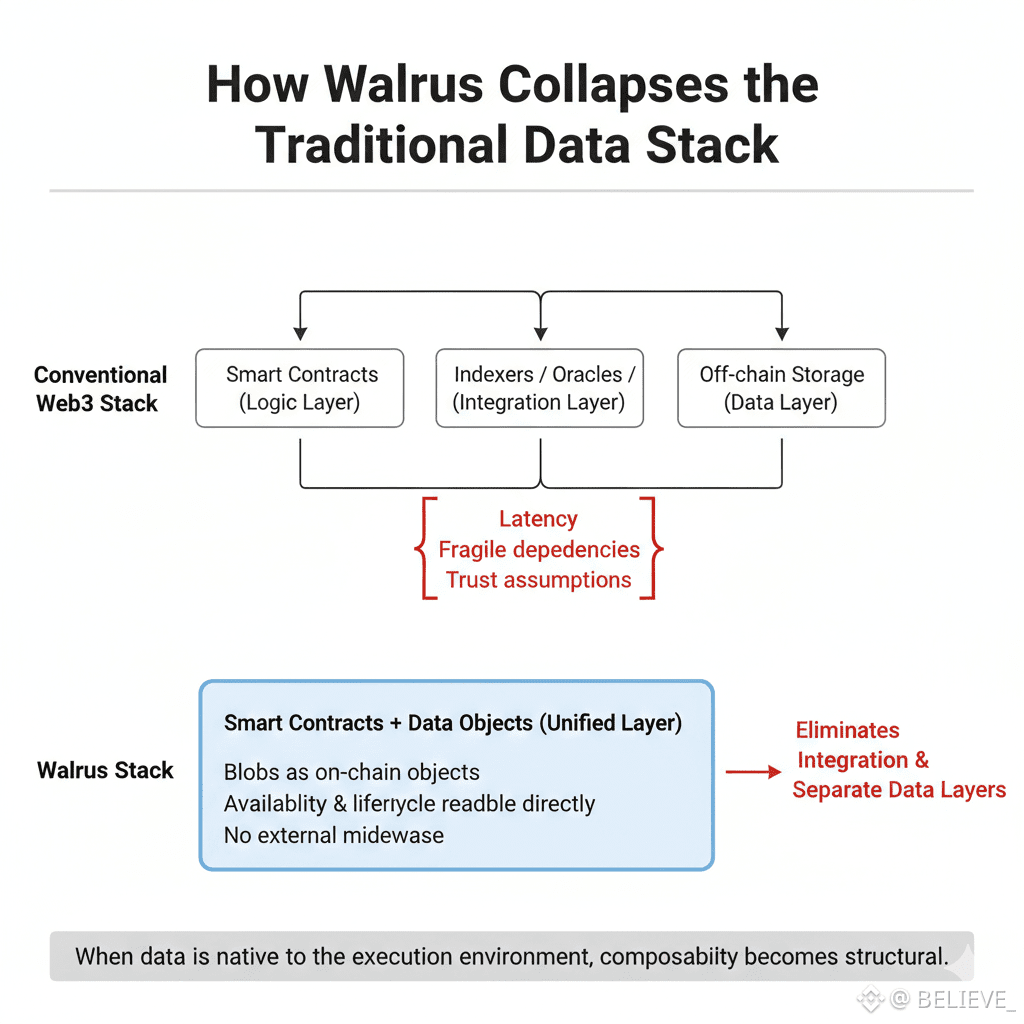
Traditionally, developers embed logic outside the storage layer: indexing services, oracle relays, validators, off-chain watchers. Each point of dependency introduces latency, points of failure, and trust assumptions.
Walrus collapses that stack. Data doesn’t sit off at the edge of application logic; it becomes part of it. Once a blob is stored, it is on the same plane that smart contracts live in — with metadata, availability, and lifecycle visible and programmable.
That shift changes how you compose systems.
In traditional app design, you have:
A logic layer (smart contracts or on-chain code)
A data layer (off-chain storage)
An integration layer (middleware to glue them together)
In Walrus, the data layer becomes part of the logic layer. You no longer need expensive, fragile bridges just to let your application depend on data state as a first-class citizen. It means developers can build interactions like:
Trigger actions only if certain large datasets remain available
Automatically renew storage commitments based on on-chain events
Write workflows that depend on data presence rather than assume it
Share the same data across multiple protocols with verifiable state
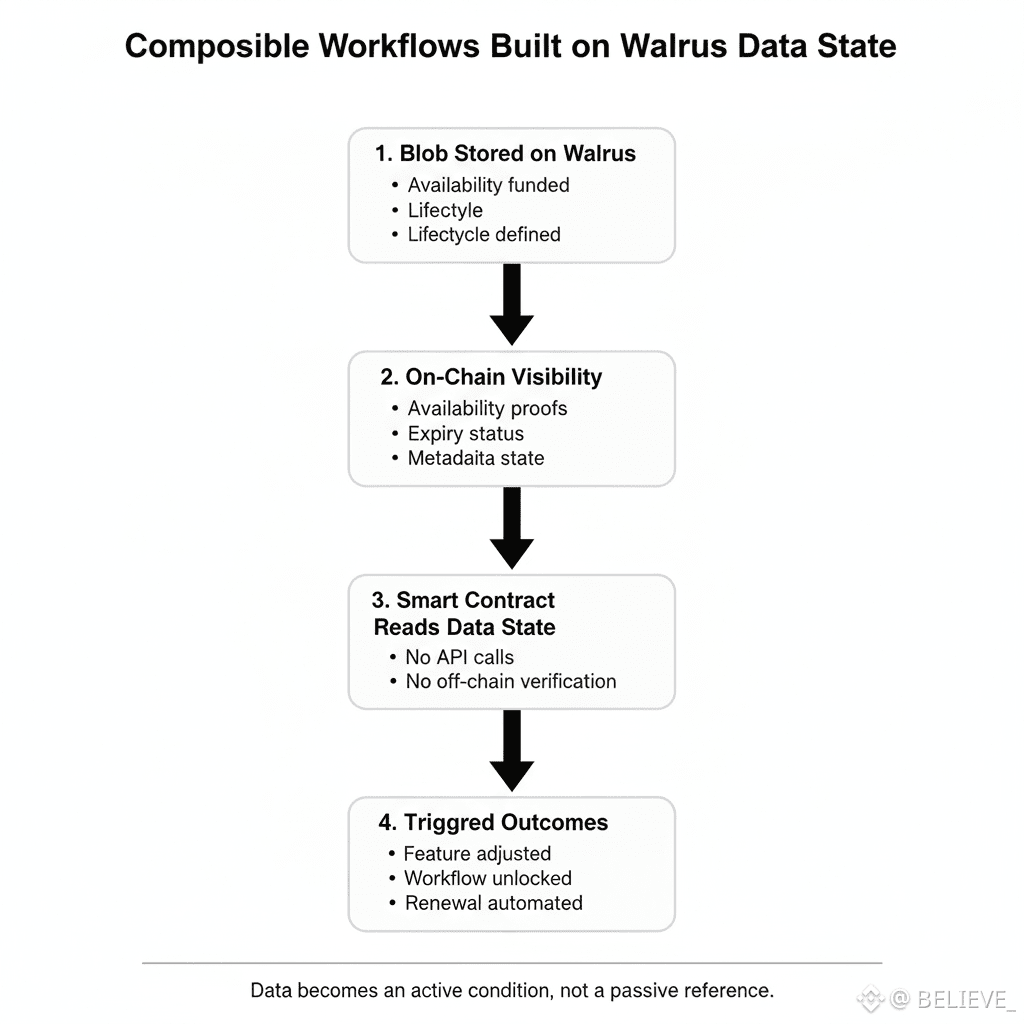
Those capabilities matter when you’re building true composability — where separate protocols, services, and contracts can trust the same data without external glue.
Think about decentralized applications that exchange context, not just tokens. Building logic that reacts to dataset states — say, adjusting payouts based on record availability, or gating features until data proofs exist — becomes straightforward because the storage layer participates in the same semantic space as the rest of the protocol.
And because this is all coordinated through the Sui blockchain, data availability isn’t a black box you query via external processes. It’s anchored in the same global state machine the contracts live in. That makes verification cheap, auditable, and reliable.
There are deeper architectural consequences as well:
1. Composable Data Is Permissionless — Protocols don’t need to grant API keys or whitelists to one another. If a blob exists with a valid proof, anyone can build on it.
2. Programmatic Lifecycles Reduce Waste — Storage doesn’t sit forever by accident. Apps can build their behavior around intent and expiration, making cleanup a product of logic rather than manual policy.
3. Cross-Protocol Interdependence Is Native — Multiple ecosystems (Sui, Ethereum, Solana) can rely on the same storage truth because the proofs themselves are machine–verifiable.
4. Data Becomes a Triggered Participant, Not a Passive Bystander — When availability or metadata matters for a workflow, that condition can be read directly on-chain.
This is why Walrus feels like a foundation rather than a service. A typical storage network provides a place to stash files. Walrus provides a plane where data and logic unify, enabling interactions that aren’t possible when storage is external to the computational stack.
In the future, this will matter more than raw capacity or throughput numbers. Because as systems grow interconnected, the real constraint won’t be “where is this data?” but how can this data participate in protocol behavior without fragile middleware?
Walrus answers that question not with bells and whistles, but with design — by making storage computationally composable rather than a silo.
And once you start designing systems that think of storage as live infrastructure, everything downstream — coordination, verification, logic, automation — becomes simpler, more robust, and more expressive.
That’s the quiet but profound shift Walrus is building toward.

