
Most blockchains depict the world in extremes: either everything is forever public, or everything is forever hidden. Anyone with real financial experience knows this is pure fantasy. Companies don't operate openly, regulators don't accept blind trust, and neither side wants immediate disclosure of every transaction. It was this paradox that drew me to the DUSK network.
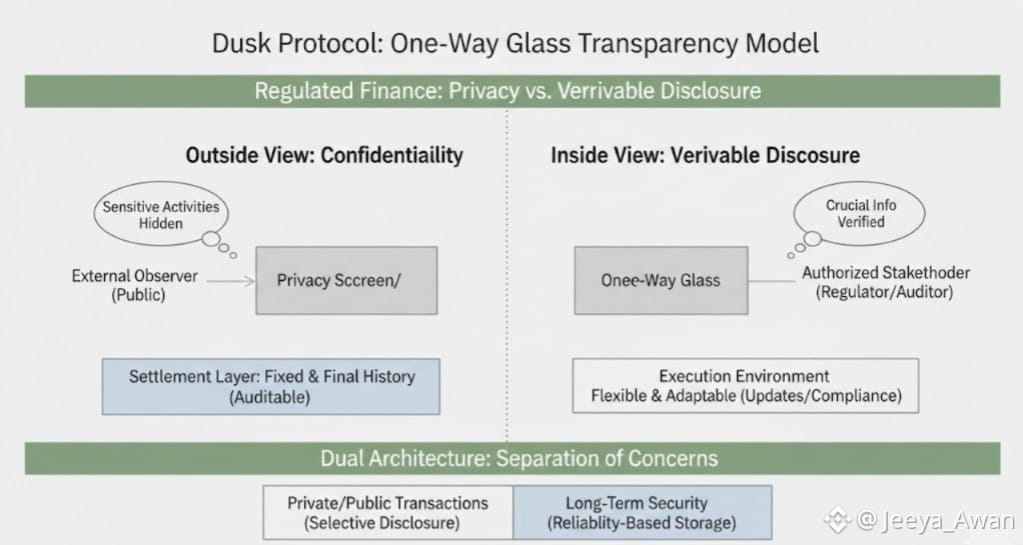
I found the best mental model for the DUSK network to be one-way glass. From the outside, sensitive activities remain confidential. From the inside, stakeholders can verify which information is crucial at critical moments. This balance—privacy versus verifiable disclosure—is the very definition of regulated finance, and the DUSK network is one of the few blockchains designed to adapt to rather than resist this reality.
DUSK's architecture makes it even more attractive. It separates settlement and execution in a way that is closer to traditional market structures than to cryptocurrency experiments. Settlement is treated as fixed and final, while the execution environment allows for continuous evolution. This constraint isn't fancy; it's exactly how a system should be constructed in anticipation of audits, updates, and regulatory pressures.
DUSK also avoids adhering to a single ideological model. Transactions can be public or private, and can be selectively disclosed when necessary. The transparency requirements vary across different stages of the financial process, and Dusk accepts these differences rather than imposing a single model. Privacy is not absolute, but rather a control mechanism.
What happened after the mainnet launch further convinced me of this. Building a two-way bridge with the BNB Smart Chain was no easy feat, but it was an honest undertaking. Liquidity and convenience are paramount. Dusk didn't pretend privacy could exist in isolation; it accepted trade-offs and continued to move forward.
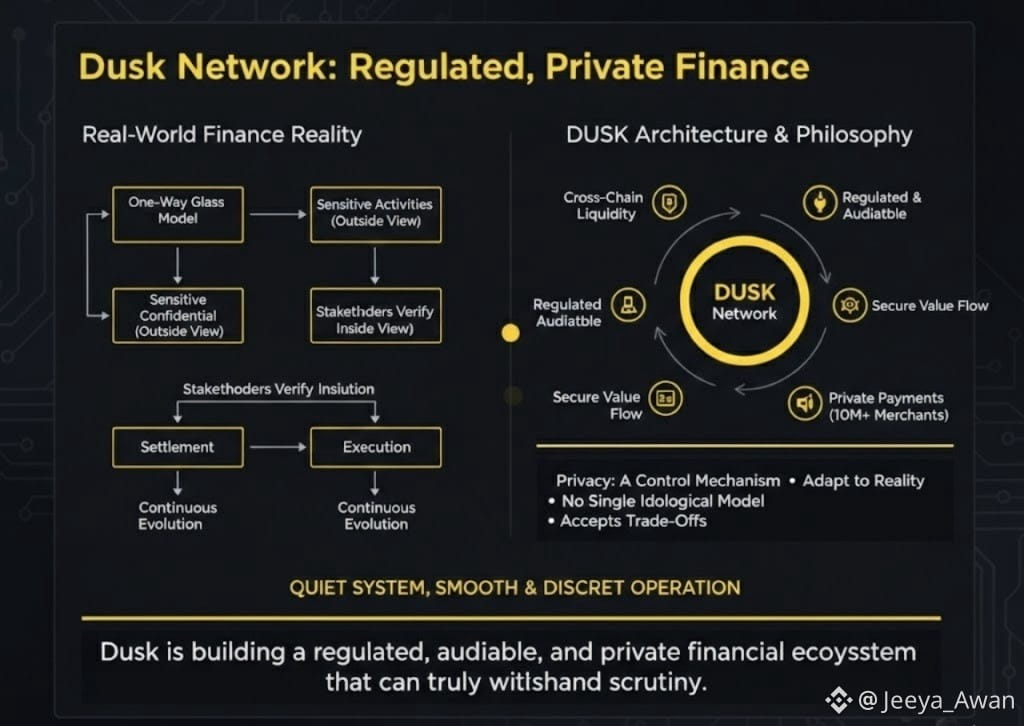
Even storage reflects this philosophy. The rules discourage frequent redistribution and reward reliability rather than precise timing. It's not aimed at short-term gains, but at long-term security, which is precisely what institutions care about most.
Dusk doesn't seem to intend to replace the financial industry, but rather to carve out its place on the blockchain without revealing all information or blindly trusting. If successful, it won't cause any commotion. A quiet system will operate smoothly and discreetly. In the financial world, this is often the true mark of success.
