
Plasma begins in a place that is deeply human long before it is technical, because it starts with a feeling many people know too well but rarely say out loud, the quiet fear that comes with sending money and waiting, watching a screen, wondering if it will arrive, wondering if something invisible will go wrong, wondering if trust was misplaced again. For years, stablecoins have quietly carried the weight of real lives, not as an experiment or a trend, but as a lifeline for people dealing with inflation, broken banks, capital controls, distance, and urgency. They became the money people used when nothing else worked, yet they were forced to live on blockchains that never truly cared about how fragile that trust was. Plasma exists because someone finally paid attention to that emotional gap, because someone noticed that the tools people depend on most are still built on foundations that feel cold, complicated, and indifferent to human stress.
Instead of trying to impress the world with novelty, Plasma chooses to build with empathy, and that choice shapes everything that follows. It keeps full EVM compatibility not because it is easy, but because it respects the time, effort, and trust developers and institutions have already invested in existing systems. It understands that progress does not always mean tearing everything down, and that sometimes the most humane decision is to meet people where they already are. On top of that familiar ground, Plasma introduces its own consensus layer designed for sub second finality, and this is where something subtle but powerful happens. When money settles almost instantly, anxiety softens. That small tight feeling in the chest between clicking send and seeing confirmation begins to fade. Businesses stop hesitating. People stop holding their breath. Finality becomes not just a technical property, but an emotional one.
The decision to anchor security to Bitcoin carries a similar emotional weight. Bitcoin represents time, resistance, and endurance in a way very few systems ever have, and Plasma leans into that reality without turning it into a slogan. By anchoring to something slow and stubborn, Plasma gives its fast execution layer a sense of calm beneath the surface, like a deep foundation that does not move even when everything above it is busy and loud. Users may never think about this anchoring, and that is exactly the point. Trust works best when it does not demand attention, when it simply holds.
At the heart of Plasma is a choice that feels almost obvious once you see it, which is to treat stablecoins not as an application, but as the reason the system exists at all. Gasless USDT transfers are not just a feature, they are a release from confusion, from the need to hold something volatile just to move something stable, from the mental gymnastics that have kept so many people feeling like crypto was never meant for them. Stablecoin first gas makes costs feel predictable and familiar, aligning the system with how people already think about money. Plasma does not ask users to change their instincts. It adapts itself to them.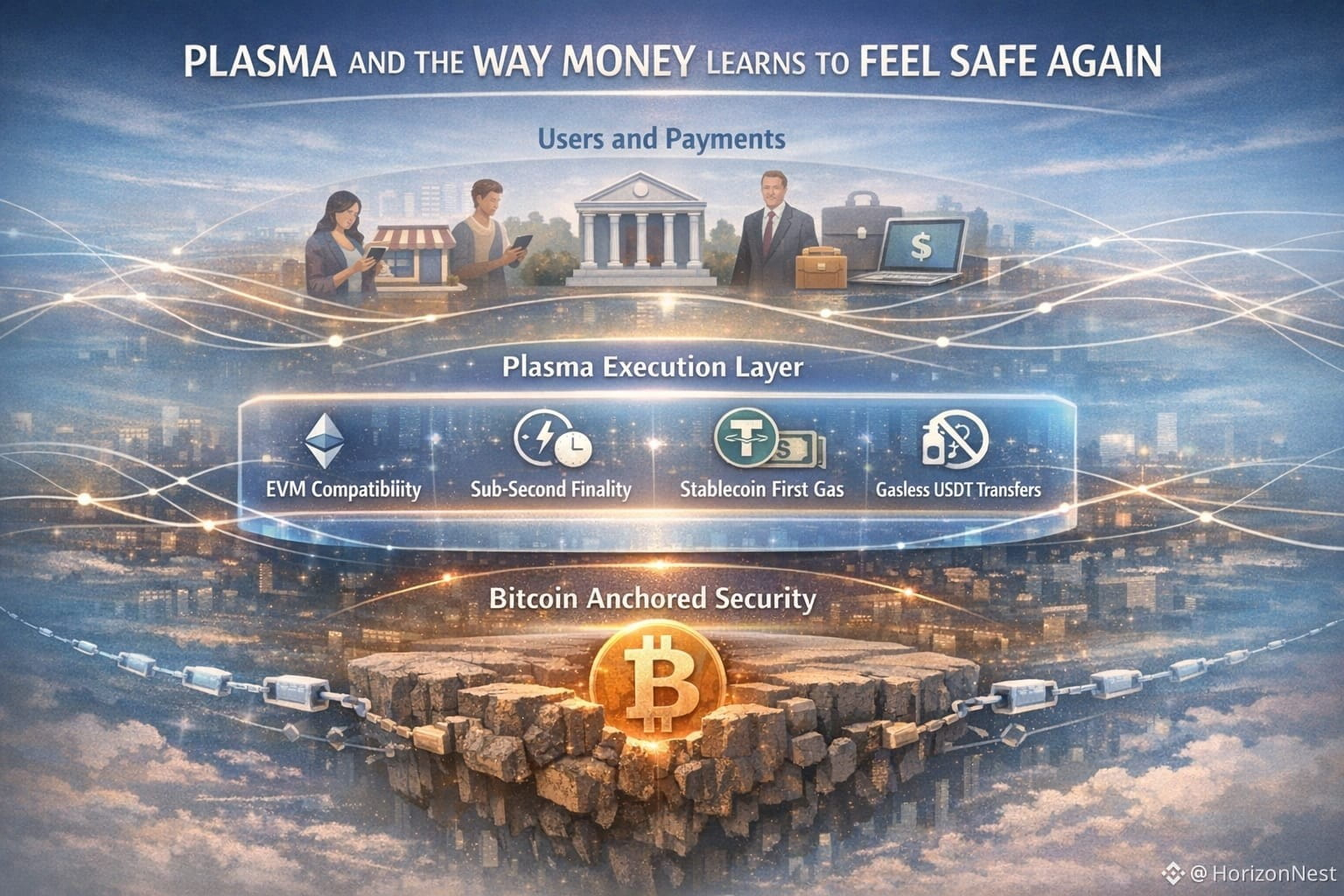
Operationally, Plasma is designed to disappear, and this may be its most ambitious promise. Validators, consensus, finality, anchoring, all of it works quietly in the background so people can focus on their lives rather than the machinery moving their value. Payments settle quickly. Balances update without drama. Applications behave consistently even when demand rises. This kind of reliability rarely creates excitement, but it creates something far more valuable, which is the confidence to build, to plan, to rely. When financial infrastructure becomes boring, it becomes safe.
The health of a system like Plasma is not found in loud metrics or speculative excitement, but in calm behavior over time. Stable fees during moments of stress. Consistent finality when volume spikes. Institutions increasing usage slowly and quietly because nothing breaks. Merchants stopping the endless debate about which chain to trust. These signals do not trend, but they tell the truth. Healthy infrastructure does not shout. It supports.
Plasma’s economic design reflects a deep awareness of how easily financial systems lose their way when speculation becomes louder than purpose. Incentives are shaped to reward reliability, honesty, and long term participation rather than short term extraction. Users are shielded from the kind of volatility that erodes trust and exhausts attention. By centering stablecoins in everyday activity, Plasma allows real economic behavior to grow naturally, creating space for patience, planning, and responsibility. It invites people to think beyond the next transaction and toward continuity.
What makes Plasma unusual is that it does not force a choice between people at the edges of the financial system and institutions at its center. For individuals in high adoption regions, it offers speed, clarity, and dignity without demanding technical sophistication. For institutions, it offers predictability, auditability, and settlement that feels serious enough to trust. Plasma suggests that these needs are not opposites, but parts of the same story, and that neutral infrastructure can serve both without compromise.
Of course, building something that touches money at scale means accepting risk, scrutiny, and responsibility. Regulatory pressure, governance challenges, reliance on stablecoin issuers, and the complexities of anchoring to external systems are all real and present. Plasma does not pretend otherwise. It approaches these risks with humility, with an understanding that trust must be earned continuously and that adaptation is not weakness but maturity.
If Plasma succeeds, it will not feel like a revolution. It will feel like relief. It will feel like sending money without that familiar knot of worry. It will feel like payments settling before doubt has time to form. It will feel like infrastructure that respects human attention instead of consuming it. The future it points toward is not loud or dramatic, but quiet, dependable, and humane.
In the end, Plasma is not just about speed or compatibility or settlement layers. It is about respect. Respect for time. Respect for trust. Respect for the emotional reality of money. By listening closely to how people already use stablecoins and reshaping itself around that truth, Plasma suggests that the future of money does not need to be aggressive or overwhelming. It can be gentle. It can be stable. It can finally feel safe.

