
The moment that usually breaks my confidence in stablecoins isn’t when I send them. It’s later, when I try to explain what happened. Which transaction settled first, which one waited, why fees were different for identical transfers, and why a “final” payment briefly looked reversible in the explorer. None of this feels catastrophic, but it feels messy. And money is not supposed to feel messy.
That’s the quiet problem Plasma seems to be focused on.
Most blockchains obsess over the act of sending money. Plasma appears more interested in what happens after the send button is pressed — when balances need to make sense, records need to line up, and nobody wants to debate edge cases. In other words, Plasma is less about movement and more about closure.
That’s an unglamorous goal, but it’s a revealing one.
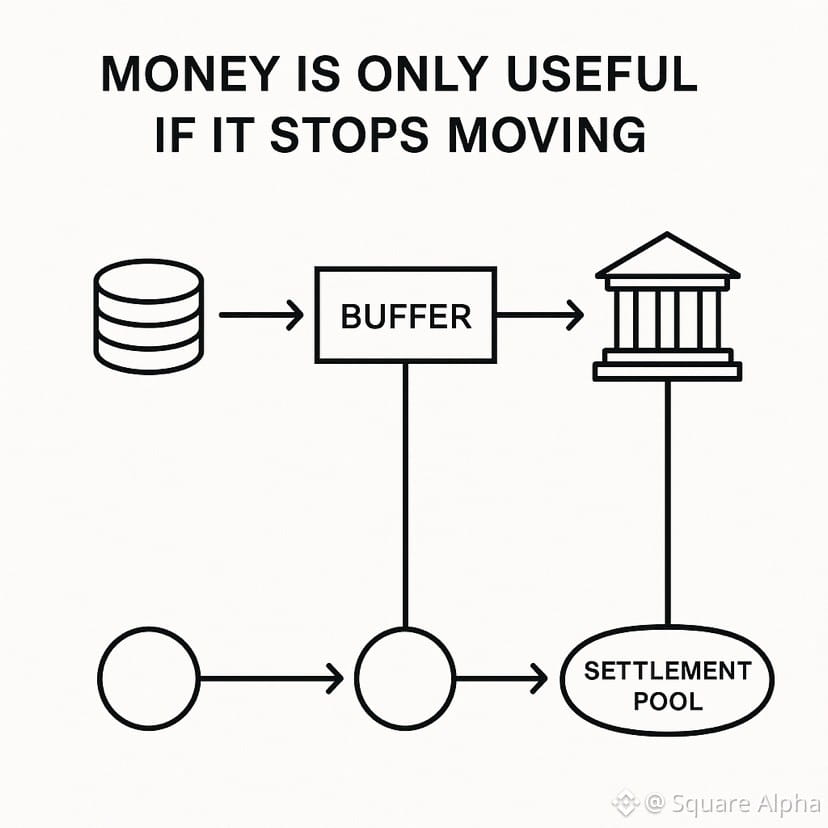
Money Is Only Useful If It Stops Moving Cleanly
In real financial systems, money spends most of its time not moving. It sits in accounts, buffers, treasuries, and settlement pools. The infrastructure around it exists to ensure that when it does move, the result is legible and final. Crypto often flips this priority. Activity is celebrated. Stillness is ignored.
Plasma feels like it starts from the opposite assumption. Stablecoins already behave like digital dollars, so the chain underneath them should behave like accounting infrastructure, not a trading venue. That mindset changes what “success” looks like. The goal isn’t maximum throughput or expressive contracts. The goal is reducing the number of questions a transaction creates downstream.
Predictability Beats Speed in Real Payments
Plasma’s fast finality is often described as a performance feature, but its real value is psychological. Payments that settle deterministically remove the need for follow-up checks. There’s no “wait a few blocks,” no probabilistic language, no awkward monitoring window. Once it’s done, it’s done.
That distinction matters far more to businesses than to traders. Finance teams don’t operate on confidence intervals. They operate on ledgers. Plasma’s design leans into that reality by prioritizing consistency over drama. It’s not trying to impress anyone with raw numbers. It’s trying to eliminate second-guessing.
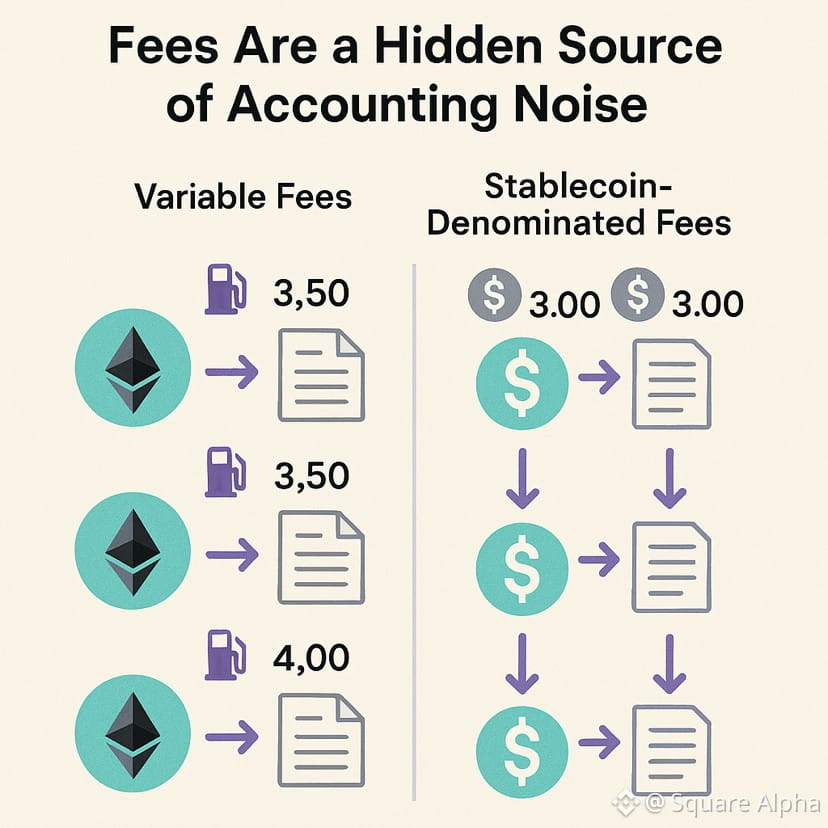
Fees Are a Hidden Source of Accounting Noise
Gas is usually framed as a UX problem, but it’s also an accounting one. Variable fees create variable records. They complicate reconciliation and make identical actions look different on paper. Plasma’s approach to stablecoin-denominated fees — and in narrow cases, gasless transfers — reduces that noise.
This isn’t about making everything free. It’s about making costs predictable and denominated in the same unit being transferred. When fees are paid in stablecoins, the system stops asking users to mentally convert between abstractions. That sounds minor until you’ve tried to manage operations at scale.
EVM Compatibility as a Risk Reduction Strategy
Plasma’s EVM compatibility is easy to dismiss as table stakes, but it serves a deeper purpose here. Familiar tooling reduces operational risk. Developers don’t need to relearn execution semantics. Auditors don’t need to reinterpret behavior. Existing assumptions carry over.
That continuity matters when the goal is trust, not novelty. Payment systems don’t win by being clever. They win by being boring in recognizable ways. Plasma seems comfortable inheriting those constraints instead of reinventing them.
The Quiet Role of XPL
In this structure, the native token, $XPL, doesn’t try to compete with stablecoins for attention. It exists to secure the network, coordinate validators, and absorb complexity that users shouldn’t have to think about. That’s a restrained role, but it’s a coherent one.
If the system works as intended, most users will never care about $XPL — and that may be the point. Infrastructure tokens that demand constant participation usually indicate a system compensating for friction elsewhere.
Adoption That Shows Up in Records, Not Headlines
Plasma doesn’t look like a chain chasing excitement. Its activity profile suggests repetition rather than experimentation. Lots of similar transfers. Stable assets dominating value flow. Few surprises. That pattern won’t trigger hype cycles, but it does signal something else: routine use.
Routine is the hardest thing to fake and the hardest thing to replace. Once workflows depend on predictable settlement, switching costs rise quietly.
What Plasma Is Really Betting On
Plasma’s bet is that crypto’s next phase will punish inconsistency more than it rewards innovation. As stablecoins continue to function as real money, the systems moving them will be judged by the same standards as financial infrastructure: clarity, finality, and explainability.
If Plasma succeeds, it won’t be because people talk about it. It’ll be because they stop needing to.
That kind of success doesn’t trend — but it lasts.