
Most blockchains want you to believe in them.
Vanar seems more interested in being relied on.
That difference sounds subtle, but it’s structural.
When you interact with most chains, you’re constantly reminded that you’re “using crypto.” Wallet prompts, fluctuating fees, failed transactions, warnings about congestion. The system asks for your patience, your understanding, sometimes even your forgiveness.
Vanar feels like it was designed by people who assume users won’t offer any of that.
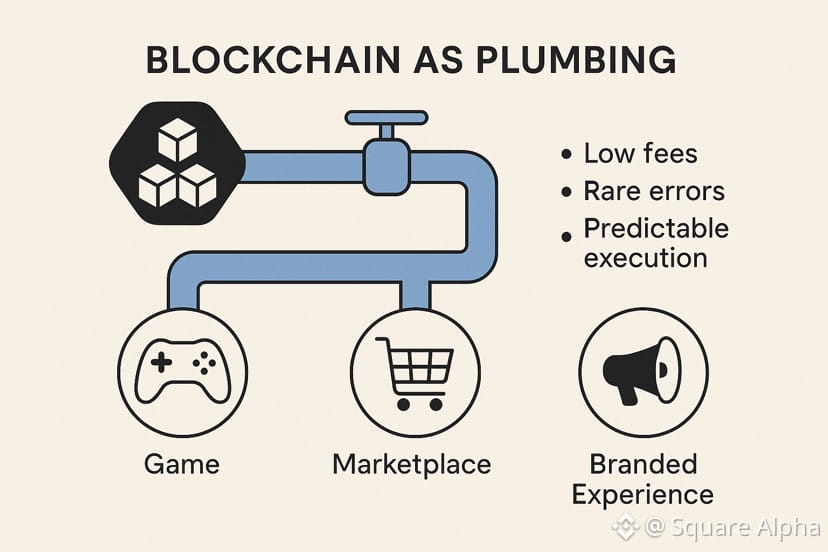
Instead of framing blockchain as a destination, Vanar treats it as plumbing. Something that should work quietly in the background while the actual product—whether a game, a marketplace, or a branded experience—takes center stage.
That mindset immediately narrows the design space. If users won’t tolerate friction, fees can’t behave like auctions. If users won’t read documentation, error states must be rare. If users won’t wait, execution must be predictable.
This is why Vanar’s fee model matters more than most people realize. The goal isn’t to be the cheapest chain on a good day. It’s to be boringly consistent every day. Costs are meant to map to real-world expectations, not market mood swings. That’s not exciting to traders, but it’s essential for anyone building consumer-facing software.
You can’t design a game economy if the cost of an action is unknowable.
You can’t run a marketplace if checkout feels like rolling dice.
Vanar treats unpredictability as a design failure, not a feature.
That same practicality shows up in how the network thinks about ordering and execution. Removing bidding wars from transaction priority isn’t about fairness narratives—it’s about making sure systems behave the same way every time. Automated processes don’t negotiate. They assume rules hold.
And that’s the recurring theme: assumptions that hold.
Governance follows the same logic. Rather than chasing maximum decentralization immediately, Vanar appears to prioritize responsibility first. Validators are curated, performance is monitored, and participation is structured. For crypto purists, that’s uncomfortable. For anyone who has shipped real infrastructure, it’s familiar.
Decentralization is powerful once systems are stable. Before that, it’s often just an excuse for nobody being accountable.
What makes Vanar more than just “another chain with opinions,” though, is how it treats data. Most blockchains are excellent at proving that something happened and terrible at preserving why it mattered. Context gets lost, fragmented, or pushed off-chain entirely.
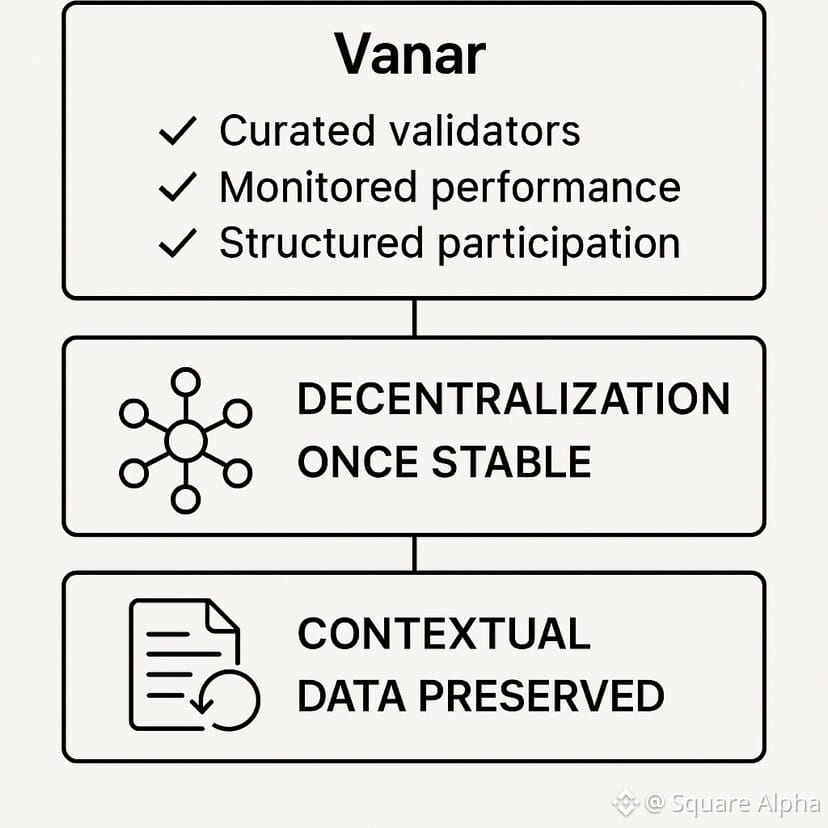
Vanar’s approach suggests that context itself is infrastructure. Compressing, verifying, and referencing information in a way applications can actually use turns the chain into something closer to a shared memory than a ledger. That matters for games, digital identities, branded assets, and eventually automated agents that need more than raw transaction logs.
This is where AI quietly enters the picture—not as a buzzword, but as a constraint. Intelligent systems don’t need blockchains to think. They need blockchains to remember consistently, settle reliably, and prove outcomes. Vanar seems designed with that division of labor in mind.
$VANRY fits this philosophy by not demanding attention. It exists to make the system function: paying for execution, securing the network, moving between ecosystems. The presence of interoperability options signals something important—the team expects value to flow outward, not remain captive.
That’s a confidence play.
Projects obsessed with control try to trap users. Infrastructure designed for longevity assumes movement is inevitable and designs for it.
The biggest compliment I can give Vanar is that it doesn’t feel like it’s trying to win a cycle. It feels like it’s trying to survive several. The choices being made—predictability over flexibility, responsibility over ideology, service over spectacle—are the kinds that rarely produce explosive moments, but often produce endurance.
The real question isn’t whether Vanar becomes famous.
It’s whether people keep using products built on it without ever thinking about why they work.
If that happens, Vanar will have done exactly what it set out to do.