
Most people still look at blockchains the way they look at sports cars. Speed numbers, acceleration, flashy specs, loud marketing. I look at the chains that actually survive and they feel more like payment networks or airports. They are not exciting. They are boring, rigid, and dependable. They work when things are messy. That is where Vanar Chain is quietly placing its bet.
The most unusual thing about Vanar right now is not AI narratives, metaverse ideas, or ultra cheap fees. It is something far less glamorous and far more important. Vanar is obsessed with network hygiene. I mean the idea that the chain should keep functioning even when nodes misbehave, connections fail, or actors try to fake participation. That is not a headline friendly goal, but it is the kind of ambition that matters when you want real payments, real games, and enterprise systems to trust your chain.
I keep coming back to this thought. Anyone can make a fast demo in perfect conditions. Very few can make a network that stays upright when conditions are bad.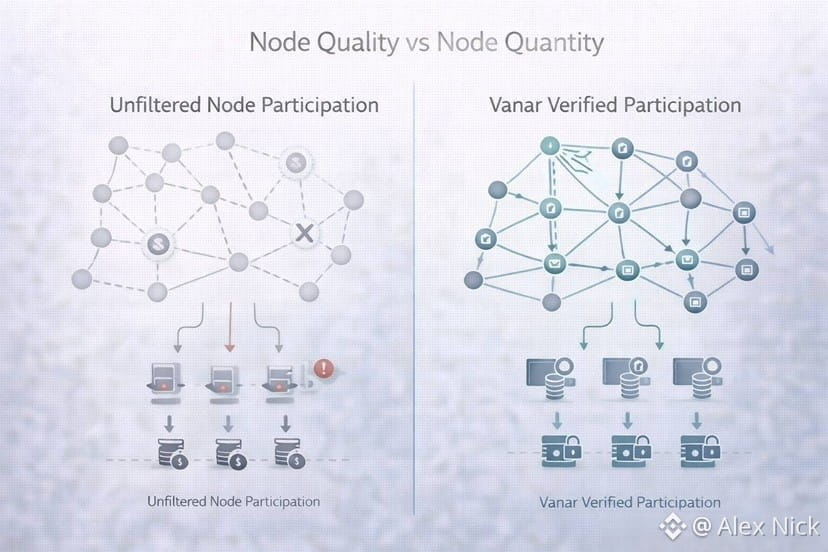
Why the V23 upgrade is really about reliability
When people hear about V23, they often expect shiny new features. That misses the point. V23 is better understood as a rethink of how the network agrees in real world conditions. Vanar has openly drawn inspiration from the Stellar SCP model, which itself is built on Federated Byzantine Agreement.
What that changes is the mental model of consensus. Instead of asking who has the most stake or raw power, the system asks which sets of nodes can reliably agree even when some participants fail or act poorly. Real networks are never clean. Servers get misconfigured. Latency spikes. Sometimes people act in bad faith. A design inspired by FBA assumes this chaos and keeps moving anyway.
To me, that is a reliability upgrade, not a marketing upgrade. The goal is that users never have to think about consensus at all. It just works in the background.
The unglamorous fight against fake and broken nodes
One detail that stood out to me is how Vanar talks about node quality. This is the boring work most people avoid. In many networks, low quality nodes can exist quietly. Some are misconfigured. Some are unreachable. Some pretend to be active just to earn rewards or cause problems later.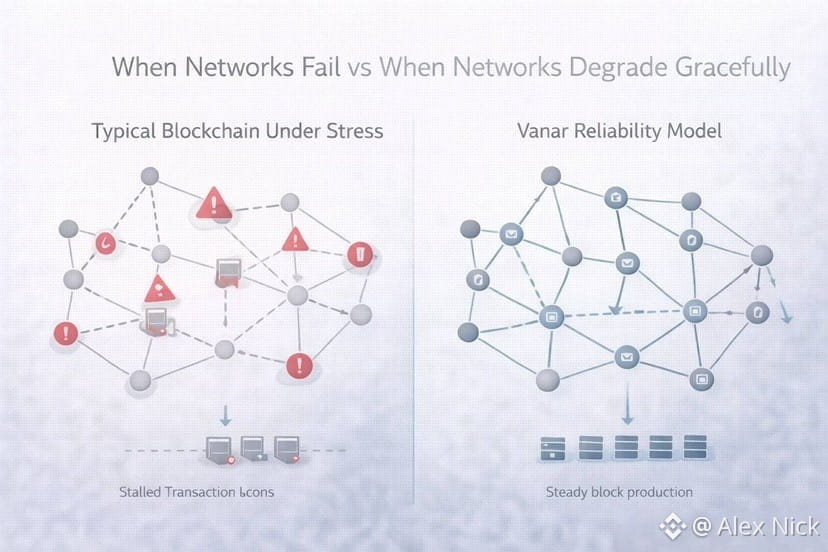
Vanar has been explicit about open port verification and reachability checks. In simple terms, if a node wants rewards, it must prove it is actually reachable and contributing at the network layer. Existence alone is not enough.
That sounds dull, but this is exactly how production systems behave. In normal software, we call this health checks and observability. Vanar is treating its validator set like a live service, not a theoretical experiment. To me, that signals maturity.
Scaling is not speed, it is surviving ugly traffic
People love to talk about scaling as more transactions per second. I see scaling differently. Scaling is doing more transactions without strange failures. Real users are not polite. They arrive in bursts. They trigger edge cases. They stress parts of the system no testnet ever touches.
This is why Vanar’s focus on maintaining steady block cadence and controlling state under load matters. When a chain claims it can keep a consistent rhythm during spikes, that is not hype. It is trying to earn the kind of trust payment systems need.
I believe trust is built during bad moments. When something fails and the network still behaves predictably.
Upgrades that do not scare builders
Another quiet problem in crypto is upgrade chaos. Many networks treat upgrades like events. Downtime. Manual steps. Confusion. Node operators scrambling. That is not how serious systems operate.
Vanar’s V23 framing talks about smoother ledger updates and faster confirmations in a way that makes upgrades feel routine. This may sound small, but it changes behavior. When developers fear upgrades, they build less. When validators fear upgrades, networks stagnate. When users fear upgrades, confidence disappears.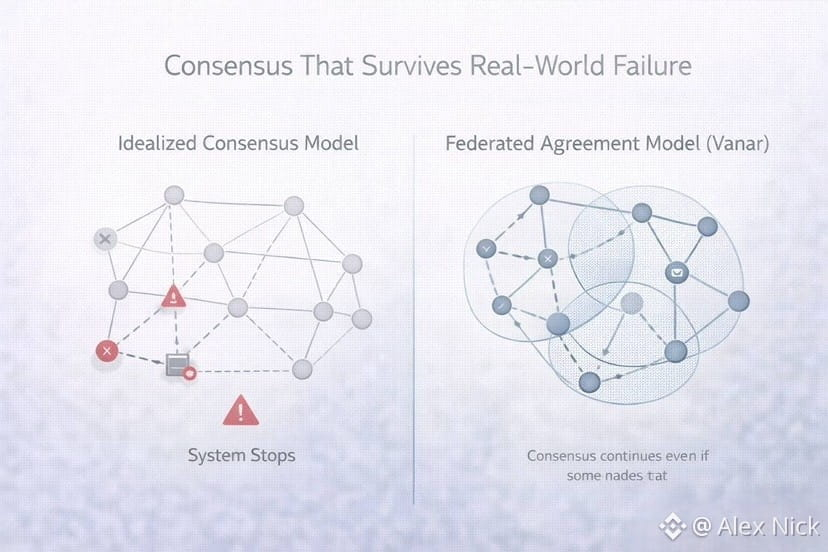
Invisible upgrades are a sign of infrastructure maturity. That is how airlines reschedule flights. Planned, coordinated, minimal drama. Vanar seems to be aiming for that standard.
Why borrowing from Stellar is a philosophy choice
Some people frame borrowing ideas from Stellar as copying. I see it as choosing a payments grade philosophy. Stellar was designed around the idea that trust grows over time. Controlled trust first, broader decentralization later.
That philosophy aligns with real systems. Instant permissionless chaos rarely produces reliability. If Vanar wants to support micro payments, finance rails, and always on agent activity, it makes sense to lean into designs that prioritize uptime and agreement over ideology.
To me, this says Vanar wants to be paid grade reliable before it wants to be flashy.
The real product is confidence
This is the idea I keep circling back to. The best blockchains are not execution engines. They are confidence machines.
I ship when I trust the system will not surprise me. Payments become real when businesses trust transactions will not fail at the worst moment. Games go mainstream when developers trust the backend will not collapse during peak traffic.
Vanar’s focus on filtering, reachability, and hardening builds that confidence quietly. It makes the chain interesting in the least exciting way.
What success actually looks like
If Vanar succeeds, it will not show up as viral tweets. It will be quieter.
A developer will say we launched and nothing broke.
An operator will say upgrades were smooth.
A user will say it just worked.
That is what the strongest networks feel like. They stop feeling like crypto. They feel like software.
Why this story matters right now
Crypto loves shiny narratives. Real ecosystems are built from habits. Good security. Good upgrades. Good consensus that does not melt under pressure.
In the V23 era, Vanar is competing on the boring layer where real systems live. Its emphasis on reliability, node quality, and payments grade thinking suggests a network that wants to reduce risk rather than amplify excitement.
