

Most people noticed Walrus when it started mentioning AI integrations and moved on. That reaction makes sense in a market flooded with shallow partnerships. But this was not a narrative pivot. It was a structural decision. Walrus is positioning storage as the layer where AI systems remain accountable over time, not just where data is parked and forgotten.
At its core, Walrus Protocol is built for persistence. In decentralized AI, the hardest failures are rarely about raw intelligence. They are about memory. Agents forget why they made decisions, teams lose track of dataset versions, and training histories become arguments instead of facts. Walrus is stepping into that gap by treating storage as long-term context, not disposable infrastructure.
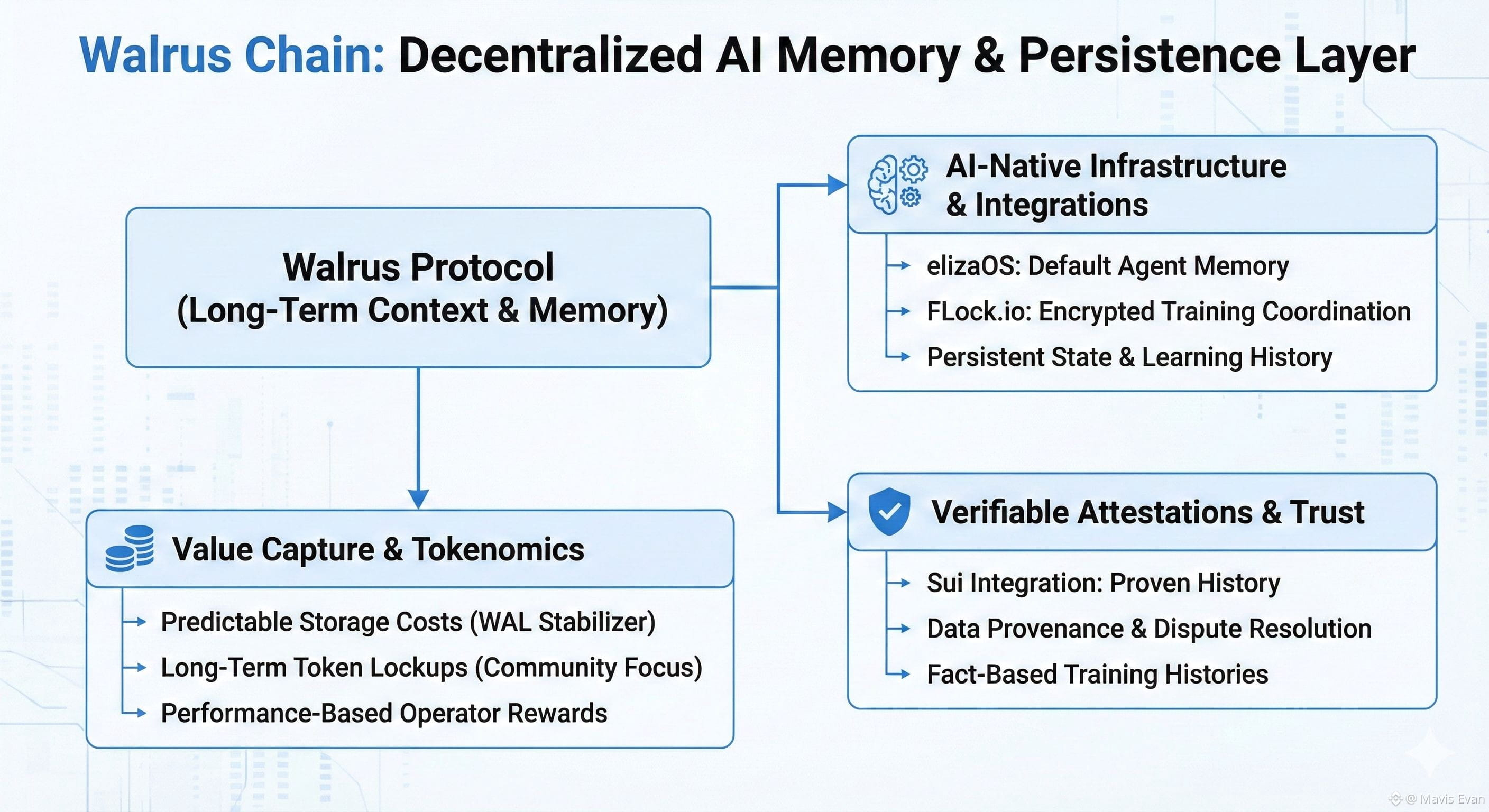
⁴⁴⁴The integration with elizaOS makes this clear. Walrus is not a secondary option in the stack. It becomes the default memory layer where agents keep state, learning history, and operational context. That changes how builders behave. When an agent can return days later without losing continuity, it stops feeling like a demo and starts behaving like a system you can rely on. The real gain is not speed or novelty. It is trust under pressure.
This matters because many AI failures are really memory failures disguised as model errors. When context cannot be verified, agents improvise. In calm environments that looks creative. In production, it looks like hallucination. Walrus does not promise perfection. It makes the past harder to fake. Data written through Walrus resolves into verifiable attestations on Sui, giving teams a way to prove what existed, when it existed, and how it was produced. Disputes move from emotion to evidence.
The same philosophy shows up in the integration with FLock.io, where training is treated as a coordination problem, not just a technical one. Federated learning only works if participants believe their contributions will not be silently copied, poisoned, or misattributed. Walrus acts as the shared layer for encrypted training outputs and parameter exchange, narrowing what must be trusted while keeping collaboration possible. This reduces the quiet fear that participation equals exposure.
Economics play a critical role here. WAL is not designed as a speculative centerpiece but as a stabilizer. Storage is paid upfront for fixed durations, and value is distributed over time to nodes providing availability. That structure keeps costs predictable even when markets are volatile. In AI systems, unpredictable storage costs lead to short retention, deleted context, and degraded memory. Walrus is explicitly designed to reduce that pressure.
The token structure reinforces long-term intent. With a capped supply of 5 billion WAL and only a quarter initially circulating, the largest share is reserved for the community with linear unlocks extending to 2033. Core contributors and investors are locked into long schedules. This is not cosmetic tokenomics. It signals that the network expects to mature slowly and be used continuously, not rushed and abandoned.
Operationally, Walrus also anticipates scale failures. Penalties discourage frequent stake reshuffling because moving data creates real network costs. Planned slashing mechanisms target low performance in ways that cannot be ignored. The goal is simple: make reliability the most profitable identity in the system. In decentralized AI, honesty must be economically easier than cutting corners.
The rollout timeline reflects discipline. Walrus focused on building the base network first, then introduced AI-facing integrations later. Funding from major institutions was framed as runway, not marketing. This order matters. Infrastructure that invites heavy systems before the ground is ready usually collapses under its own ambition. Walrus chose the opposite path.
What makes this approach stand out is not noise but restraint. Storage is boring when it works, and that is the point. Walrus is betting that Web3 and AI are entering a phase where continuity matters more than spectacle. Builders will judge it by simple outcomes: does memory persist, can conflicts be resolved with proof, and does the system remain calm when conditions change fast.
That is the quiet shift Walrus is making. It is not selling intelligence. It is selling the ability to remember responsibly. In decentralized AI, that may be the most valuable infrastructure of all.

