


Most people think decentralized storage means a huge forever hard drive owned by nobody. You upload files and trust they will stay there somehow. Walrus is not built on that idea. Walrus treats storage as a service with rules time limits and proof.
When you store data on Walrus you choose how long it should stay. The network assigns your data to a known group of storage nodes. You can see what is happening instead of guessing. The system talks about blobs epochs committees certification and challenges because these things explain real behavior not marketing words.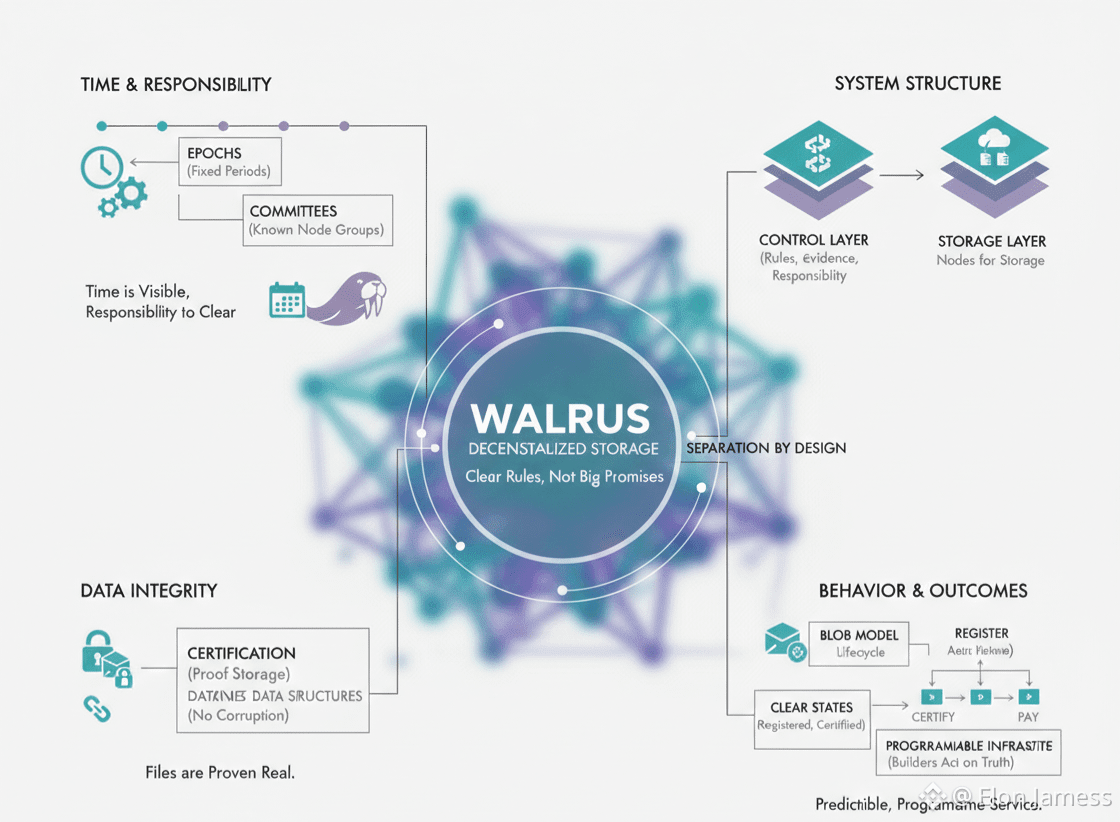
This approach separates Walrus from storage projects that rely on hope instead of structure.
Walrus Makes Storage Visible Not Invisible
A big problem with many storage networks is that users cannot answer simple questions. Who is holding my data right now. What if they go offline. How do I prove someone cheated.
Walrus is designed to answer these questions clearly.
At any time you can identify which nodes are responsible for your data. You can see the current epoch and the committee in charge. When something changes the system shows it. Fraud is not hidden it can be detected.
This is the difference between just storing files and running real infrastructure.
Control Layer And Storage Layer Are Separate By Design
Walrus does not put large files on the blockchain. Storage nodes hold the data. The blockchain is used to record evidence rules and responsibility.
The chain keeps track of who should be storing what and when epochs change. The research design shows that epoch changes connect the blockchain to storage groups while allowing many nodes to join freely.
This creates a shared source of truth. Every step in a file life can be verified on chain. Other apps do not need to trust a single company database. They can trust public records.
Epochs Turn Time Into Something You Can See
Walrus divides time into epochs. Each epoch is a fixed period where a specific group of nodes is responsible for storing your data.
This matters because real networks fail. Nodes leave. Connections break. Many systems assume perfect availability and only react after problems appear.
Walrus expects change. When an epoch ends responsibility rotates. No node holds your data forever. Churn is normal and planned.
Time is visible so silent failure is avoided.
Committees Make Responsibility Clear
Instead of hiding responsibility Walrus uses committees. A committee is a known group of storage nodes responsible during a specific epoch.
This information is public and linked to WAL staking contracts.
You can directly answer who is storing my file right now.
This clarity lets builders create monitoring tools alerts dashboards and auto renew systems. You can react to real signals instead of guessing.
Certification Is When A File Truly Exists
In most systems a file feels uploaded when your computer finishes sending it. In Walrus that moment does not matter.
What matters is certification.
A file is only considered real when the network confirms that enough pieces are stored correctly and can be retrieved within the agreed time.
This certification is public and verifiable on chain or through tools.
This allows strong applications. Marketplaces games AI systems and data services can wait for certification before acting. No certificate means no trust.
Blob Model Shows Storage Is A Process
Walrus treats storage as a full lifecycle.
You register a blob
You upload the data
You wait for certification
You pay SUI for transactions and WAL for storage based on size and time.
This shows that storage is not free or endless. Cost time and proof are built in. Developers can design around these rules instead of ignoring them.
This makes Walrus programmable infrastructure not just a storage bucket.
Walrus Is Built For Real Networks Not Perfect Ones
Many people imagine networks as clean and fast. Walrus does not.
The research including RedStuff explains how attackers might try to cheat using delays and timing tricks. Walrus challenge system is designed to stop this behavior.
This is not just redundancy. It is protection against real world network problems.
The design assumes networks are messy and attackers are clever.
Bad Clients Are Also Considered
It is not only bad storage nodes that matter. Clients can also be malicious.
Walrus uses authenticated data structures to ensure that the data stored and the data retrieved are exactly the same.
This is critical for AI analytics finance and media. Silent data corruption destroys trust more than downtime.
Walrus focuses on integrity not just availability.
Builders Get Clear States To Build On
Walrus defines clear states for storage.
Registered
Uploaded
Certified
Available during each epoch
These states can be checked on chain.
Builders can create logic that waits for certification before minting NFTs or starting AI training. Data markets can sell access to proven events not promises. Monitoring tools can track epoch and committee changes instead of guessing reliability.
This is what stable infrastructure looks like.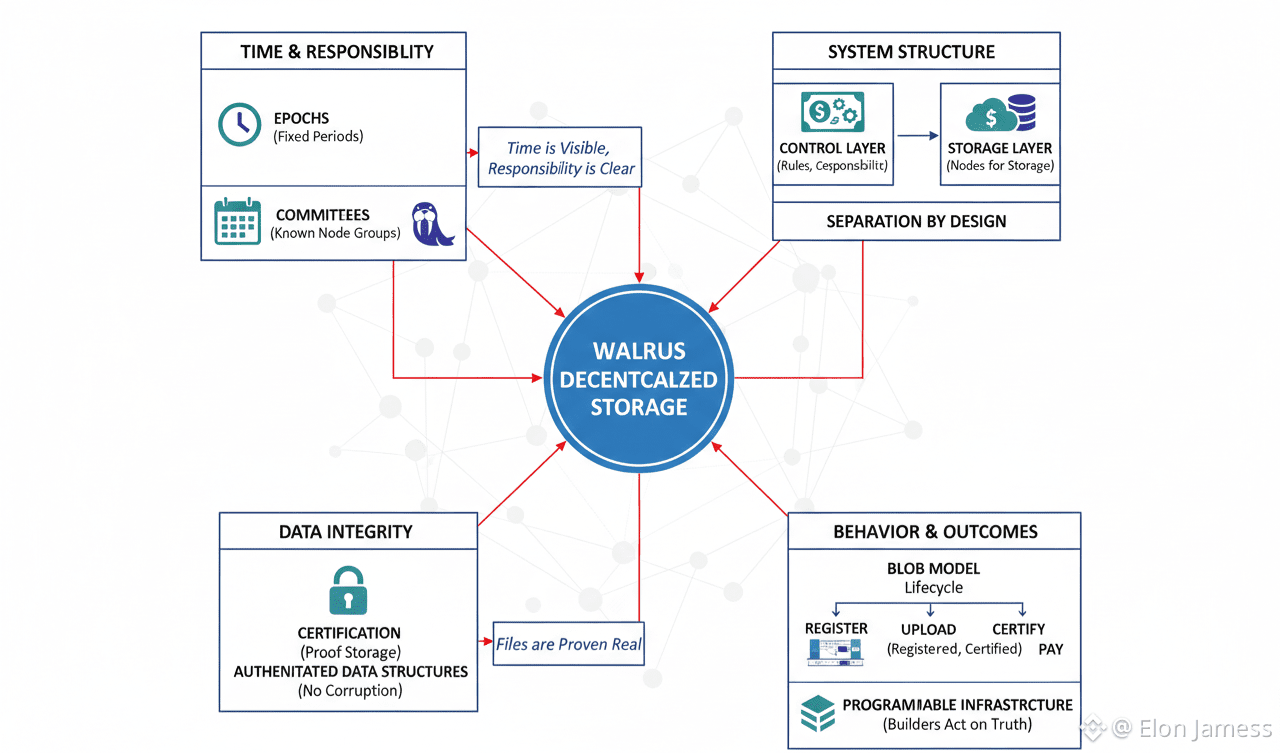
Walrus Turns Storage Into A Service Contract
When you look at the full picture Walrus is turning decentralized storage into a service contract.
Time is defined with epochs. Responsibility is defined with committees. Truth is defined with certification. Attacks and failures are expected not ignored.
Everything can be measured verified and acted on.
This is why serious builders are drawn to Walrus.
Why This Model Can Win Long Term
Crypto infrastructure does not succeed by being loud. It succeeds by being reliable.
Walrus pushes decentralized storage toward boring dependable behavior.
Clear responsibility
Clear time limits
Clear proof
Clear accountability
If this continues Walrus does not need a flashy feature. The idea itself becomes the strength.
It shows that decentralized storage can meet real infrastructure standards without central control.
That foundation allows ecosystems to grow without constantly rebuilding trust.