
The first mistake I made with Dusk Network was trying to frame it like every other crypto project. I kept looking for the pitch for the moment where it declares what it’s trying to disrupt or overthrow. That moment never really comes. Dusk doesn’t sell a vision so much as it assumes a future where someone will eventually ask uncomfortable questions and demand precise answers.
Most blockchains want attention. Dusk seems designed to survive attention.
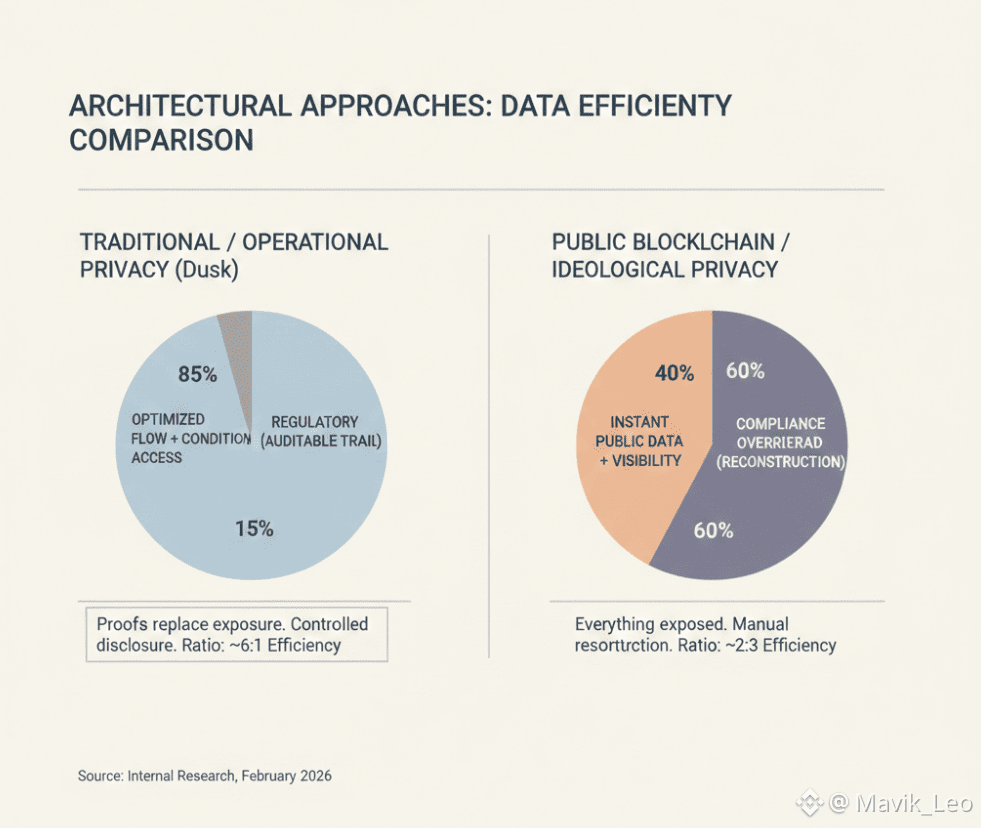
That distinction matters more than people realize. In crypto, visibility is treated as virtue: everything public, everything instant, everything exposed. But real financial systems don’t work that way. Traders don’t publish positions. Institutions don’t broadcast settlement details. Clients don’t consent to their activity becoming a dataset. Yet regulators, auditors, and courts must be able to reconstruct events perfectly when something breaks. Traditional finance solves this through layers of access, permissions, and delayed disclosure. Dusk doesn’t reject that model it encodes it.
What’s different here is how privacy is handled. On Dusk, privacy isn’t an act of disappearance. Nothing is swept under the rug. Data still exists, but access is conditional. Proofs replace exposure. Correctness can be demonstrated without revealing the entire state, and disclosure can happen later if and when authority requires it. That’s not ideological privacy it’s operational privacy. It looks far closer to how compliance actually functions in the real world than the all-or-nothing approach most chains take.
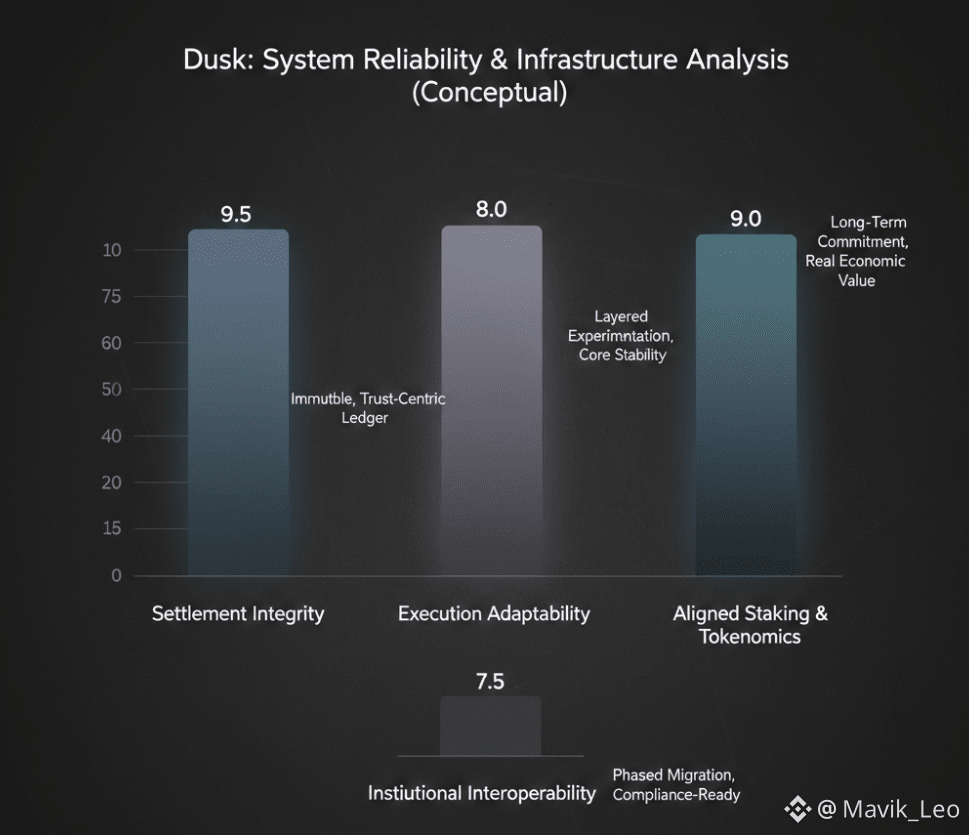
You can see this mindset reflected in how the network itself has been rolled out. The mainnet launch in early 2025 didn’t come with fireworks or ecosystem hype. There was no rush to flood the chain with applications. Instead, the base layers settlement finality, data availability, validator mechanics came first. Execution environments are being introduced deliberately, not marketed as proof of innovation but treated as components that must earn their place. From a speculative angle, that feels slow. From a risk management perspective, it feels inevitable.
This separation between settlement and execution is where Dusk quietly diverges from most of the space. In financial markets, execution is where competition lives. Settlement is where trust lives. You can innovate endlessly at the edge, but the final ledger the book of record cannot wobble. Dusk’s architecture seems to internalize that hierarchy. It wants to be the layer you don’t experiment with casually, while still allowing experimentation above it without threatening the integrity of the system itself.
Even the staking model carries that same tone. There’s no theatrical punishment system or gamified coercion. The requirements are clear, the commitment is real, and the incentives are aligned toward long-term participation rather than quick yield extraction. The short maturity period discourages opportunistic hopping, and the minimum stake signals seriousness. It doesn’t try to scare validators into behaving. It assumes that if you’re here, you’re here to do the job properly.
The token tells a similar story. DUSK isn’t engineered to be clever. It secures the network, pays for computation, and compensates those who maintain consensus over a long horizon. Emissions feel calibrated for endurance, not momentum. There’s no sense that the design is chasing attention cycles or quarterly narratives. It reads like a system built by people more concerned with what happens in year fifteen than in month three.
Even the continued existence of DUSK as ERC-20 and BEP-20 alongside the native chain feels intentional rather than transitional. It acknowledges that liquidity, custody, compliance tooling, and reporting frameworks don’t move just because a new chain exists. Institutions don’t teleport their workflows. They migrate slowly, once infrastructure proves itself under real conditions. Dusk seems comfortable operating in that in-between phase, letting trust accumulate instead of demanding it upfront.
Where this becomes concrete is in the kinds of integrations Dusk prioritizes. Instead of chasing speculative DeFi primitives, it leans toward licensed venues and compliant instruments assets that have to withstand audits, disclosures, and regulatory edge cases. Euro-denominated, regulation-friendly tokens don’t make for viral threads, but they expose whether a blockchain can actually function under institutional scrutiny. These integrations don’t tolerate ambiguity. They force the protocol to behave correctly or fail visibly.
That’s why Dusk feels almost intentionally unexciting. It’s not built for hype cycles or narrative momentum. It’s built for the moment when value becomes heavy, oversight becomes real, and excuses stop working. The real test ahead isn’t whether another environment goes live on time or whether developers can deploy contracts. It’s whether the system holds up when the stakes stop being theoretical.
If Dusk succeeds, it won’t feel like a revolution. It will feel like infrastructure quiet, boring, and essential. The kind you don’t think about until it’s gone, and then you realize how much depended on it never making a mistake.
That may not be how legends are made in crypto.
But it’s exactly how trust is.
