


I’ve spent some time digging into the latest 2026 developments for Dusk Network, and what’s interesting is how the "boring" infrastructure narrative is actually playing out in real-time. With the mainnet having gone live in early January 2026, the focus has shifted from research to actual production.
Here is the perspective on Dusk, keeping that same grounded, peer-to-peer energy.
Dusk: When Privacy Becomes a Financial Requirement
When I sit with Dusk Network for a while and stop looking at it like just another Layer-1, the thing that keeps standing out to me is how consistently it frames privacy as a financial requirement instead of a cultural preference. The whole design reads like it was built for situations where transactions are allowed to be public in outcome but not public in sensitive detail.
Dusk keeps pulling the conversation back to the same practical truth: real markets do not operate well when every position and treasury move becomes a permanent public broadcast. At the same time, they can't operate in a total black box either—you still need an audit trail. That tension is exactly where Dusk lives.
Privacy in the Mechanics
The deeper I look, the more Dusk feels like a network that made a deliberate choice to build privacy into the mechanics rather than treating it like a bolt-on feature.
* Phoenix: This isn't just about hiding things; it’s a transaction model designed for the messy reality of smart contracts where outcomes aren't known until execution.
* Zedger: This is Dusk acknowledging that financial assets aren't just tokens you toss around. Security-style instruments come with real constraints—controlled participation and enforceable rules—and Zedger allows those to exist without turning the network into a surveillance state.
* Confidential Security Contracts (XSC): This standard is a quiet statement of intent. Standards are how finance becomes repeatable, moving the ecosystem from "cool demos" to real issuance.
Reliability Over Hype
One of the more understated parts of Dusk is the emphasis on settlement finality. Privacy without dependable settlement is just a clever trick. The recent 2026 mainnet launch and the DuskDS settlement layer upgrades show a posture of "this must work" rather than "this must trend." Financial workflows hate probabilistic outcomes; they need the boring reliability that Dusk is quietly shipping.
The Economic Engine
The tokenomics aren't built for short-term "moon" cycles. With a maximum supply of 1 billion and long-term emissions designed for staking, the $DUSK token is treated like an economic engine. Its job is to keep the chain alive and secure through participation. Recent integrations—like the Quantoz EURQ (a MiCA-compliant stablecoin) and the NPEX regulated trading dApp—suggest that the network is finally starting to shift actual institutional money.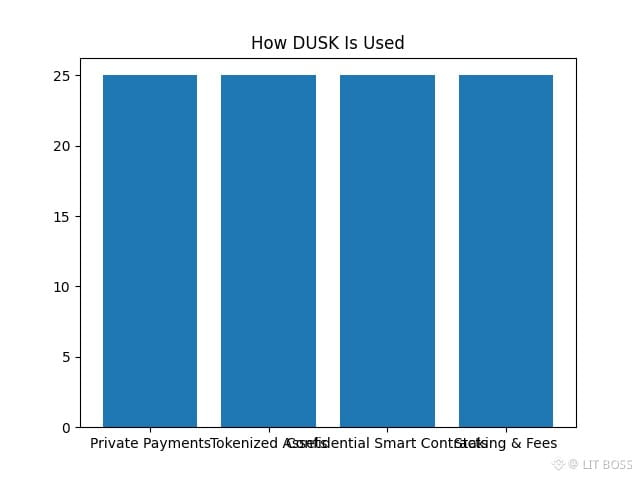
Final Thoughts
The real benefit here isn't just "private transactions." It’s about making confidentiality compatible with the real obligations of financial assets. The next chapter for Dusk isn't about proving the concept works—they did that with the January launch—it's about proving the system can be relied on as the volume of tokenized securities grows.
Dusk is becoming predictable, stable, and regulated. In this space, that’s exactly the kind of "boring" we should be looking for.
Would you like me to create a thumbnail concept for this Dusk analysis, or should we compare its privacy model to another L1?