I have felt that quiet shock when something I saved with real effort suddenly was not there anymore and it never feels like a normal error because it feels like a piece of your time just got erased and that is why Walrus pulls attention in a deeper way since they are not trying to entertain you with a trend they are trying to harden the internet itself by making big important files live in a place that does not depend on one company one server or one policy mood swing and Walrus is built as a decentralized blob storage and data availability protocol which is a fancy way of saying it is designed for the large real world data that powers everything people actually use like videos images documents app front ends game assets and AI datasets and the reason this matters is simple because most blockchains were not designed to carry huge files directly since onchain storage usually forces heavy replication across validators which becomes expensive and unrealistic at scale so builders often keep logic onchain but push the real content offchain and that creates a painful weak spot where the app can look decentralized yet the thing users see and trust can still disappear or be replaced and Walrus is aiming to close that gap by making storage resilient verifiable and efficient while using the Sui blockchain as a coordination layer where references to stored blobs and economic rules and proof style confirmations can be anchored so the storage layer can focus on what it does best which is keeping data available across a network of independent operators. 
What makes the design feel real is that Walrus does not treat failure as an exception it treats failure as normal and that mindset is exactly what you want when you are trusting your product your community history or your creative work to a system because when you store a file on Walrus it is treated as a blob and instead of placing that blob in one location the network encodes it into many smaller pieces using erasure coding and spreads those pieces across many storage nodes so the original file can be reconstructed later from only a portion of the pieces and it becomes a kind of durability that changes the emotional experience because your data stops being a single point of failure and starts being a network responsibility and the Walrus team has even described that with its model user data can remain available even if up to two thirds of the network nodes go offline which is the kind of simple sentence that hits hard once you have experienced outages in the real world.
Under the hood this is not just marketing language because the Walrus research paper explains a core innovation called Red Stuff which is a two dimensional erasure coding protocol that targets high security with about a 4.5x replication factor while also enabling self healing recovery that only needs bandwidth proportional to the data that was actually lost rather than forcing full blob re downloads every time something breaks and that detail matters because long term availability is not only about how you store data on day one it is about how you keep it healthy month after month while nodes churn and hardware fails and networks behave unpredictably and the paper also describes storage challenges designed to work in asynchronous networks so adversaries cannot exploit network delays to pass verification without truly storing data which is a big deal because decentralized systems are always attacked at the edges where timing and incentives collide and Walrus also introduces an epoch change approach that handles storage node churn while maintaining uninterrupted availability during committee transitions which is exactly the kind of boring sounding engineering that separates a demo from infrastructure that can actually carry the next decade of apps.
This is where the phrase data availability becomes more than a technical label because when you are building something serious you do not only want to know that your file was accepted you want to know that it will be retrievable when you need it most when traffic spikes when nodes go down when conditions are messy and when a project is under pressure and we are seeing more and more applications reach the point where storage availability is not a nice feature it is the difference between trust and failure and Walrus is built to make availability something that can be supported by both cryptography and economics rather than hope and support tickets.
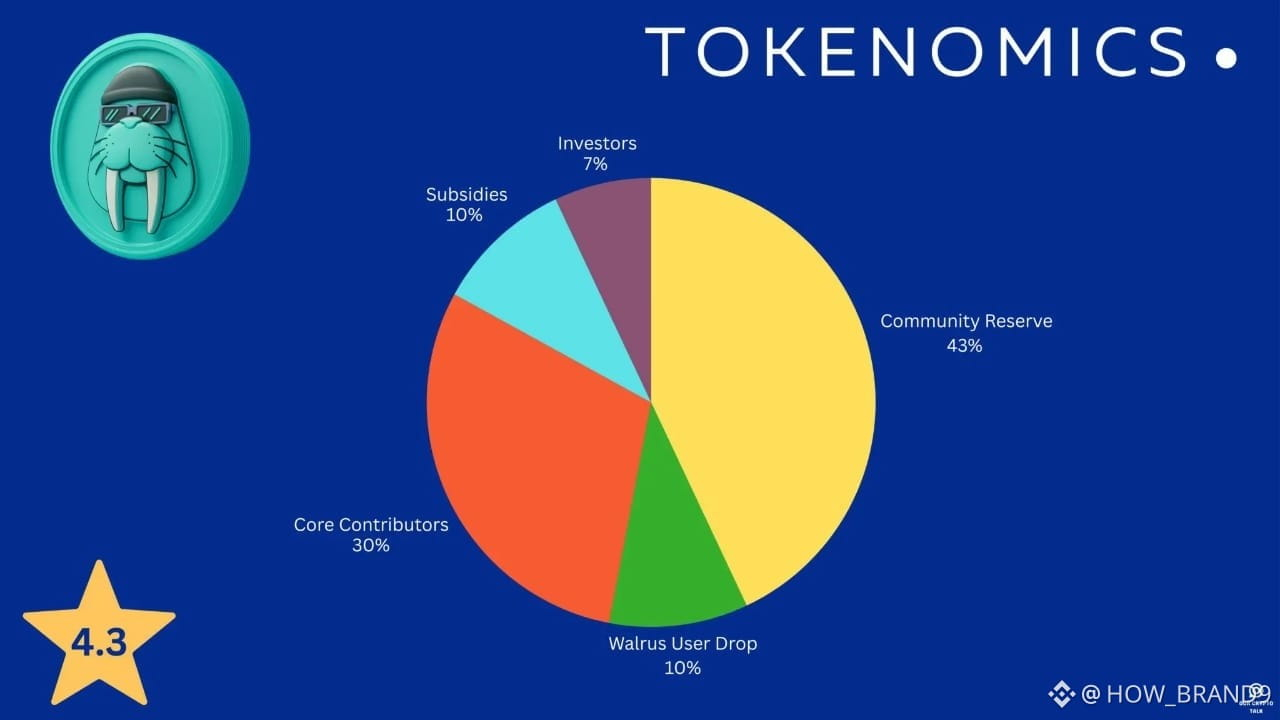
Now the WAL token fits into this story in a way that feels practical rather than decorative because decentralized storage has real costs and I am not talking about theory I mean hardware bandwidth uptime maintenance and the operational discipline required to keep serving data when it is not convenient so WAL is positioned as the payment token for storage on the Walrus protocol with a payment mechanism designed to keep storage costs stable in fiat terms while protecting users from long term token price swings and when users pay for storage they pay for a fixed amount of time and the WAL paid upfront is distributed across time to storage nodes and stakers as compensation for their services which is a thoughtful structure because it aligns long term performance with long term rewards instead of encouraging short bursts of behavior.
WAL also connects to staking style security and governance because a network like this needs a way to reward reliable operators and punish the ones who do not honor commitments and Walrus documentation and ecosystem explanations describe staking and epoch based mechanics where performance and reliability influence rewards and parameters and They are building a system where participants have something to gain from doing the hard work consistently and something to lose if they try to cheat or under deliver and it becomes the emotional difference between a service you hope works and a network that is incentivized to keep working. 
When I step back the most exciting part is not the encoding math even though it is impressive and not the token mechanics even though they matter but the way all of this changes what builders can realistically ship because once blob storage becomes resilient and programmable you can imagine NFTs whose media does not vanish because a host changed its rules you can imagine dApps whose front ends are not quietly dependent on a centralized provider you can imagine AI products whose datasets and proofs of origin can be stored and retrieved reliably and you can imagine enterprises and public projects using decentralized storage as a serious alternative for archives and critical records and Walrus itself frames this direction around enabling data markets and supporting AI era workflows where agents and applications store retrieve and process data with a decentralized foundation which signals that they are aiming at real usage not only crypto culture.
Only when it is necessary to mention it some users may eventually encounter WAL through major exchanges if listings happen but the real story is not where it trades because the real story is what it unlocks and if Walrus keeps delivering on the design they have published then it becomes easier to picture a future where storage feels like a public utility where creators publish without fear where builders ship without hidden hosting weak points and where communities stop losing their history overnight and that is the kind of future that does not just sound technical it feels personal because it is the moment your data stops asking for permission to exist and starts living with the durability it always deserved.