
Blockchain technology has transformed the way we think about digital systems, enabling decentralized applications smart contracts and trustless ecosystems.
Yet, despite its revolutionary impact, one persistent challenge remains: efficient, reliable, and scalable data storage. As blockchain applications grow in complexity and scale, traditional storage solutions often struggle to keep pace exposing vulnerabilities in performance cost and security.
Enter the Walrus Protocol, an innovative decentralized storage network developed by MystenLabs, designed to tackle these challenges head-on and redefine the way blockchain data is stored managed and accessed.
Modern digital ecosystems increasingly rely on massive datasets ranging from high-resolution videos and NFT media to AI training datasets and critical application files. Relying on centralized servers or third-party storage providers for this scale of data introduces a significant risk.
Downtime, data corruption, or security breaches in centralized infrastructures can disrupt entire ecosystems, undermining both user trust and application reliability. Centralized solutions often force a trade-off between affordability, speed, and reliability, leaving developers and users with compromises they shouldn’t have to make.
Walrus Protocol offers a fresh approach.
By leveraging a decentralized network of distributed nodes, it eliminates single points of failure and ensures data integrity through robust replication and advanced encoding techniques. Each file stored on the network is split into secure fragments, encrypted, and distributed across multiple nodes, making it nearly impossible for a single compromised node to threaten the overall system. This decentralized architecture not only improves security but also increases redundancy, ensuring that critical data remains available even if individual nodes go offline.
One of the most compelling aspects of the Walrus Protocol is its ability to balance
efficiency
affordability
scalability
Traditional storage networks often rely on simple replication, which can be costly and inefficient. Walrus, however, employs sophisticated erasure coding and dynamic node management to reduce storage overhead while maintaining reliability. This means that developers can store and retrieve large files faster, without breaking the bank a critical factor as blockchain-based applications continue to scale globally.
Transparency is another hallmark of the protocol. Every transaction involving data storage is recorded on-chain, providing verifiable proof that files have been correctly stored and remain accessible. This feature not only increases trust among users and developers but also opens new possibilities for auditable storage in regulated industries, including finance, healthcare, and digital content management. By bridging the gap between decentralized technology and real-world utility, Walrus Protocol sets a new standard for how digital information can be safely and efficiently handled.
Moreover, the network is designed to be highly adaptable. It accommodates a variety of use cases, from high-demand content delivery to long-term archival storage, making it a versatile choice for developers seeking a robust, future-proof solution. Its integration with blockchain ecosystems ensures seamless compatibility with smart contracts, decentralized applications, and emerging Web3 tools, positioning Walrus as a foundational piece of the decentralized internet infrastructure.
In a world where data is the new currency, secure and efficient storage is no longer optional it’s critical.
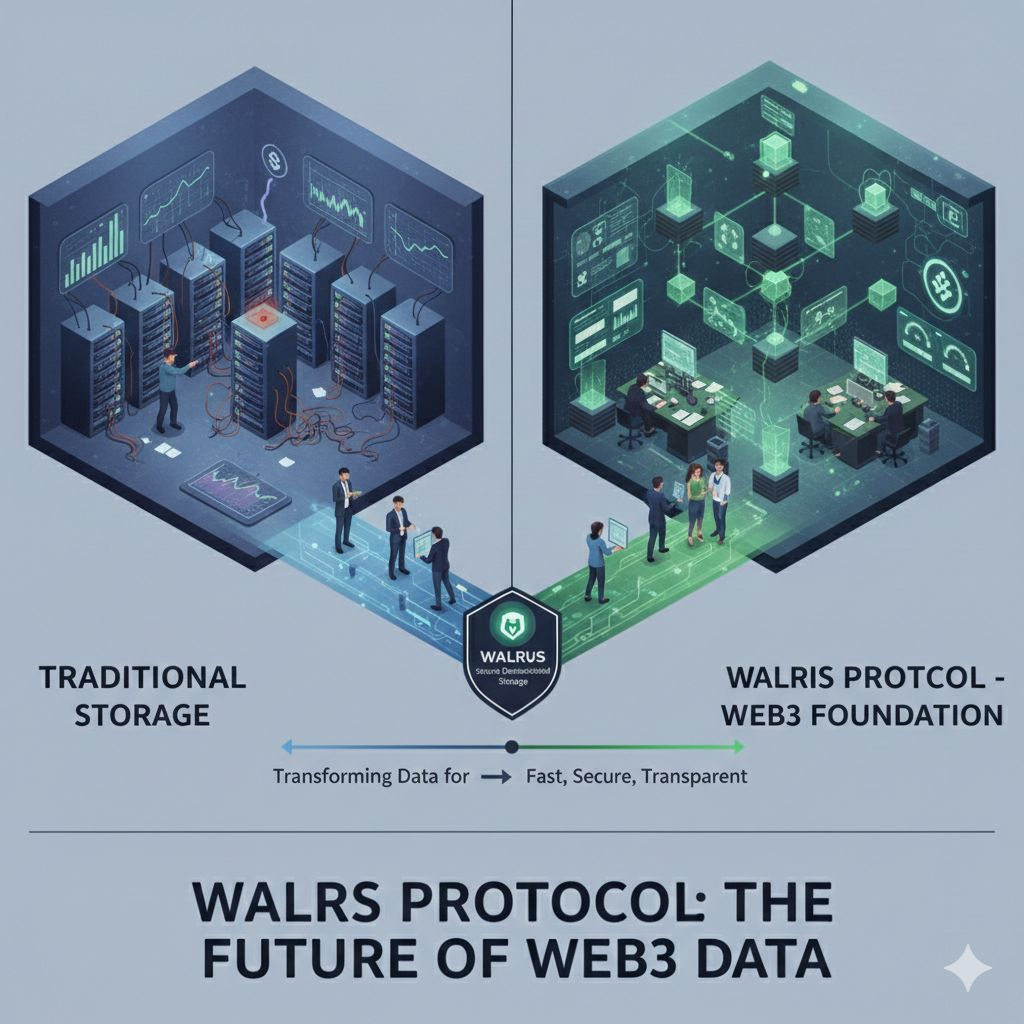
Walrus Protocol addresses this need with a combination of cutting-edge technology, thoughtful architecture, and an unwavering commitment to reliability and security. By transforming how data is stored, accessed, and managed in the blockchain space, it empowers developers, enterprises, and individual users to embrace decentralization without compromise.
As blockchain applications continue to evolve, solutions like Walrus Protocol will be key to unlocking the full potential of decentralized ecosystems. For anyone building on the blockchain or looking to safeguard their digital assets, Walrus is not just a storage network
it’s a strategic foundation for the future of Web3.