

Blockchains were supposed to make the world verifiable.
Yet most of the data powering Web3 today still lives off-chain — behind cloud servers, centralized APIs, and brittle storage layers that quietly re-introduce trust into a system designed to remove it.
Smart contracts execute on-chain.
Tokens settle on-chain.
But the data they rely on? Images, models, logs, state histories, application records?
Usually… not.
That’s the gap Walrus is targeting.
Not with hype.
Not with flashy tokenomics first.
But with something far more difficult:
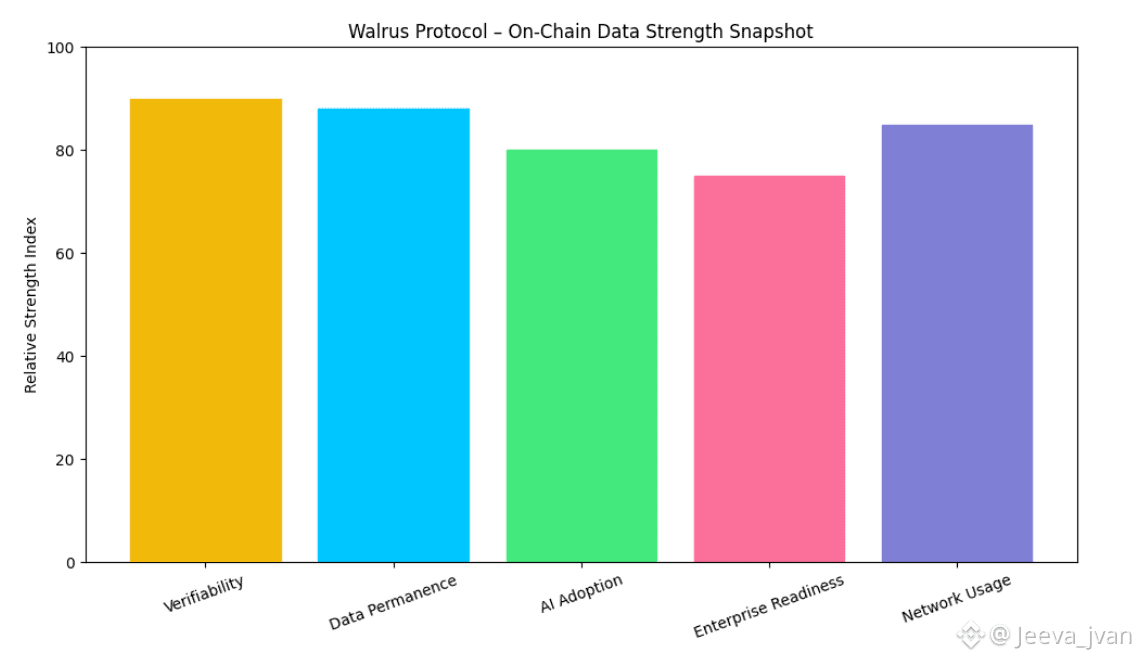
permanent, verifiable, on-chain-anchored data infrastructure at real scale.
Let’s unpack what that actually means — and why Walrus is quietly positioning itself as one of the most important layers in the next generation of Web3.
🧠 The Hidden Crisis: Bad Data Costs Billions
In traditional systems, corrupted or missing data is expensive.
In decentralized systems, it’s existential.
If a protocol cannot prove:
• where data came from
• that it hasn’t been modified
• that it will still exist tomorrow
• that it was the same data every validator saw
…then the system is no longer trust-minimized.
It’s just distributed.
AI agents hallucinate when memory systems fail.
DeFi protocols collapse when records disappear.
NFT metadata breaks when IPFS pins vanish.
Enterprise systems refuse adoption when auditability isn’t guaranteed.
Verifiability isn’t a luxury.
It’s the foundation.
Walrus is built around that single premise.
🧱 Walrus’ Core Idea: Data Should Behave Like State
In blockchains, state is sacred:
Every node verifies it.
Every update is deterministic.
History is preserved.
Tampering is impossible without consensus.
Walrus asks:
Why shouldn’t large-scale application data behave the same way?
Instead of treating files and records as disposable blobs floating in the cloud, Walrus treats them as:
• cryptographically verifiable
• permanently anchored
• reproducible
• independently retrievable
• secured by protocol rules, not companies
This turns storage from an off-chain dependency into part of the trust surface itself.
That’s a huge shift.
📦 What Walrus Actually Stores
Walrus is optimized for “blobs” — large, structured data objects such as:
• AI model memories and logs
• training datasets
• application states
• multimedia assets
• historical records
• compliance archives
• game worlds
• identity artifacts
• scientific data
• enterprise audit trails
These aren’t tiny calldata fragments.
They’re real-world-scale datasets.
And Walrus doesn’t just store references.
It stores verifiable commitments to the data — so anyone can prove:
✔️ the data existed
✔️ when it was written
✔️ that it hasn’t changed
✔️ that it matches what applications used
That’s what elevates it from “decentralized cloud” to on-chain infrastructure.
🔐 Verifiability Over Availability
Most storage networks compete on:
• cheap gigabytes
• replication counts
• retrieval speed
Walrus optimizes for something subtler:
cryptographic correctness over decades.
Availability is necessary.
But verifiability is what gives systems legal, financial, and institutional weight.
Walrus focuses on:
• proof systems that attest to data integrity
• protocol-level verification
• deterministic retrieval
• audit-friendly persistence
• long-term guarantees
This is why enterprises and AI builders care.
Because if you can’t prove your data later…
…it didn’t really exist.
🤖 Why AI Loves Walrus
AI agents are becoming autonomous economic actors:
Trading bots.
On-chain research systems.
DAO managers.
Governance models.
Personal assistants.
They all need memory.
But AI memory cannot be:
• mutable
• centralized
• easily erased
• unverifiable
• dependent on one provider
Walrus gives AI something new:
permanent, cryptographically provable memory layers.
An agent can:
• store its reasoning steps
• persist training logs
• checkpoint models
• reference historical states
• prove what information it used
That makes on-chain AI auditable.
Which is… unprecedented.
🏛️ Enterprise-Grade by Design
Corporations don’t adopt systems because they’re cool.
They adopt systems because auditors approve them.
Walrus is architected around:
• immutability
• provable retention
• deterministic recovery
• regulatory auditability
• compliance workflows
• multi-decade persistence
Think:
📂 Financial reporting archives
📂 Legal evidence logs
📂 Supply-chain records
📂 Medical research datasets
📂 Scientific experiments
📂 Regulatory filings
These industries can’t tolerate “maybe it’s still pinned.”
They need:
proof, not promises.
📈 The Quiet Signal: Storage at Scale
When a network reports hundreds of terabytes already stored, that isn’t marketing fluff.
That’s load.
That means:
• real users
• real writes
• real retrievals
• real costs being paid
• real infrastructure being exercised
Storage networks don’t fake scale.
If people are paying to store data permanently, something is working.
That traction matters far more than daily price candles.
⚙️ Why Walrus Feels Different From Past Storage Plays
Earlier decentralized storage networks focused on:
• cheap cloud replacement
• bandwidth markets
• pinning incentives
• CDN-like distribution
Walrus is pushing a different thesis:
Data as protocol-level state.
Instead of competing with AWS…
…it competes with the idea that applications can safely rely on anything that isn’t cryptographically locked.
That makes Walrus closer to:
• a settlement layer for data
• an archive chain
• an AI memory network
• an institutional ledger
• a historical backbone
It’s infrastructure for the next 20 years — not the next market cycle.
🌍 Why This Matters for Web3’s Next Phase
The next billion users won’t come for tokens.
They’ll come for:
• stable financial rails
• autonomous agents
• global apps
• compliant systems
• verifiable records
• persistent identities
Every one of those requires:
durable, provable data layers.
Walrus isn’t building flashy frontends.
It’s building the basement of the skyscraper.
And those are always invisible… until they fail.
🧭 Final Thought
Crypto doesn’t scale because prices go up.
It scales because systems become boringly reliable.
Walrus is betting that the future of blockchains isn’t just execution…
…it’s memory.
Permanent.
Auditable.
Unforgeable.
When the next generation of AI agents, fintech systems, and institutional protocols need to prove what happened years ago…
they won’t care about narratives.
They’ll care about which network never forgot.

