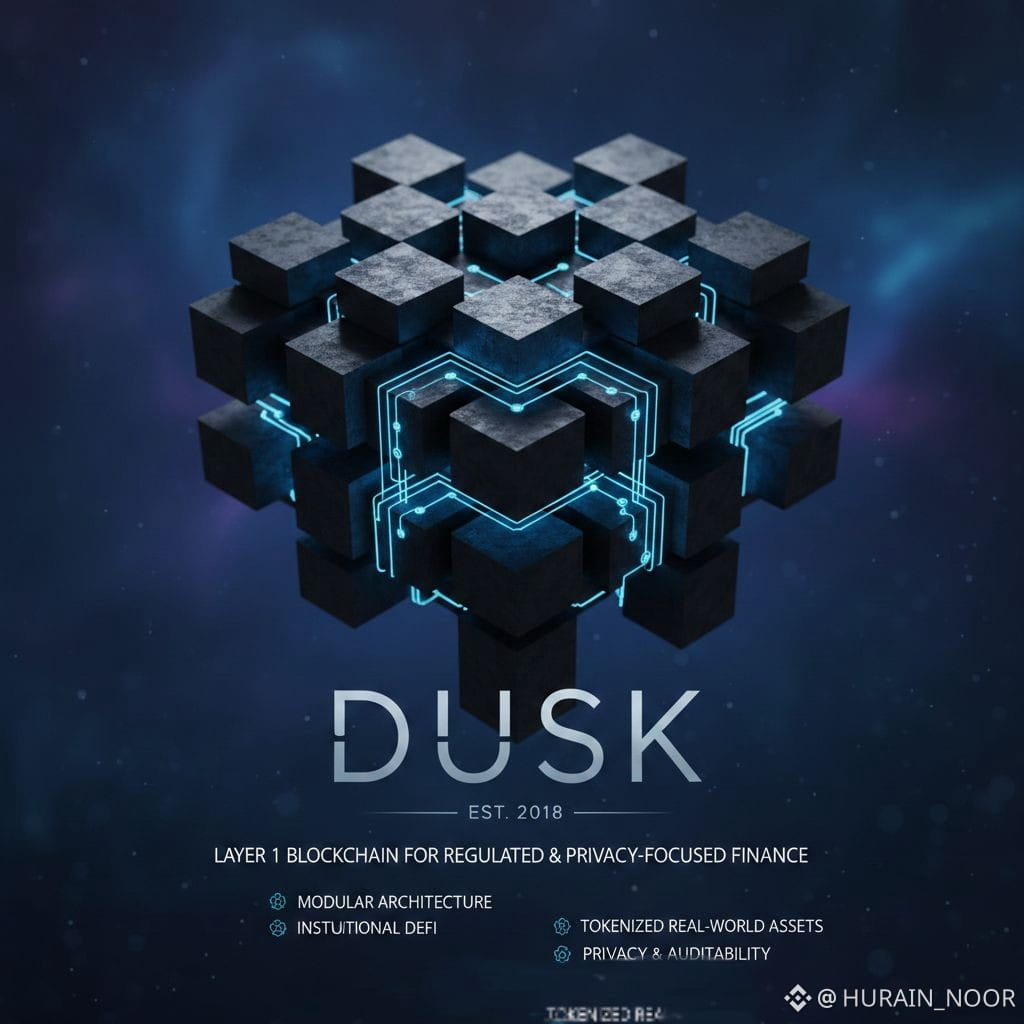
@Dusk #dusk did not emerge from the same ideological soil as most blockchains. Founded in 2018, it wasn’t born to overthrow banks, abolish regulation, or romanticize radical openness. It was designed around a quieter, more uncomfortable truth: real financial markets do not function in full public view, and they never have. The institutions that move size, allocate risk, and issue assets depend on confidentiality as much as they depend on settlement finality. Dusk’s architecture reflects this reality, not as a compromise, but as a first principle.
Most crypto systems still confuse transparency with credibility. They assume that if everything is visible, everything is fair. Markets don’t work that way. In public blockchains, transparency often creates extractive behavior: front-running, copy trading, liquidation hunting, governance capture. Dusk flips the model. It treats privacy not as an add-on, but as market infrastructure. Transactions can be shielded while remaining verifiable, which means capital can move without advertising intent, and compliance can exist without broadcasting strategy. That distinction sounds subtle until you consider how institutions actually deploy capital.
The modular structure of Dusk is where this philosophy becomes operational rather than theoretical. Instead of hard-coding assumptions about users, assets, or execution environments, the chain separates consensus, execution, and privacy logic in a way that lets each evolve independently. This matters because regulation doesn’t arrive as a single rulebook. It arrives as a moving target. By isolating compliance logic from core settlement, Dusk can absorb regulatory change without fragmenting liquidity or forcing protocol migrations that destroy long-term incentives.
One of the most overlooked mechanics in decentralized finance is how privacy changes price formation itself. In transparent systems, large traders either split orders inefficiently or route through intermediaries to avoid signaling. On Dusk, native privacy allows size to move on-chain without distorting markets before execution. That has second-order effects. Liquidity becomes less predatory. Volatility caused by anticipatory behavior declines. This is not theoretical. On-chain metrics like slippage distribution and execution variance would immediately show tighter spreads when order intent is concealed yet provable.
Tokenized real-world assets are where Dusk quietly becomes more important than louder competitors. Issuing equity, debt, or structured products on-chain requires selective disclosure. Investors must prove eligibility. Regulators must audit flows. Counterparties must not see each other’s positions. Public ledgers break this model. Dusk’s design allows assets to exist on-chain with programmable restrictions, private ownership, and auditable histories that only authorized parties can inspect. This is how capital markets actually operate, translated into cryptographic form rather than forced into ideological purity.
Game economies reveal another layer of Dusk’s relevance that most analysts miss. In GameFi, transparency destroys balance. When every reward curve, wallet balance, and transaction path is public, players optimize extraction instead of engagement. Bots dominate. Economies collapse under their own visibility. Privacy-aware execution allows games to enforce rules without exposing exploits, preserving uncertainty where it creates value. Dusk’s approach makes sustainable on-chain economies possible without relying on centralized servers to hide mechanics.
Scaling debates in crypto often fixate on throughput while ignoring behavioral load. Layer-2 systems increase capacity but inherit the same transparency-driven problems as their base layers. Dusk’s architecture suggests a different scaling vector: reducing adversarial behavior rather than just increasing block space. If fewer actors can exploit mempool visibility or liquidation mechanics, the system scales socially as well as technically. Network congestion is not just a function of usage; it’s a function of abuse.
Oracle design on privacy-first chains is another underexplored frontier. Feeding external data into a system that values confidentiality requires rethinking trust assumptions. Dusk-compatible oracle models can attest to data correctness without revealing the full dataset, which matters for regulated instruments tied to off-chain events. This opens the door to derivatives, insurance, and structured products that cannot exist on fully transparent rails without leaking proprietary data. The incentive alignment here is cleaner because data providers are paid for accuracy, not visibility.
From an analytics perspective, Dusk challenges how on-chain intelligence will evolve. The industry is addicted to dashboards that track everything in real time, but institutions don’t trade on public dashboards. They trade on selective insight. Dusk-compatible analytics would shift from voyeurism to inference, focusing on aggregate flows, settlement guarantees, and risk exposure without deanonymizing participants. This mirrors how traditional market surveillance works and signals a maturation of on-chain analysis rather than a loss of insight.
Capital flows already hint at where this is going. Large allocators are no longer chasing maximal yield; they are chasing legal clarity, predictable execution, and insulation from adversarial environments. Chains that cannot support private compliance will remain retail playgrounds. Chains that can will quietly absorb the issuance, custody, and settlement of assets that actually matter. Dusk sits squarely in that second category, not because it markets itself loudly, but because its design matches how capital behaves under real constraints.
The long-term risk for Dusk is not competition from louder chains, but complacency in execution. Privacy systems are unforgiving. A single flawed assumption can undermine trust for years. But if Dusk continues to treat privacy, auditability, and regulation as co-equal constraints rather than opposing forces, it occupies a strategic position that few others even attempt to reach. The future of on-chain finance will not be fully public or fully private. It will be selectively transparent, structurally compliant, and economically realistic. Dusk is one of the few systems built for that future from the start.