The debate around blockchain transparency has long been framed as a moral binary: openness is good, opacity is bad. This framing has shaped the design of most public blockchains and, by extension, the behavior of on-chain markets. Yet as digital assets mature and institutional participation deepens, it is becoming increasingly clear that excessive transparency does not produce fairness. In many cases, it does the opposite. It rewards actors who can extract value from information asymmetry while penalizing those who seek orderly execution, predictable settlement, and regulatory alignment.
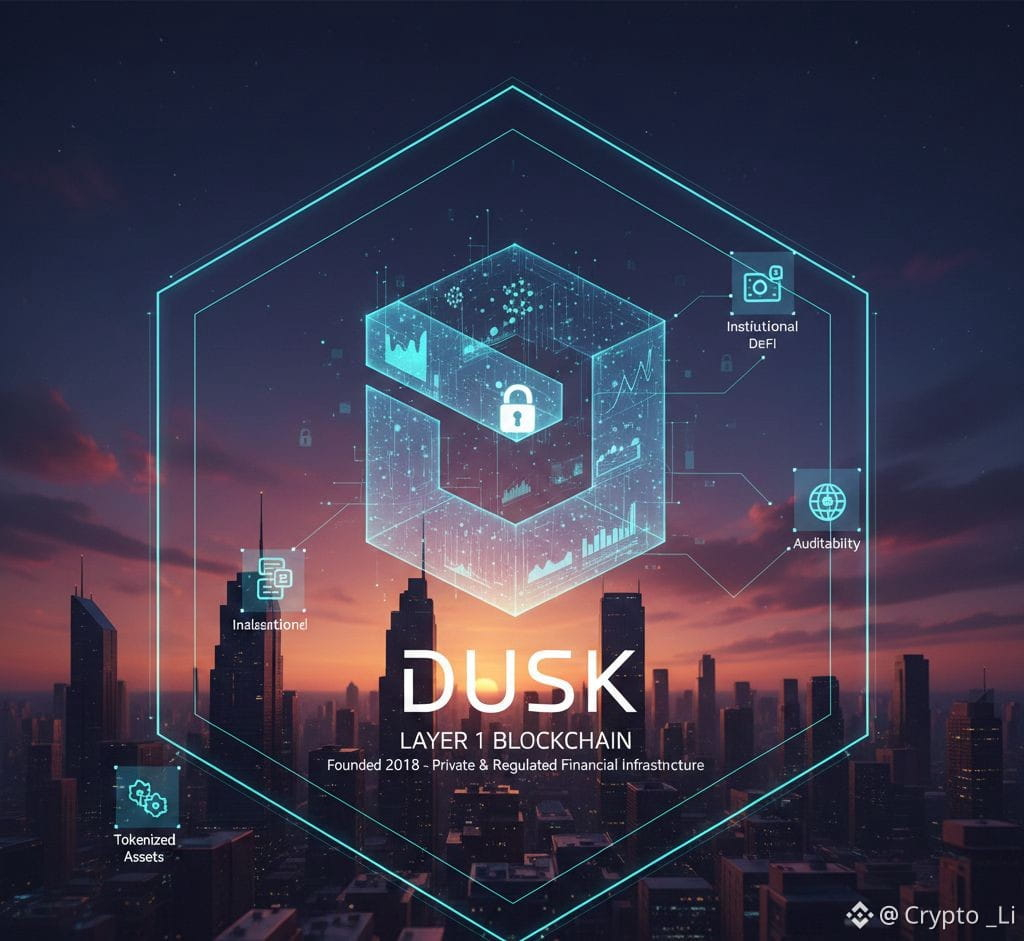
Dusk Network was founded in 2018 with a different premise. Rather than treating privacy as a feature for concealment, Dusk treats privacy as a structural requirement for market fairness. Its design choices reflect an understanding that fair markets depend less on radical visibility and more on controlled information flow, enforceable rules, and protection of legitimate trade intent. This article examines Dusk not as a “privacy chain,” but as an attempt to redesign on-chain market structure around principles long established in traditional finance.
Transparency and the Erosion of Market Fairness
Public blockchains expose transaction data by default. Order sizes, counterparties, timing, and even smart contract logic are visible to anyone capable of monitoring the network. While this level of transparency is often celebrated as democratizing, in practice it introduces systemic unfairness. Sophisticated actors exploit this openness through front-running, back-running, sandwich strategies, and latency arbitrage. The result is a market where outcomes are shaped less by price discovery and more by extraction.
In traditional markets, transparency exists at the level of outcomes, not intentions. Trades are disclosed after execution. Order books may be visible, but identities, strategies, and unexecuted intent are protected. This separation is essential. If every participant could observe another trader’s full strategy in real time, markets would collapse into predatory behavior. Public blockchains, by contrast, often force participants to reveal intent before settlement, creating a structural disadvantage for anyone not operating specialized infrastructure.
Information Leakage as the Real Adversary
The core problem is not a lack of rules or insufficient decentralization. It is information leakage. When transaction intent is visible before finality, the market ceases to be competitive in any meaningful sense. Instead, it becomes a contest of who can react fastest to exposed data. This dynamic disproportionately benefits actors with superior tooling and access, while undermining confidence among institutions that are accustomed to protected execution environments.
Dusk’s approach begins with acknowledging that information leakage is incompatible with serious trading. Rather than attempting to patch the problem at the application layer, Dusk addresses it at the protocol level. The goal is not secrecy for its own sake, but the elimination of exploitable pre-settlement visibility.
Lessons from Traditional Market Design
Traditional financial markets have spent decades refining mechanisms that balance transparency with fairness. Trade intent is typically shielded until settlement, clearing is handled by trusted intermediaries, and regulatory oversight ensures accountability without exposing sensitive information to competitors. These systems are not opaque; they are structured.
Most public blockchains ignore these lessons. By prioritizing radical transparency, they inadvertently recreate environments closer to extraction games than regulated markets. Value accrues not to those providing liquidity or managing risk, but to those adept at exploiting visibility.
Dusk’s architecture reflects a deliberate attempt to align blockchain design with established market principles, while retaining the benefits of programmability and cryptographic verification.
Privacy as Market Hygiene, Not Secrecy
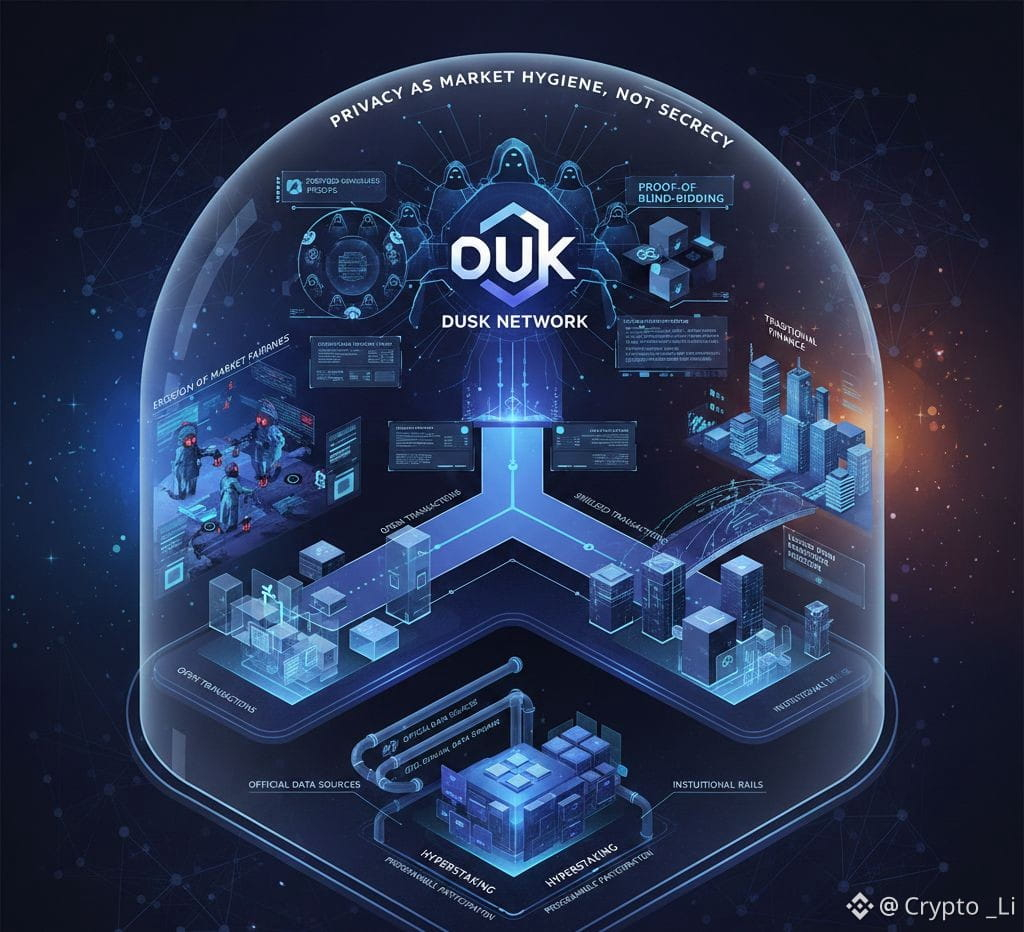
Dusk does not frame privacy as a shield against oversight. Instead, privacy is treated as market hygiene: a baseline condition that prevents unfair advantage and preserves integrity. Transactions can be confidential without being unverifiable. Rules can be enforced without revealing sensitive data. This distinction is central to understanding Dusk’s philosophy.
By separating privacy from anonymity as an end goal, Dusk positions itself within the context of regulated finance. Confidential settlement does not imply untraceable behavior. It implies that only the necessary information is disclosed, at the appropriate time, to the appropriate parties.
Dual Transaction Model and Its Implications
A defining feature of Dusk is its dual transaction model, which supports both open and shielded transactions. This is not a compromise; it is a recognition that markets require different levels of disclosure depending on context. Some activities benefit from openness, such as governance signaling or non-sensitive transfers. Others, particularly trading and settlement, require confidentiality to function fairly.
This flexibility allows applications to choose the appropriate disclosure model without forcing all participants into a single paradigm. For institutions, this is critical. It mirrors existing practices where reporting obligations coexist with protected execution.
Zero-Knowledge Proofs as Enforcement Mechanisms
Zero-knowledge proofs are often misunderstood as tools for hiding information. In Dusk’s design, they function primarily as enforcement mechanisms. They allow participants to prove compliance with rules without revealing underlying data. This enables regulated DeFi applications where eligibility, limits, and compliance checks are enforced cryptographically.
The emphasis is not on obscuring activity, but on ensuring that activity adheres to defined constraints. This approach aligns with regulatory expectations while preserving on-chain market fairness.
Proof-of-Blind-Bidding and Validator Protection
Consensus design is another area where Dusk diverges from conventional blockchains. Its Proof-of-Blind-Bidding mechanism prevents validators from seeing transaction details before they are finalized. This reduces incentives for manipulation and protects validators from coercion or targeted attacks.
Validator anonymity in this context is not about evading accountability. It is about preventing undue influence and ensuring neutral processing. In regulated environments, infrastructure providers are expected to operate without bias. By limiting information exposure at the consensus layer, Dusk reinforces this neutrality.
The Role of Validator Anonymity in Regulated Finance
In traditional finance, intermediaries are often legally obligated to avoid conflicts of interest. They are also protected from certain disclosures that could compromise their role. Dusk applies similar logic to blockchain validators. By minimizing the information available during transaction processing, the network reduces the risk of selective inclusion or censorship based on transaction content.
This design choice acknowledges that validators are economic actors subject to incentives and pressures. Fair market infrastructure must account for this reality rather than assuming idealized behavior.
Execution Environment and Adoption Considerations
Dusk’s Lightspeed infrastructure and DuskEVM provide compatibility with Solidity and existing development workflows. This is not merely a convenience feature. Adoption depends on minimizing friction for builders who already operate within established tooling ecosystems.
By supporting familiar execution environments, Dusk lowers the barrier to building regulated DeFi applications that require confidential settlement. This pragmatic approach contrasts with chains that prioritize novel languages or architectures at the expense of interoperability.
Market Data and the Limits of Crowd-Based Oracles
Accurate market data is foundational to fair markets. Many blockchains rely on crowd-sourced oracle models that introduce latency, manipulation risk, and coordination challenges. For institutional use cases, these weaknesses are unacceptable.
Dusk emphasizes the importance of official and standardized data sources. Integration with established oracle standards ensures that pricing and reference data meet the reliability expectations of serious market participants.
Chainlink standards such as CCIP, DataLink, and Data Streams provide a framework for secure data delivery and cross-chain communication. Within Dusk’s architecture, these tools function as institutional rails rather than speculative enhancements. Interoperability is treated as settlement infrastructure, enabling assets and data to move predictably across networks.
Interoperability Beyond Speculation
Interoperability in many ecosystems is framed around liquidity migration and yield opportunities. Dusk approaches it differently. Cross-chain communication is necessary for settlement finality, reporting, and integration with external systems. By anchoring interoperability in standardized protocols, Dusk positions itself as part of a broader financial stack rather than an isolated venue.
Hyperstaking and Programmable Participation
Dusk’s hyperstaking model abstracts staking logic into programmable components. This allows participation rules to be tailored to specific regulatory or institutional requirements without altering the core protocol. Staking becomes an adaptable layer rather than a rigid mechanism.
For institutions, this flexibility matters. Participation in network security can be aligned with internal policies, risk frameworks, and compliance obligations. This further reinforces Dusk’s focus on infrastructure over speculation.
Beyond the Privacy Chain Label
Labeling Dusk as a privacy chain misses the point. Privacy is a means, not an end. The network’s design choices reflect a broader critique of existing on-chain markets and a proposal for how they might evolve. By addressing information leakage, validator incentives, data integrity, and execution fairness, Dusk reframes the conversation around what blockchain markets are for.
The result is an institutional blockchain infrastructure oriented toward regulated DeFi and privacy-preserving finance, without relying on narratives of secrecy or rebellion against oversight.
Conclusion: Toward Fair On-Chain Markets
As blockchain markets mature, the limitations of radical transparency are becoming harder to ignore. Fairness does not emerge automatically from visibility. It requires intentional design, informed by decades of market practice and adapted to cryptographic systems. Dusk Network represents an effort to confront these realities directly.
By treating privacy as market hygiene, enforcing rules through zero-knowledge proofs, protecting validators from undue influence, and prioritizing reliable data and settlement infrastructure, Dusk addresses problems many blockchains prefer to overlook. It does so without promotional rhetoric or promises of disruption, focusing instead on structural integrity.
The future of on-chain markets will depend on whether they can support serious participation without devolving into extraction. If blockchain is to function as credible financial infrastructure, it must reconcile transparency with fairness. Dusk’s architecture suggests that this reconciliation is not only possible, but necessary for the next phase of on-chain market evolution.