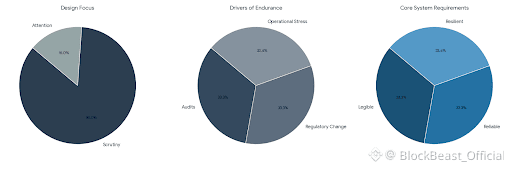
Founded in 2018 DUSK NETWORK , positions itself not as a provocation against the financial system, but as an attempt to coexist with it. This distinction is subtle yet foundational. Where many blockchain projects are designed in implicit opposition to regulation—treating compliance, auditability, and supervision as transient obstacles—Dusk appears to assume the opposite. Its architecture reflects the expectation that any infrastructure handling real capital, securities, or institutional workflows will ultimately be examined, constrained, and held accountable by external authorities. The protocol is designed with that inevitability in mind.
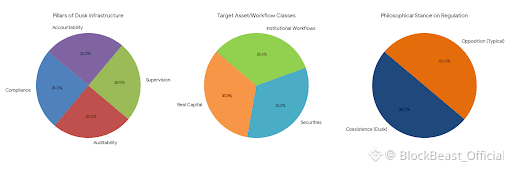
Nowhere is this posture more evident than in Dusk’s approach to privacy. Rather than framing confidentiality as a binary choice between total opacity and full transparency, the system treats privacy as conditional and contextual. This mirrors how privacy functions in modern financial systems. Banks, custodians, and market infrastructures do not offer anonymity; they offer confidentiality with structured disclosure. Information is shielded from public view, yet remains accessible to regulators, auditors, or counterparties when legally required. Dusk’s emphasis on selective disclosure and programmable auditability reflects this reality. Privacy is not positioned as resistance to oversight, but as a controlled mechanism that can operate within it. This is less a concession to regulation than an acknowledgment that durable financial infrastructure cannot depend on perpetual invisibility.
The protocol’s modular design reinforces this conservative orientation. By separating consensus from execution and allowing system components to evolve independently, Dusk prioritizes containment of risk over architectural novelty. In traditional financial infrastructure, decoupling systems reduces the blast radius of failures and simplifies regulatory adaptation. Settlement, messaging, and custody layers are often distinct precisely because upgrades or incidents rarely affect all components simultaneously. Dusk follows a similar logic, enabling incremental evolution without forcing disruptive, system-wide rewrites—an essential characteristic for platforms expected to operate continuously over long horizons.
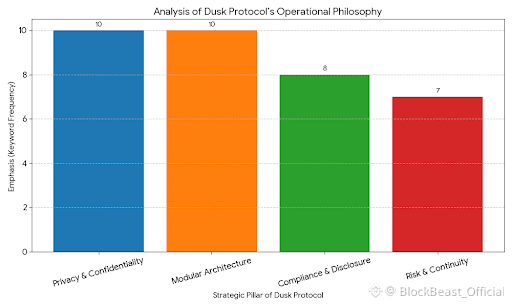
Equally telling is the platform’s emphasis on compatibility with established developer tools and programming paradigms. Rather than introducing bespoke languages or unfamiliar environments, Dusk appears to favor familiarity. In regulated environments, this is not a cosmetic choice. Developer turnover, third-party audits, and external reviews are routine. Tooling that diverges sharply from industry norms increases operational risk and complicates long-term maintenance. Familiarity may limit experimentation at the margins, but it significantly improves the likelihood that systems remain understandable, auditable, and supportable years after deployment.
These design choices come with trade-offs. Privacy-preserving computation and selective disclosure mechanisms introduce complexity and, in many cases, latency. Settlement finality may be slower than on systems optimized purely for throughput. Cross-chain interactions, custody models, and upgrade mechanisms introduce trust assumptions that cannot be eliminated—only governed. From an institutional perspective, these are not fatal weaknesses. They are variables to be priced into risk models and operational planning. The greater danger lies in ignoring such constraints rather than acknowledging them explicitly.
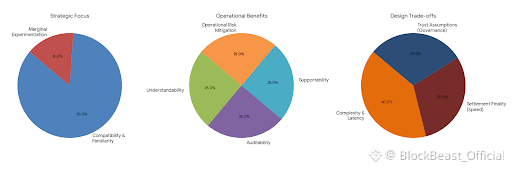
Operational considerations—often undervalued in early-stage protocols—take on outsized importance under regulatory scrutiny. Predictable upgrade paths, reproducible deployments, clear documentation, and mature monitoring tooling determine whether a system can be operated by a risk committee rather than an experimental team. Dusk’s long-term viability will depend less on headline features and more on whether operators can answer practical questions: How disruptive is an upgrade? How transparent are failure modes? How recoverable is the system under stress? These issues rarely generate excitement, but they are decisive when moving from pilot deployments to production environments.
Viewed through an institutional lens, the token design follows a similarly restrained philosophy. Liquidity matters not as a speculative accelerant, but as a mechanism for orderly entry and exit. Predictable issuance, clear utility, and the absence of aggressive incentive schemes reduce the risk of misalignment between infrastructure providers and application builders. Institutions are less concerned with upside narratives than with whether exposure can be hedged, unwound, or accounted for without unexpected friction. A token that behaves more like infrastructure fuel than a speculative asset is more likely to integrate into existing financial frameworks.
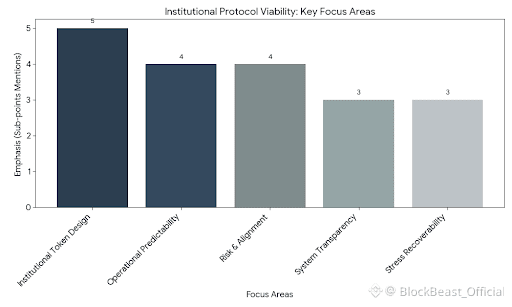
Taken together, Dusk reads as infrastructure built with the expectation of scrutiny rather than attention. Its design philosophy suggests an understanding that success in regulated finance is not measured by visibility or rapid adoption, but by endurance—through audits, regulatory change, and operational stress. Systems intended for this domain do not need to be revolutionary; they need to be legible, reliable, and resilient. If Dusk succeeds, it will likely do so quietly—by functioning as intended under constraints that others prefer to ignore.