
Most blockchains want you to feel them.
They want you to see the wallet, think about gas, wait for confirmations, understand networks.
Vanar Chain wants the opposite.
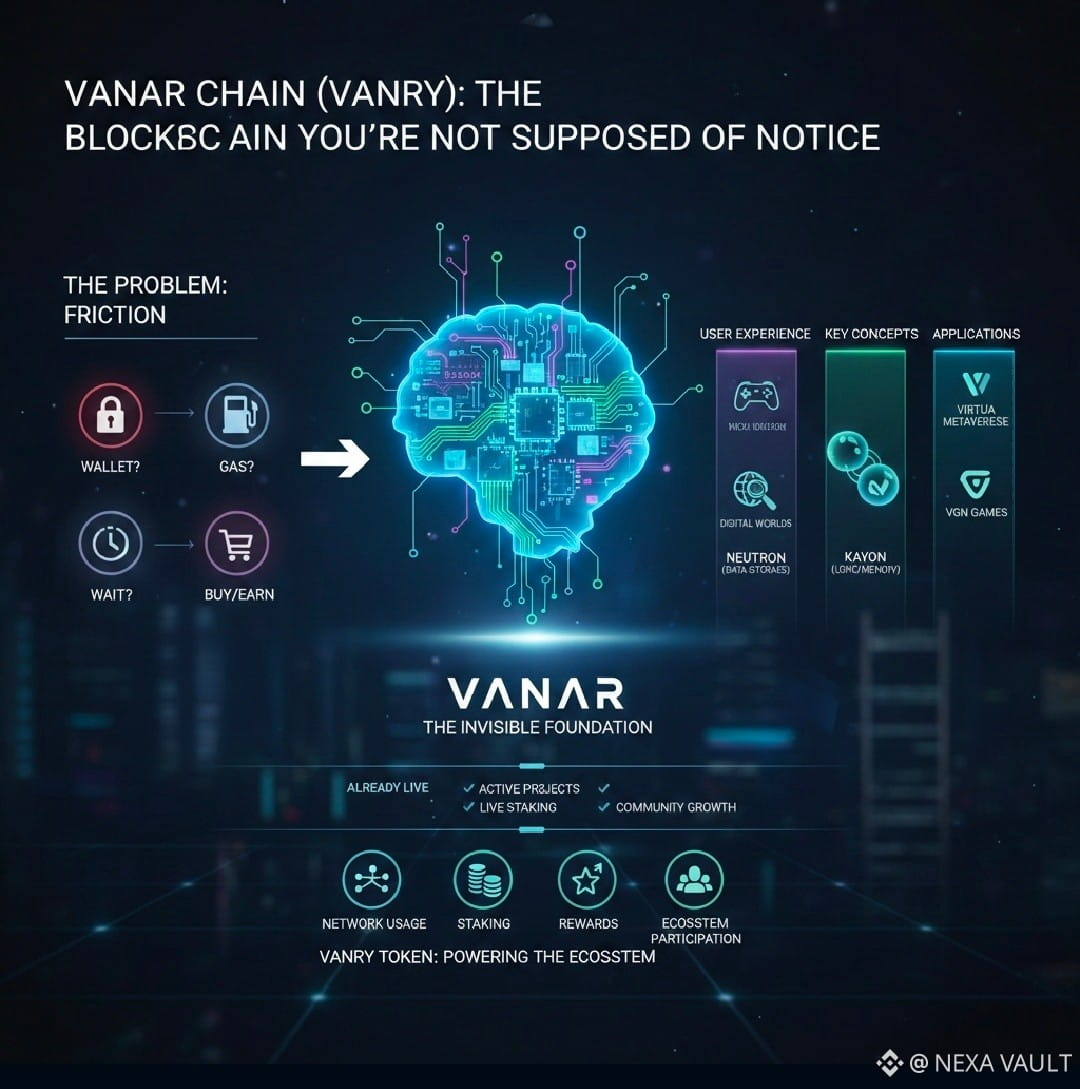
It wants you to open a game, explore a digital world, use an app, buy an item, earn a reward… and never once think about the blockchain underneath.
That’s the heart of Vanar.
It starts from a very human question
Instead of asking, “How fast is our chain?”
Vanar feels like it asks, “Can a normal person use this without realizing it’s Web3?”
That’s why Vanar is deeply connected with things people already understand, like Virtua Metaverse and the VGN Games Network.
People don’t enter these worlds because they love blockchain.
They enter because they love experiences.
Vanar simply makes sure ownership, speed, and trust work quietly in the background.
A chain that tries to “remember”
Vanar often talks about two internal ideas:
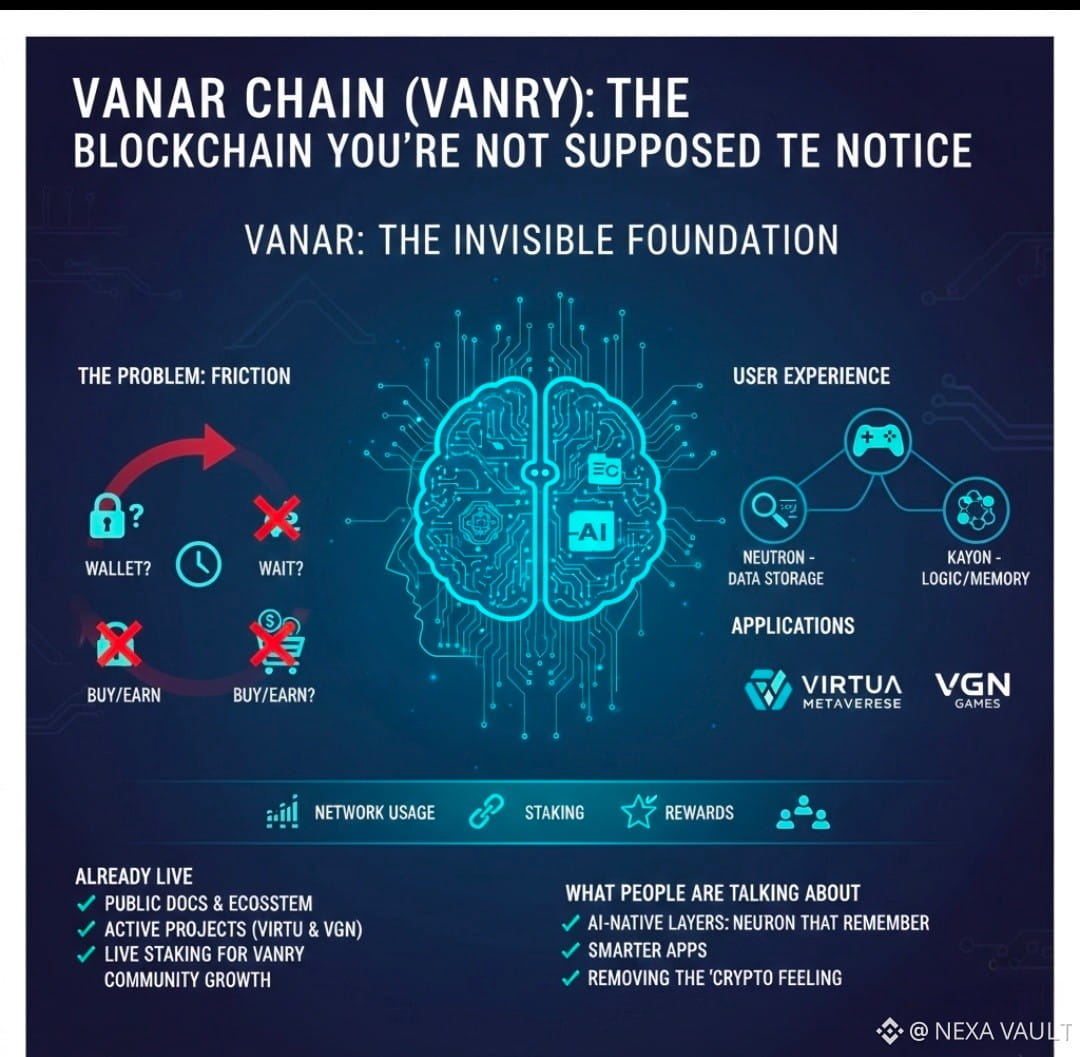
Neutron — a way to store meaningful data without heavy cost
Kayon — a way for the system to read that data and apply logic
In simple words, Vanar is trying to build apps that don’t forget you every time you open them.
Most smart contracts are like calculators. They do a small task and stop.
Vanar is trying to make apps that behave more like intelligent software that understands context.
That’s a very different direction from typical L1 talk.
Why gaming, metaverse, and brands fit perfectly
Think about games and digital worlds.
You buy items.
You trade assets.
You interact constantly.
If any of that feels slow, confusing, or expensive, you leave.
That’s why Vanar living inside environments like Virtua and VGN makes sense. These places force the chain to be smooth, because users have no patience for friction.
They come for fun. The blockchain just does its job silently.
Where VANRY fits into this
The VANRY token powers this whole environment:
network usage
staking
rewards
ecosystem participation
There’s even a live staking portal where holders actively support the network. VANRY isn’t just sitting in wallets; it moves inside the system.
What Vanar is really trying to build
From how Vanar presents itself, the goal looks clear:
Make blockchain AI-ready
Help developers build smarter apps, not just smart contracts
Bring real users through games, experiences, and brands
Remove the “crypto feeling” from Web3 products
Why this matters more than it sounds
The biggest problem in Web3 is not speed.
It’s friction.
Too many steps. Too much thinking. Too much explaining.
Vanar’s whole idea is: what if users never need an explanation at all?
They just use the product.
And yes, it’s already live
This is not theory. You can see:
Public docs and ecosystem
Active projects like Virtua and VGN
Live staking for VANRY
Ongoing community growth
Vanar is already building in public.
What people are talking about recently
The current focus around Vanar is less about hype and more about its AI-native layers — Neutron and Kayon — and how this could change the way apps are built on-chain.
Instead of being “another fast chain,” Vanar is slowly shaping the image of being a chain where apps can remember, understand, and act.
The real feeling of Vanar
Vanar doesn’t try to be loud.
It tries to be invisible.
If it succeeds, people will be using blockchain every day without ever realizing they are.